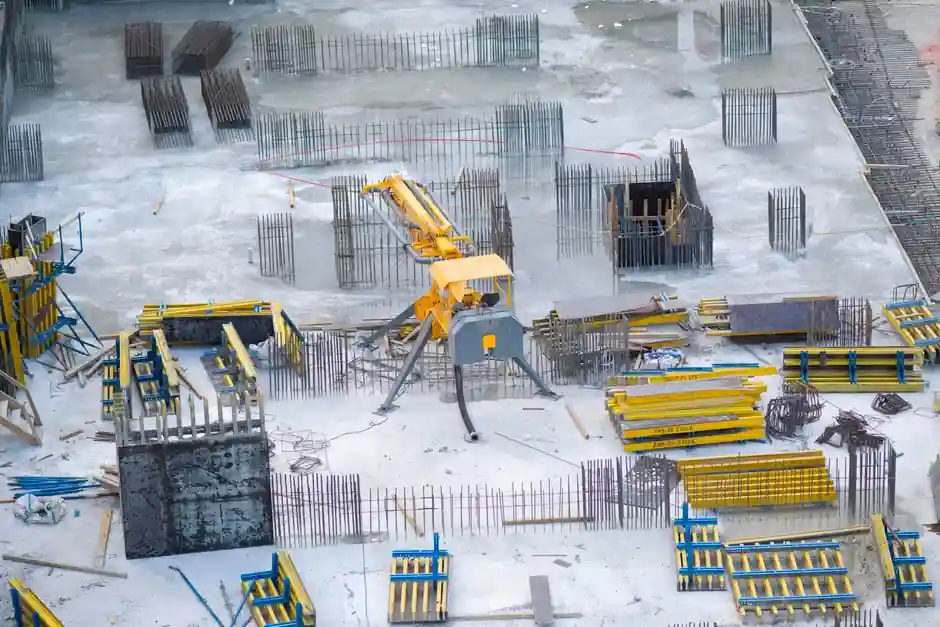
On pours above 4,000 sq ft, a laser screed places roughly 240 sq ft of struck concrete per minute (about 14,400 sq ft in a working hour) and finishes the leveling pass in 3-4 hours, where a hand-rolled vibratory truss typically needs a full day plus a separate rake crew [S1][S5].
Below that threshold, or when slab thickness drops under 15 cm, a single-operator vibratory screed with a 2.5-3 m profile still beats a laser rig on mobilization cost, setup time, and the ability to run on sites without three-phase power [S4][S5].
Throughput and Flatness: Where the Laser Screed Wins
A laser screed's on-board computer samples elevation at roughly 5 Hz and corrects the screed head against a laser or 3D profiler reference, so the machine holds grade within a tighter window than any human-pulled profile can deliver [S5]. Bartell cites 240 sq ft struck per 60 seconds as the working benchmark for an average laser screed, a figure echoed by Loco Concrete's comparison of 3-4 hour finishing windows on large pours [S1][S5].
The head mounts on a telescopic boom that stays outside the pour, so the machine does not drive through the rebar mat; some boom models extend up to 20 ft (about 6 m) per pass, and foam-filled tires let the chassis roll over rebar chairs without displacing them [S2]. Auger-fed concrete, integrated vibration, and the self-leveling head mean a single operator can place, consolidate, and strike the floor in one pass [S2][S5].
Where Vibratory Screeds Still Make Sense
Vibratory screeds compact and level the top 15 cm of slab in a single pass, the layer where surface vibration is most effective, while internal vibrators handle air removal in deeper lifts [S4]. ENAR's guide breaks the category into single L-profile units (TORNADO, QX, 1.5-3 m, one operator), symmetrical profiles (HURACAN, bidirectional, no rails, 2.5-4 m), and double-profile rail-guided units (QP, QG, 4-5 m and up) for tight-tolerance industrial floors [S4].
Above 3 m working width, ENAR specifies double profiles on rails with two operators to maintain flatness, an explicit warning that single profiles lose accuracy as length grows [S4]. The vibratory category also covers stand-up wet screeds that drag behind an operator and bring a cement slurry to the surface, which improves durability and reduces the risk of surface cracks, but still needs a raking crew ahead of the screed [S2][S4].
Decision Matrix: Four Criteria Side by Side
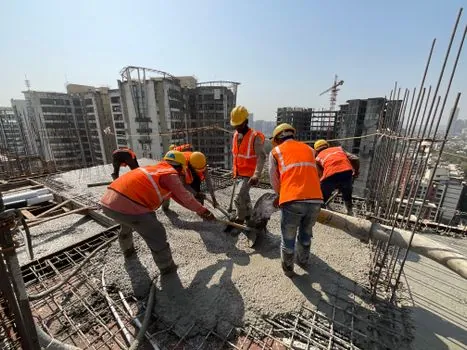
For a process engineer picking equipment, the comparison boils down to four numbers: throughput, lift thickness, labor count, and capital cost. A laser screed delivers about 14,400 sq ft/hr throughput and a 3-4 hour finishing window on a 40,000 sq ft pour, against roughly 3,000-5,000 sq ft/hr for a rail-guided double vibratory profile with a 3-4 person crew [S1][S4][S5].
Lift thickness caps at 15 cm for surface vibration, while a laser screed head handles deeper structural pours as long as the mix stays workable [S4][S5]. Labor runs one operator on a laser rig versus 2-4 on a truss or double-profile vibratory setup [S2][S4]. Capital cost is the dominant downside of laser screeds: new top-of-line units run $100,000 to $350,000, while a stand-up vibratory screed typically costs a small fraction of that [S5].
For variable-width pours and hybrid contractors, Ligchine's LS120 combines drive-in and boom-screeding in one chassis, and boom screeds with adjustable heads (SCREEDSHIFT-class designs) can work around embedded piping without breaking the grade reference [S2]. Roller screeds stay limited to small residential and contoured pours because they lack vibration and demand heavy manual labor [S2].
Power Source and Site Logistics
Petrol 4-stroke engines (typically Honda-class) give complete autonomy on outdoor road and slab work, while 230V corded electric drives suit indoor warehouses and enclosed areas where exhaust is a problem; battery options have entered the category for small to mid-size profiles [S4]. A laser screed's console, hydraulics, and auger system draw substantially more power than a hand-pulled vibrator and usually need a dedicated generator or shore power on the pour pad [S5].
For floor flatness and levelness (FF/FL) targets tied to ACI 117 or higher tolerances on warehouses and distribution centers, laser screeds are the practical default because hand vibratory methods cannot hold the required F-numbers on pours larger than a few thousand square feet without repeated re-screeding passes [S2][S5].
Cost, ROI, and When Not to Buy a Laser Screed
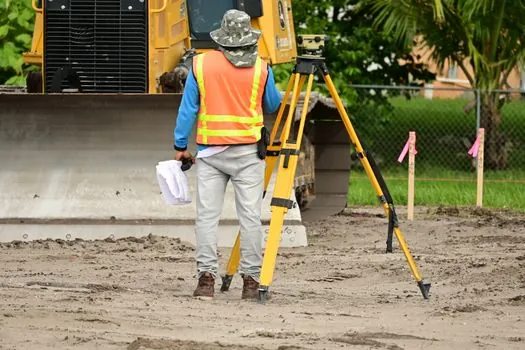
Industry sources report that laser screeds deliver 40% faster installation and roughly 90% fewer surface defects versus traditional leveling, which is the case to make for full-time flatwork contractors running multiple pours per week [S7]. For the occasional pour contractor, a one-man vibratory screed delivers better unit economics because the $100,000-$350,000 capital outlay on a laser rig only amortizes above a threshold of annual square footage that most non-specialized concrete crews never reach [S5].
Truss screeds remain a reasonable bridge for large-crew contractors on pours up to 80 ft wide, but they are heavy, slow to set up, and waves left in the surface are hard to bull-float out, so the labor savings versus a laser rig rarely appear on the schedule [S2][S5].
Related Equipment and Adjacent Specs
Laser screeds ride on the same laser leveling hardware used by general-construction laser levels, so drainage grade settings on the transmitter matter for outdoor slabs; the 0.3% to 8.33% spec range is covered in the drainage-grade spec map at Drainage Grade Settings on Laser Levels, which explains how a 3D profiler package and LPS controller turn a boom screed into a slope-matching tool. For indoor pours where the laser transmitter sits near glazing and obstructions, the hose-vs-laser trade-off in Water level hose vs laser level for work around obstructions is worth a read before committing to a laser-only workflow. [S2]
On the curing side, slab flatness is only half the durability story: the resin chemistry in the curing compound controls moisture retention, and Paraffin Wax vs Acrylic Resin: 2026 Raw Material Cost in Curing Compounds maps the cost-versus-permeability decision that follows the screed pass. For general background on the laser level hardware that drives a screed head, the laser level encyclopedia page covers the transmitter classes used on flatwork sites.
A 3D profiler package and LPS controller turn a boom screed into a slope-matching tool, and the laser screed encyclopedia page covers the head, boom, and reference-class architecture in more detail. For projects that need profile or elevation logging during the pour, a laser profiler feeds the same control loop the screed head is already riding on.
One trackable signal: ACI 117 F-number requirements continue to tighten on distribution-center slabs, and most new tilt-up and big-box specs written in 2026 default to laser screeds as the placement method. A second signal: battery-powered vibratory screeds in the 2-4 m class are now credible substitutes for petrol units on indoor pours, narrowing the site-logistics gap that previously pushed contractors toward a full laser rig.