
Global 3D LiDAR safety scanner revenue hit $3.8B in 2025, with Asia Pacific capturing 44.2% of sales and industrial automation accounting for 38.5% of application share [S4]. The market is forecast to grow at 11.5% CAGR to $9.2B by 2033, and the regional split is now structural, not transitional.
The 2026 supplier landscape splits cleanly along two axes: wavelength/architecture (905 nm silicon vs 1550 nm fiber-laser) and end-use cluster (automotive ADAS/robotaxi vs industrial 3D mapping and AGV/AMR). Hesai and RoboSense lead automotive shipments on 905 nm MEMS at manufacturing scale that compresses unit pricing [S1], while SICK AG and OMRON Corporation top the 3D safety scanner competitive landscape by deployment volume [S4].
Automotive LiDAR: 905 nm vs 1550 nm and the Vendor Stack
Automotive-grade LiDAR in 2026 is dominated by five vendors, Luminar, Hesai, RoboSense, Valeo, and Innoviz, with working ranges of 150-300 m at Class 1 eye-safety [S1]. 905 nm silicon-compatible modules remain the most cost-competitive, but the eye-safety limit caps useful range to roughly 200 m at 10% retro reflectivity, which is the ADAS benchmark condition. 1550 nm fiber-laser units from Luminar-class suppliers push range past 250 m at the same reflectivity, at the cost of a more expensive InGaAs receiver chain and stricter thermal management.
Mechanical spinning, MEMS-mirror, and flash/OPA architectures are all shipping in 2026 series programs, with MEMS as the dominant mid-range choice for L2+/L3 ADAS due to its balance of size, reliability, and unit cost [S1]. Hesai and RoboSense lead automotive shipments on 905 nm MEMS, with manufacturing scale that pressures unit pricing downward in 2026, and CES 2026 (January 2026) confirmed both companies as headline robotic-vision exhibitors [S6]. Valeo was the first Tier 1 to mass-produce automotive LiDAR, with its SCALA line on Audi A8 since 2017, and it is the only Western Tier 1 still in volume series production at automotive-grade.
Industrial and Mapping LiDAR: Long-Range, Point Rate, and the European Base
RIEGL and SICK serve the long-range surveying segment, with airborne units reaching above 1000 m and terrestrial scanners typically delivering 100-500 m at 905 nm or 1550 nm, with point rates from 100 kHz to over 1 MHz per head [S1]. Velodyne and Ouster compete in robotics and short-range industrial mapping, with ranges of 50-120 m and resolutions driven by channel count (16, 32, 64, 128, 256). The SICK, LEUZE, and KENCY ecosystem continues to define the European 2D-industrial base, while China's Tianjin G-TEK Sensor Technology anchors the Chinese 2D segment [S2].
Industrial 2D sensors for AGV, AMR, and conveyor lines now span 0.1-40 m at 1-10,000 Hz frame rates with sub-2 W power budgets, and 3D units have crossed 10 million points per second on 128-channel silicon, the operating envelope most line builders are standardising on in 2026 [S2]. SICK's TiM781S at 270° horizontal FOV, 25 m range, and IP67 housing, priced around $4,000, is the default European warehouse AGV navigation sensor, and SICK units routinely run 50,000+ hours in the field without replacement [S3]. For deeper time-of-flight sensing context, see the displacement sensor encyclopedia entry.
Comparison Table: Main LiDAR Vendor Families on 4 Decision Criteria
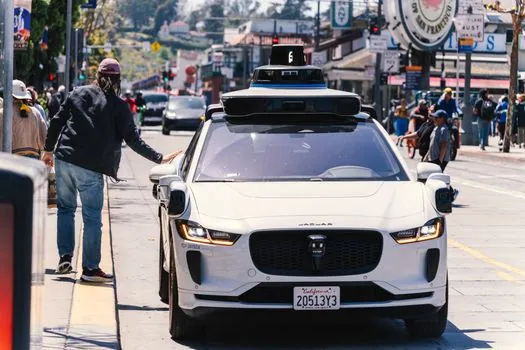
Spec-driven buyers should shortlist by application rather than by brand familiarity, and the table below lines the main vendor families up against range, wavelength/eye-safety, dominant architecture, and primary application [S1].
Automotive cluster: Luminar, Hesai, RoboSense, Valeo, Innoviz, range 150-300 m, 905/1550 nm, MEMS + flash, ADAS/robotaxi. Industrial/mapping cluster: Velodyne, Ouster, RIEGL, SICK, range 50-1000 m, 905/1550 nm, mechanical + flash, mapping/robotics/AMR. Chinese volume tier: Hesai and RoboSense lead automotive shipments on 905 nm MEMS, with manufacturing scale that pressures unit pricing downward in 2026 [S1]. The 3D safety scanner landscape, where SICK AG and OMRON Corporation lead by deployment volume and Asia Pacific holds 44.2% revenue share, is a separate stack optimised for ISO 3691-4 industrial-truck safety and ISO 13849-1 machinery-safety compliance [S4].
Selection Criteria: Range, Point Rate, FOV, Power, and Interface
Five numbers drive the spec sheet in 2026: range, frame rate, point cloud density, FOV, and power consumption, and the vendor data shows they trade off predictably [S2]. A TF-Luna at 0.2-8 m, 1-250 Hz, 0.35 W and under 5 g is the typical short-range, low-power pick; a TF03 at 0.1-180 m, 1-9,800 Hz, IP67 and 86 g is the long-range industrial workhorse; a TFA300 reaches 0.1-290 m at 1-10,000 Hz for 0.45 W in a 10.5 g package, the densest power/weight ratio in the Benewake lineup [S2].
Interface choice matters as much as optics: UART, I²C, and I/O dominate short-range boards, while CAN and RS-485 show up the moment the sensor is mounted on a moving AGV or mobile robot, and the TFmini-i, TF02-i, and TFA300 all use CAN/RS-485 specifically for vehicle-bus integration [S2]. Protection class separates enclosure-less modules (TF-Luna, TFA170-L, TF-NOVA) from IP65 (TFmini-S, TF02-Pro) and IP67 (TF03, TF350) units, and that is usually the first filter buyers apply. For 3D perception, Ouster's OS1 mid-range sensor hits 90 m at 10% reflectivity, 250 m maximum, 0.0 m minimum range, and 10.4 million points per second across 128 vertical channels [S2], a spec combination most automation buyers compare against.
Who LiDAR Is For, and Where It Does Not Fit
LiDAR is for plant-floor and outdoor autonomy use cases where resolving geometry is the primary sensing task, not measuring a scalar like flow or proximity, and it differs fundamentally from flow sensor and inductive sensor families in that it produces point clouds rather than single values [S1]. Outdoor autonomous vehicles and robotaxis in mixed traffic typically need 1550 nm MEMS units with 200 m+ range and Class 1 eye-safety, while in-cabin or short-range AGV deployments are well served by 905 nm solid-state units at 30-80 m [S1].
The displacement-sensing family shares the time-of-flight principle with LiDAR but operates at millimetre scale rather than 100 m scale, and the lvdt-sensor family addresses a different physical quantity again.
Standards, Eye-Safety, and Market Concentration
Eye-safety compliance to IEC 60825-1 Class 1 governs the laser classification that all automotive-grade LiDAR must meet, and ISO 3691-4 plus ISO 13849-1 are the dominant regulatory frameworks for industrial-truck safety and machinery safety in 3D LiDAR safety-scanner deployments [S1][S4]. In the 3D safety scanner market, Asia Pacific commands $1.68B in 2025 revenue, Japan-based Yujin Robot and Hokuyo Automatic leverage regional supply-chain advantages, and SICK AG and OMRON Corporation lead the competitive landscape [S4].
Leuze electronic holds approximately 8-10% market share in mobile-scanner segments, and Pepperl+Fuchs has expanded LiDAR capabilities through internal development and strategic acquisitions [S4]. Chinese suppliers including Hesai, RoboSense, Benewake, and Richbeam are defining the Chinese 2D and 3D industrial spec window, with Richbeam's HaloBeam120 covering 120° FOV and HaloBeam240 a 240-line FOV for automotive-grade blind-spot and autonomous-logistics roles [S2]. The vendor list differs sharply between the automotive safety/navigation cluster and the industrial surveying/mapping cluster, and shortlisting by application rather than brand familiarity remains the working method for 2026 sourcing. The 2026 machine vision vendor map is the closest sister reference for the perception side, while 2D LiDAR overlap with industrial proximity sensors keeps the inductive sensor page a useful cross-check.