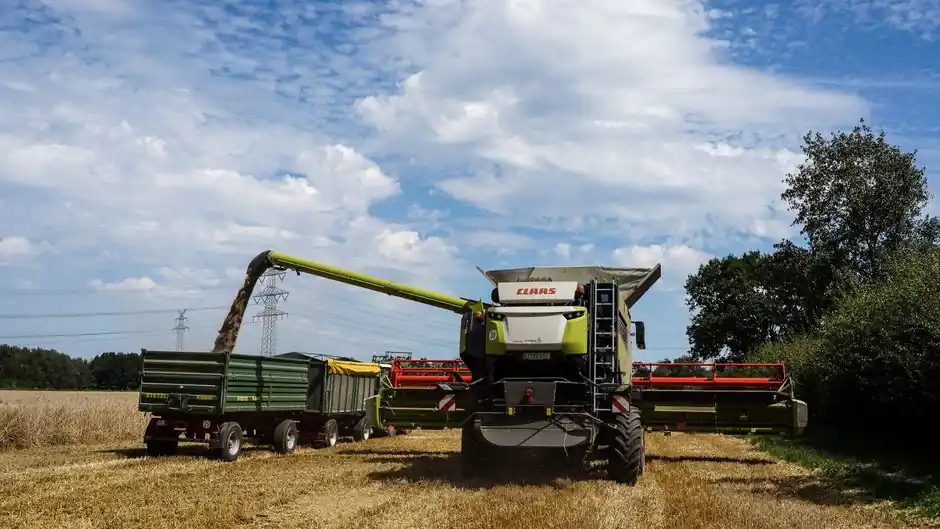
Line frequency (50/60 Hz mains-frequency) coreless induction furnaces in the 0.5 t to 40 t class dominate agricultural-machinery casting because they melt iron, steel, and aluminum from the same supply, with steel-shell and aluminum-shell body options listed on the Made-in-China frequency-induction catalog at US$8,800 to US$180,000 per set [S6].
Agricultural machinery (tractor housings, plough shares, harvester gear blanks, rotary-tiller blades) needs both ferrous wear parts and non-ferrous housings, so a foundry running both streams tends to standardize on a line frequency induction furnace rather than splitting capital between separate medium-frequency units.
What "line frequency" actually means on a foundry floor
Line frequency induction furnaces draw mains-frequency alternating current (50 Hz in China/EU, 60 Hz in the US) directly through the induction coil without a frequency-conversion stage, which is why they are also called mains-frequency or 50 Hz furnaces in vendor catalogs [S4]. The simpler power path translates into higher electrical efficiency at large melt mass (typically above 1 t per furnace) and lower harmonic distortion on the plant bus, two facts that matter when a foundry shares a substation with welding, plasma-cutting, and shot-blast loads. Compared with a medium-frequency (MF, 150 Hz to 10 kHz) or high-frequency (HF, above 10 kHz) unit, the line-frequency furnace produces more molten-metal turbulence, which is useful for melt homogenization but limits how much power density can be pushed into a small bath; that trade-off is the fundamental reason line-frequency units are built in 0.5 t to 40 t classes rather than bench scale [S4].
Agricultural-machinery foundries typically melt ductile iron (for gear boxes, differential housings, drawbars), gray iron (for engine blocks, brake drums), and aluminum alloys (for transmission cases, implement frames); a single 3 t line-frequency furnace can service all three, while a 0.25 t MF furnace would be a better match for a specialty copper-alloy bearing shop, a non-overlap with the ag-machinery use case.
Capacity, power, and body-shell selection gates
The Made-in-China listings show a clear capacity-to-power ratio: a 150 kg intermediate-frequency unit sits in the US$13,000 to US$15,000 band with a steel shell, a 1 t induction melting furnace ships within 20 days of payment, and a 1400 kW class steel-shell/aluminum-shell furnace is offered as a single-set OEM package for steel and iron scrap melting [S3][S4][S7]. A practical sizing rule is roughly 400 kW to 600 kW per ton of iron melt at 1500 degrees Celsius target, which puts a 3 t ag-machinery foundry in the 1.2 MW to 1.8 MW class, well within the line-frequency envelope.
Body-shell choice (steel shell vs aluminum shell) follows melt chemistry: a steel shell tolerates higher radiation losses and is the default for iron/steel melts, while an aluminum shell is lighter and used for aluminum-melt service to reduce parasitic eddy losses in the shell itself. Vendors publish these two variants as separate model codes on the same product family [S7], so procurement should specify the shell material on the RFQ rather than treat it as a vendor preference.
Refractory lining and crucible selection
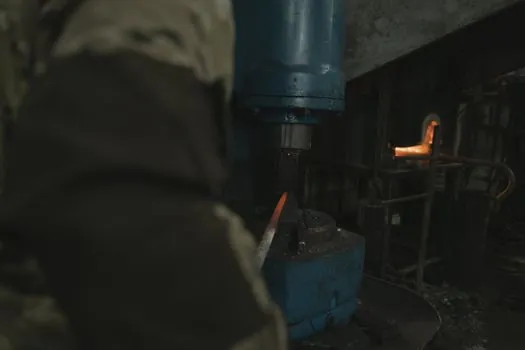
Induction furnace linings are typically dry-vibrated silica-alumina for iron melts, magnesia-based dry vibratable for steel, and high-alumina or silicon-carbide for aluminum; the lining is consumed each campaign and relined, so the induction furnace total cost of ownership is refractory-driven, not just kWh-driven. The HS-code customs declaration for a nonferrous crucible energy-saving line-frequency aluminum melting furnace classifies it under heading 7321.90 (non-electric domestic appliances parts) at 80 percent general tariff / 8 percent MFN, and a 13 percent VAT applies on the China-domestic side [S1].
Charge cleanliness is the operationally binding constraint: induction heating has limited refining capacity, so charge materials must be free of rust, sand, and oil, and alloying elements lost to oxidation must be re-added to the melt, as published in the OKorder 1 t product specification sheet [S4]. Agricultural-machinery foundries running return scrap (broken plough shares, sprues, risers) usually pre-sort and shot-blast the charge to meet this constraint; skipping that step degrades lining life faster than it saves labor.
Control board tier and operator interfaces
MPU-6 and MPU-11 control boards are the two tiers most often listed in the induction-furnace OEM catalogs, with MPU-11 being the higher-channel-count unit used on 1 t and above line-frequency furnaces for parallel coil protection, water-cooling interlocks, and VFD coordination [S4]. A separate VFD cabinet drives the compensation-capacitor bank and any auxiliary stir-coil power, and on line-frequency units the VFD is usually a soft-start/regulator rather than a frequency-conversion drive, which is one reason line-frequency units cost less per kilowatt than MF units of equivalent melt capacity.
Operator diagnostics rely on the magnetostriction hum of the coil: a steady pitch indicates correct operation, while pitch drift signals power-level change or coil-water temperature rise, a behavior documented in the OKorder product specification [S4]. Modern control boards expose this to the HMI as a power vs. frequency trace, which lets the foundry record each heat for ISO 9001 process traceability without adding an external data logger.
Compliance and standards to write into the procurement spec
EU-bound agricultural-machinery castings have to ship under 2006/42/EC machinery safety compliance, and at least one Made-in-China listed frequency-induction furnace supplier is marked "2006/42/EC certified" on its product page [S6]. CCC certification is not the same as CE marking: 2006/42/EC is the Machinery Directive applied at the EU import border, while CCC is the China Compulsory Certification for products sold inside China, and the customs declaration for the aluminum-melting furnace variant does not list CCC as required [S1].
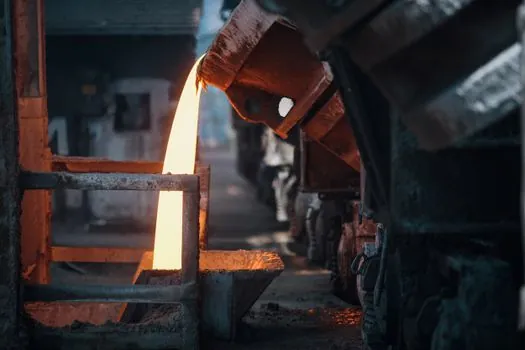
For the molten-metal handling line downstream of the furnace, the same foundry spec will pull in a molding line (green-sand or horizontal flaskless), an automatic molding line for higher-mix tractor-housing batches, and a conveyor sorting line for sprue and casting separation; the induction furnace is only one node in that chain, and its melt-tap cadence has to match the molding line's flask cycle time or the buffer ladle becomes a bottleneck.
Failure modes, limits, and what line frequency cannot do
Line-frequency induction furnaces do not refine: charge composition must be known, slag is removed by skimming rather than by chemical reaction in the bath, and any alloying element that floats (magnesium in ductile iron, for example) burns off faster than in a channel furnace, a limitation written into every product specification in this category [S4]. The lack of refining is the reason agricultural-machinery foundries pairing a line-frequency melter with a separate ladle furnace or a small channel induction unit are common, and it is also why a high-frequency alloying furnace is sometimes added as a third unit for stainless or copper-alloy runs [S2].
Another hard limit is melt rate: at the same kW rating, a 50 Hz unit melts slower than a 1 kHz to 10 kHz MF unit because the lower frequency drives less vigorous stirring and less skin-effect concentration in the charge. Foundries that need sub-30-minute melt cycles on small heats should pick MF; foundries that need 4-hour campaigns on 5 t to 10 t iron heats with low electricity cost per ton should pick line frequency. The two are not interchangeable, and treating the line-frequency furnace as a "cheap MF" is the most common procurement error in this segment.
Comparison: line frequency vs intermediate vs high frequency for ag-machinery
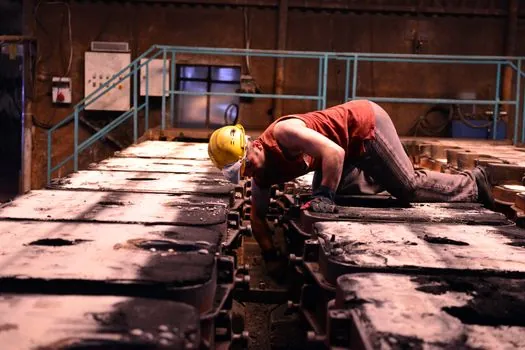
Against three decision criteria (melt mass, power density, capital cost per ton), the three technologies line up as follows. Line frequency (50/60 Hz) handles 0.5 t to 40 t per furnace with the lowest cost per ton but the lowest kW-per-ton density, making it the fit for steady-state iron and aluminum production [S4][S6]. Intermediate frequency (150 Hz to 10 kHz) covers 0.05 t to 5 t at moderate cost and is the right pick for short-cycle jobbing work, with the Made-in-China 150 kg MF unit priced at US$13,000 to US$15,000 per piece and a 1 t MF unit as a common step-up [S3][S4]. High frequency (above 10 kHz, laboratory and specialty alloy scale) is the fit for small-lot alloy development and induction brazing, not for agricultural-machinery volume production [S2].
For a 5 t/h agricultural-machinery iron foundry running two shifts, the calculation is: 1 line-frequency furnace of 3 t to 5 t capacity, plus 1 small MF unit (0.25 t to 0.5 t) for startup and alloy trim, plus a 2006/42/EC compliant control cabinet and a ladle preheater. Two line-frequency units without an MF trim furnace is the most common over-spec mistake; one MF unit only is the most common under-spec mistake for steady iron production.
Sourcing and supplier-evaluation checklist
RFQ clauses that close the most disputes: explicit shell material (steel or aluminum), explicit control-board model (MPU-6 or MPU-11), explicit lining chemistry per melt, explicit delivery term (20 days after payment is the OKorder reference, longer for engineered builds) [S4], and explicit CE/2006/42/EC documentation package for EU shipments [S6]. For China-domestic sales, the customs declaration specifies declaration norms including brand type, export preferences, materials, principle (non-electric heating), fuel category, and model, which means a non-compliant RFQ will be held at Chinese customs even before it ships [S1].
Trackable signals to monitor over the next 6 months: (1) shifts in the 2006/42/EC certification listings on Made-in-China frequency-induction products, which directly affect EU shipment acceptance; (2) the MFN tariff movement on HS 7321.90 (currently 8 percent) and HS 8544.49 (currently 8 percent) for the furnace body and the internal conductors, which set the landed cost of imported units [S1]; (3) the price spread between 0.5 t and 5 t line-frequency units, currently running from US$8,800 for a 500 kg aluminum-copper-iron-steel unit to US$180,000 for a 40 t unit on the Made-in-China catalog [S6], which compresses when steel prices move.
Related analysis: Rebar Cutter Selection for Interior Finishing: 2026 Spec Gates.