
A line-interactive UPS is the right pick when the load is a single-phase IT or light-industrial device under 3 kVA, the input voltage drifts but rarely drops to zero, and the budget rules out true double-conversion. The mid-2026 catalog window from AUNILEC, Bluewalker, and Chinese OEM ranges shows three working power bands — 0.5-0.85 kVA DIN-rail, 0.6-0.8 kVA desktop lead-acid, and 1-3 kVA pure-sinewave desktop — all 230 V output with AVR Buck/Boost [S1][S2][S3][S4].
Inside that envelope the differentiating specs are input voltage window (162-290 V on the GXB series, 175-290 V on ARES), output waveform (simulated sinewave vs pure sinewave), and battery autonomy, which is governed by the built-in VRLA/AGM pack and the configurable charge current [S1][S2][S3]. For a deeper topology comparison that includes the double-conversion alternative, see the online double-conversion UPS selection map.
What a line-interactive UPS actually does
A line-interactive UPS sits between an offline (standby) and an online double-conversion unit: under normal mains it feeds the load through an AVR stage that uses Buck and Boost taps to correct under- and over-voltage without switching to battery, and only flips to inverter mode when the input fails or drifts outside the AVR window [S1][S3]. The AUNILEC DIN-rail unit runs 0.5 kVA (300 W) and 0.85 kVA (510 W) with a 230 V input, 230 V output, RS-232 interface, simulated sinewave, RJ45 tel-comm protection, and surge protection — the spec sheet explicitly lists PLC, robotics, conveying, and IP-based control as duty [S1]. Transfer time is typically 2-6 ms on this topology, which is fine for PCs, NAS, routers, CCTV, and PLCs, but not for medical or motor drives that cannot tolerate a half-cycle dropout.
The ARES series from the same vendor shows the wider IT/desktop variant: 1 / 1.5 / 2 / 3 kVA at output power factor 0.8, input window 175-290 V, output 200-240 V adjustable, DSP control, configurable ECO mode, no-load shutdown, USB and RJ45 comms, SNMP card optional, and short-circuit plus overload protection [S3]. That is the realistic ceiling for single-phase line-interactive before the economics push buyers to a 5-10 kVA online unit.
Selection criteria: kVA, waveform, input window, autonomy
Four specs decide the build sheet. First, size the load in watts, then add 20-30 % headroom and divide by 0.8 to get the kVA rating, because most line-interactive models are specified at power factor 0.8 (e.g. ARES 1 kVA = 800 W, 2 kVA = 1600 W, 3 kVA = 2400 W) [S3]. Second, pick waveform by load: simulated sinewave is acceptable for PC, router, and CCTV inputs (AUNILEC EPC and DIN-rail units use it) [S1][S4]; pure sinewave is mandatory for any load with an active PFC front end, for downstream transformers, and for any inductive element — the Bluewalker GXB and the ARES series both specify pure sinewave [S2][S3].
Third, match the input voltage window to the site: GXB accepts 162-290 V, which is wider than the ARES 175-290 V and noticeably wider than the DIN-rail 230 V nominal unit, so sites with frequent brownouts benefit from the GXB [S1][S2][S3]. Fourth, autonomy is a function of the built-in battery (VRLA/lead-acid, AGM on most models) and the configurable charging current; ARES exposes adjustable charging current and battery-shutdown voltage, which is what lets integrators stretch runtime on a 2 kVA unit by throttling charge current when the site runs hot [S3]. For panel builders, also check mounting: DIN-rail for control-cabinet retrofit, desktop for IT-room rack-side use.
Who it is for, and who should pick something else
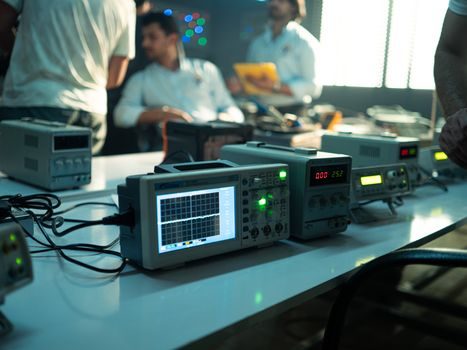
Line-interactive is the correct answer for: single-phase loads under 3 kVA, IT gear (PC, NAS, server, router, CCTV), light-industrial cabinets (PLC, HMI, IP-based control, small VFD auxiliaries), and sites with a stable grid that drifts ±20 % rather than fails outright [S1][S3]. It is the wrong answer for: three-phase industrial lines, any motor drive that will not ride through a 4-10 ms transfer, medical devices with patient-contact isolation rules, and any process where a half-cycle glitch trips a safety relay — those belong on a true online double-conversion UPS, where the inverter runs continuously and the transfer time is effectively zero.
Buyers who need >5 kVA single-phase, or who need to parallel units, are also pushing past the line-interactive envelope. The same AUNILEC catalog lists the IRIS+TT parallel three-phase and HELIOS-RM double-conversion lines for those duties [S1 catalog references]. A 60 kVA long-standby tier — labeled online interactive on some Chinese OEM sheets — sits in a different category entirely and is closer to an online double-conversion product than to the 1-3 kVA desktop units covered here [S7].
Side-by-side comparison of the three working variants
Three product lines carry the bulk of 2026 line-interactive sales and bracket the decision space. AUNILEC DIN-rail (compact industrial): 0.5 kVA / 0.85 kVA, 300 W / 510 W, simulated sinewave, RS-232, RJ45 tel-protect, 230 V in / 230 V out, CE / IEC / ISO / RoHS, IP-based control and PLC duty [S1]. AUNILEC EPC series (desktop lead-acid entry): 0.6 kVA / 0.8 kVA, 360 W / 480 W, built-in battery, LED status, CE / RoHS, PC duty [S4]. AUNILEC ARES series (desktop IT): 1 / 1.5 / 2 / 3 kVA at PF 0.8, 800-2400 W, pure sinewave, 175-290 V input, 200-240 V adjustable output, DSP control, ECO mode, SNMP, CE / IEC / ISO / RoHS, server / NAS / CCTV / light-industrial duty [S3].
Decision rule in one line: if the load sits inside a control cabinet and is under ~500 W, the DIN-rail unit is the cleanest mechanical fit; if it is a PC and the budget is tight, the EPC series is the right call; if the load has active PFC or includes a NAS, the ARES (or the equivalent GXB / CSW / SW pure-sinewave tier from Bluewalker at 1-1.5 kVA / 600-900 W, 162-290 V input) earns its premium [S1][S2][S3][S4]. For adjacent panel-side protection decisions such as breaker and RCCB sizing upstream of the UPS, the RCCB price and tier-band spec map and the air circuit breaker cost-driver guide cover the upstream side of the same cabinet.
Standards, certifications, and sourcing
The OEM datasheets consistently claim compliance with IEC, CE, ISO 9001, and RoHS for the AUNILEC line, and the China export tariff schedule lists line-interactive UPS under HS code 9027 9000 00 at a 0 % MFN duty with a 13 % VAT on the Chinese side [S1][S3][S4][S5]. Practical sourcing note: 1 kVA class line-interactive units in the Chinese OEM channel are landing in the US$ 35-250 range per piece, with 1-piece MOQ from audited suppliers, and the 1000 VA / 510 W desktop with LCD, AVR, and off-mode charging is a common build at the low end of that band [S6].
Buyers should still verify that the IEC compliance claim on the datasheet maps to a test certificate — IEC 62040-3 is the UPS performance and test standard, and EMC compliance for a unit sold into the EU market also requires EN 62040-2 — and that any "online interactive" label on a Chinese OEM sheet is read as a topology descriptor for AVR-stepped line-interactive units, not as IEC 62040-3 class 1 (VFI) online double-conversion [S7]. Where the load is a higher-kVA IT or process line and a real VFI transfer is required, the online double-conversion UPS selection map lays out the kVA and topology thresholds to switch to. The trackable signals for the next cycle: any tightening of IEC 62040-3 revision language around ECO-mode efficiency claims, and any move by Chinese OEMs to publish 62040-2 EMC test reports alongside the existing CE declarations.
Detailed specification references: industrial ups, linear guide, and crossed roller guide.