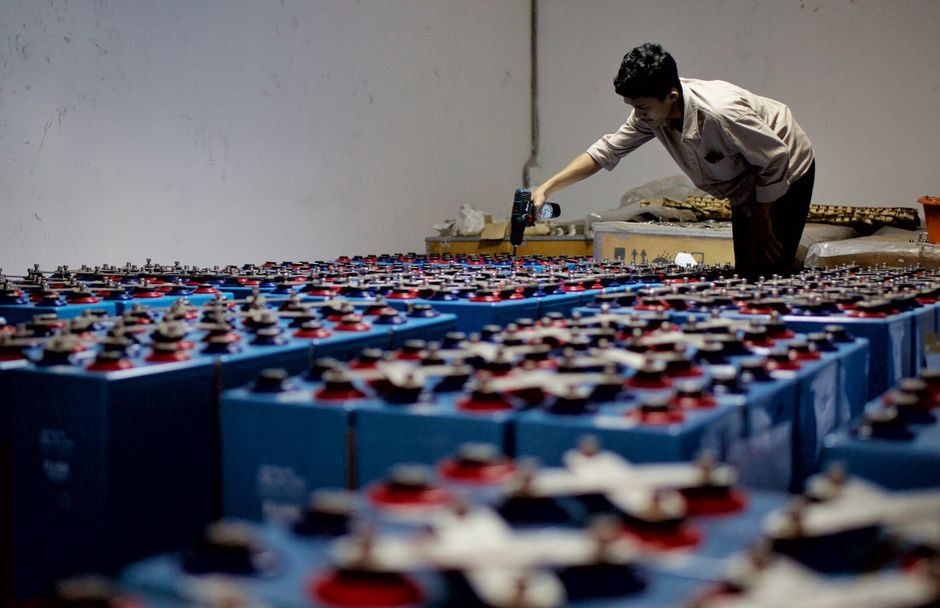
An online double-conversion UPS continuously rectifies incoming AC to DC and inverts it back to a clean sine-wave AC, isolating the load from sags, surges, and frequency drift at all times the inverter is healthy [S1].
Industrial buyers can choose from at least 152 catalog models across 42 manufacturers, with single-phase units from 1 kVA and three-phase modular frames reaching 800 kVA per the DirectIndustry double-conversion UPS index [S1].
What "Online Double-Conversion" Actually Means
Online double-conversion is classified as VFI-SS-111 under IEC 62040-3, meaning the load is fed from the inverter at all times and there is zero transfer time to battery when mains fails [S1].
This is fundamentally different from line-interactive or standby topologies, where the load briefly runs on raw mains until the inverter kicks in. For process control PLCs, SCADA servers, and turbine yaw controllers, that sub-cycle transfer is unacceptable because it can corrupt memory and drop safety loops [S3].
As a result, double-conversion is the default for any load the user describes as "critical" — control rooms, medical IT, telecom nodes, and the supervisory layer of renewable plants [S2][S3].
Sizing: kVA, kW, and the 0.9-1.0 Power Factor Question
Most current-generation double-conversion UPSs are advertised with output power factor 1.0, meaning kVA equals kW, which simplifies the sizing math for buyers [S1][S8].
Older transformer-based units typically delivered 0.8-0.9 PF, so a 100 kVA frame only supported 80-90 kW of load. New transformerless designs like the INVT 1-20 kVA tower/rack family explicitly publish PF=1 for the 6-10 kVA band, with online efficiency up to 95% [S8].
A practical rule for first-pass sizing: take the connected load in kW, add 25% headroom for inrush (VFDs, transformers, motors), then divide by PF. For a 50 kW control-room load on a PF=1 UPS, the minimum frame is 63 kVA; on a PF=0.9 legacy unit, the same load needs a 70 kVA frame [S1][S8].
Single-Phase vs Three-Phase: Where Each Voltage Class Fits

Single-phase double-conversion UPSs dominate the 1-10 kVA band and are typically configured 1:1 with input/output selectable at 200, 208, 220, 230, or 240 V [S4][S8].
Three-phase units split into two sub-categories: 3:1 hybrid frames (three-phase input, single-phase output) for 10-40 kVA mixed loads, and 3:3 full three-phase frames for 10 kVA and above where the downstream distribution is also three-phase [S5][S8].
For industrial buyers, the decision tree is straightforward: if the upstream feeder and downstream PDU are both three-phase, specify 3:3 (for example, the AEG Protect 1 at 10-20 kVA or 380-415 V class [S5]). If the load is mixed IT and small-control gear on 230 V outlets, 3:1 hybrid or pure 1:1 single-phase keeps transformer losses and footprint down [S8].
Topology Features That Change the Spec Sheet: Eco Mode, N+1, and Modular Scaling
Eco mode is a manufacturer-defined energy-saver that lets the load run on filtered bypass when mains is within tolerance, then drops back to full double-conversion on demand; AEG's Protect C 3000 WD and Protect D 3000 both list Eco mode as a selectable feature [S3][S4].
For buyers wary of the brief transfer time Eco mode implies, parallel-redundant N+1 operation is the higher-reliability alternative. PILLER's APOSTAR AR Comfort supports N+1 redundant parallel operation from 10 kVA to 80 kVA per module, with hot-swap battery modules for runtime extension [S2].
Modular chassis like Riello's Multi Power (45-294 kW per frame) and Sentryum Rack (20-160 kVA) let capacity scale in 10-45 kW steps and allow a failed power module to be replaced while the load stays on inverter [S1]. When loads are expected to grow 30-100% over a 5-year horizon, modular beats fixed-frame on lifecycle cost.
Comparison: Four Realistic Double-Conversion Options on Four Decision Criteria
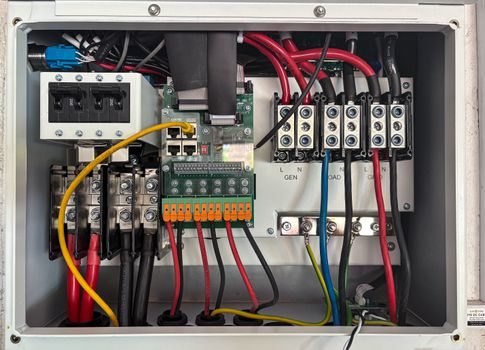
Buyer-relevant comparison: 1) PILLER APOSTAR AR Comfort (10-80 kVA, N+1 redundant, IEC-certified, 50/60 Hz frequency converter built-in [S2]); 2) AEG Protect C 3000 WD (3 kVA single-phase, ruggedized for wind turbine yaw/lighting, hot-swap battery, Eco mode [S3]); 3) AEG Protect 1 (10-20 kVA, 220-415 V three-phase/single-phase, transformerless, VRLA battery [S5]); 4) INVT 1-20 kVA single-phase tower/rack (PF=1, 95% online efficiency, CE/RoHS, 6-10 kVA band with PF=1 [S8]).
Decision criteria line-up:
- Redundancy architecture: N+1 native on PILLER APOSTAR AR Comfort; absent on the standalone AEG Protect C and INVT tower units; achievable via parallel frames on Protect 1.
- Voltage class: 230 V single-phase on AEG Protect C, INVT, and AEG Protect D; 380-415 V three-phase on PILLER, AEG Protect 1, and Riello Multi Power.
- Environmental hardening: AEG Protect C is explicitly "rugged" for harsh environments including wind turbine nacelles; the other three target benign indoor control rooms and IT rooms [S3].
- Efficiency: INVT publishes 95% online double-conversion; AEG and PILLER publish "very high efficiency" qualitatively; Schneider Galaxy VS in the same band quotes up to 97% double-conversion and 99% in Eco mode [S1][S8].
Who Should NOT Buy a Standard Online Double-Conversion UPS
Loads that are pure resistive heating, large motors with soft-starters, or non-critical lighting do not need VFI-SS-111 isolation and waste 5-10% of input energy as conversion losses [S1][S8].
Buyers expecting the UPS to ride through a 30-minute outage on a single 3 kVA frame should check battery autonomy tables carefully — most small single-phase units ship with 5-15 minutes of runtime at full load and require add-on battery cabinets to reach 1-4 hours [S3][S4].
If the site has a poor input frequency profile (generator-fed, weak grid), Eco mode becomes a liability rather than a saver, and the UPS will drop to battery repeatedly. Disable Eco mode or specify a unit with input frequency tolerance of 45-65 Hz as standard, not as a special build [S2][S3].
Standards, Certifications, and Sourcing Reality in 2026
Industrial double-conversion UPSs from major OEMs — PILLER, AEG, Riello, Schneider, INVT, ABB — carry IEC certification as a baseline, with many also meeting CE and RoHS for European and Asian deployments [S1][S2][S3][S4][S5][S8].
UL listing remains a separate mark that not every European or Chinese OEM publishes; buyers shipping to North American sites must verify UL/cUL on the specific model code, not just the family name. Made-in-China sourcing platforms list 1-300 kVA modular double-conversion units in the US$65-6,600 factory-price band, but factory certification scope and after-sales warranty terms vary widely [S7].
For control-room power architectures that also need industrial UPS reference designs, the standard pairing is double-conversion UPS upstream of a surge protective device and downstream of a properly coordinated molded case circuit breaker — the breaker selectivity table decides whether a UPS fault trips the upstream feed or stays isolated to the UPS feeder.
Practical Shortlist Logic for a Spec-Driven Buyer
Step 1: tabulate connected load in kW, decide the power factor assumption (PF=1 for new transformerless units, PF=0.9 for legacy or low-cost imports), and add 25% inrush margin [S8].
Step 2: pick voltage class — 1:1 single-phase under 10 kVA, 3:1 hybrid at 10-40 kVA, 3:3 three-phase above 40 kVA or wherever the upstream feeder is three-phase [S5][S8].
Step 3: decide between fixed-frame (lowest cost per kVA) and modular (scalable, N+1 inherent, easier service) when load growth is expected or downtime tolerance is low [S1].
Step 4: confirm Eco mode is selectable, battery autonomy curve is published at 0.8 and 1.0 load PF, and the residual current device on the UPS feeder is coordinated with the UPS input filter leakage current. Shortlist three models in writing, request full data sheets including IEC 62040-3 VFI classification, then issue the RFQ.
For component-level specifications, see online water analyzer, and linear guide.