
A linear module specified for a paper machine must hold rated repeatability (typically ±0.01 mm to ±0.02 mm for slitter, reel and winder positioning) inside a washdown envelope of IP65 or higher, with a stainless or hard-chrome rail surface and food-grade H1 lubricant where airborne fibre and condensate are unavoidable [S1].
Defining scope: a linear module (also called a linear slide unit or linear robot axis) is a pre-engineered assembly combining a linear guide carriage, a linear bearing block, a drive screw or belt and optional linear encoder and motor mounting, delivered as one stroke-defined unit rather than as a kit of loose parts [S1]. Pulp-and-paper duty covers reel drum turning, slitter positioning, calender roll adjustment, headbox slice lip actuation, press felt guide, and roll handling in the converting hall — each with different load, speed and contamination profiles.
Contamination and Materials: Why Standard Slides Fail in Paper Mills
Paper-machine environments expose linear modules to hot steam, peroxide bleach, sodium hydroxide carry-over, and airborne cellulose fibre that compacts into ball-screw raceways. Stainless-steel rails (commonly 1.4404 / 316L) or hard-chromed carbon-steel rails are the default choice; untreated black-oxide rails fail within a few thousand hours in TMP or bleaching areas [S1].
Seal selection has a direct effect on service life: a double-lip wiper plus an additional metal scraper is the minimum spec for fibre-laden zones, and bellows covers (folded polyurethane or fabric-reinforced rubber) extend that protection across the full stroke [S1]. Grease specification matters because paper-machine condensate washes water-soluble lubricants out of the carriage; food-grade H1 aluminium-complex or PFPE greases are routinely approved for paper-grade hygienic zones and for tissue machines where contact risk exists [S1].
Stroke, Load and Repeatability Bands by Paper-Machine Zone
Sizing starts from the paper-machine zone, not from the catalogue: a slitter-positioning axis typically runs 300 mm to 800 mm stroke, 0.5 m/s to 1.5 m/s, ±0.01 mm repeatability, payload 25 kg to 60 kg; a reel-spindle turn-up axis is 1000 mm to 2500 mm stroke, slower at 0.2 m/s to 0.5 m/s, payload 500 kg to 2000 kg, and almost always ball-screw or rack-and-pinion driven [S1].
Calender roll skew actuators fall between those two: 50 mm to 150 mm stroke, static load up to 100 kN per actuator at the roll-nip reaction, repeatability often relaxed to ±0.05 mm. Headbox slice-lip adjustment uses compact linear actuator modules on a 25 mm to 100 mm stroke at sub-0.1 m/s, with parallel multi-axis mounting across the full headbox width — typically 5 m to 10 m — and individual module repeatability of ±0.005 mm at the slice lip after the mechanical leverage of the linkage is removed. A useful sizing sanity check: a lead screw sizing pass at the rated axial load and continuous-duty speed should not exceed 60–70% of the catalogue critical speed; above that band the screw whips and the encoder feedback will not save you from the resonance.
Drive Type Comparison for Paper-Machine Service
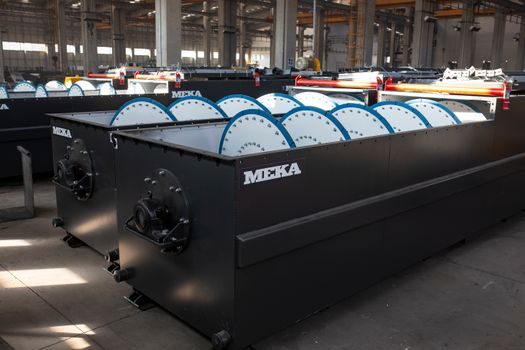
Ball-screw, roller-screw, belt-drive and rack-and-pinion modules are all sold for paper-machine duty, but they map to different zones [S1]. A direct criteria comparison helps spec writers pick quickly:
Ball-screw linear module: 0.05 m/s to 1.5 m/s, payload 5 kg to 500 kg, repeatability ±0.01 mm to ±0.02 mm, efficiency 85–95%, stroke 100 mm to 1500 mm; best for slitter, sheet guide and converting-line axes where stroke and speed are moderate. Roller-screw linear module: 0.05 m/s to 1.0 m/s, payload up to 1000 kg, repeatability ±0.005 mm to ±0.01 mm, life 10× to 15× the equivalent ball-screw; preferred for heavy reel and calender actuators that run continuously under vibration.
Belt-driven linear module: 1 m/s to 5 m/s, payload 5 kg to 100 kg, repeatability ±0.05 mm, long stroke 1500 mm to 6000 mm at low cost; suited to cross-direction web transfer and converting infeed where the line speed is high but the positioning tolerance is relaxed. Rack-and-pinion linear module: 0.2 m/s to 2 m/s, payload 500 kg to 5000 kg, long stroke above 2 m, repeatability ±0.02 mm; dominant on roll-handling gantries and reel-yard shuttles. Direct-drive linear motor modules reach 3 m/s to 5 m/s with sub-micrometre encoder feedback, but they are rarely the right answer on a paper line because the ironless or iron-core coil must still live behind an IP65 seal and a stainless track cover — the cost premium rarely pays back outside of calender and coater inspection stands.
Enclosure, Lubrication and Maintenance: The Total-Cost Levers
IP65 is the standard minimum washdown rating for paper-machine linear modules; IP67 is the typical spec for press-section and dryer-section axes exposed to direct steam release and weekly caustic wash, and any axis above the wire pit or in the broke chest should be IP67 minimum [S1]. Centralised lubrication with auto-greasers is common on multi-module converting lines, while single-axis slitter and reel modules are usually fitted with a single grease nipple per carriage and a maintenance interval of 2000 hours to 4000 hours depending on contamination load.
Service-life expectation in a typical bleached-kraft paper machine: 18 000 hours to 25 000 hours for sealed ball-screw modules with monthly wipe-down; 8 000 hours to 15 000 hours for unsealed units in TMP areas [S1]. Bellow life is the weakest link: standard folded PU bellows survive 1 to 3 years before a single fold tears and fibre enters the screw; reinforced fabric or stainless-link bellows extend that to 5 to 7 years. Bushing-style linear module units are almost never specified on a paper machine above 100 kg payload because their dry-friction behaviour amplifies stick-slip in the wet/dry swing zones.
Standards, Documentation and Sourcing Watch-Outs

Paper-machine linear modules are commonly specified against the same machinery safety framework as general industrial automation, with the supplier expected to provide CE declaration, declaration of incorporation under the EU Machinery Directive, and where the axis is mounted inside a hazardous area, an ATEX assessment matching the zone (typically zone 21 / zone 22 dust) or, for new North American paper-machine builds, a NEC Class II Div 2 dust rating [S1]. Component-level bearings and screws are usually traceable to ISO 15 and ISO 3408 respectively, and the module's corrosion test is typically a 96-hour neutral salt-spray result on the rail, not on the housing paintwork.
Sourcing levers for 2026: Chinese OEM clusters in Suzhou, Wuxi and the Pearl River Delta ship the bulk of the world’s cost-competitive belt-driven and ball-screw linear modules, and lead time on 1 m stroke, IP65, ball-screw units sits around 25 to 45 days for stocked OEMs and 60 to 90 days for engineered-to-order IP67 stainless units. European suppliers (Bosch Rexroth, Rollco, SKF) and Japanese suppliers (NSK, THK, Hiwin JP) dominate the heavy-payload roller-screw and rack-and-pinion segment with lead times of 60 to 120 days, and 2D or 3D CAD models of the carriage, motor flange and bellows assembly should be requested as a contractual deliverable before PO. If a mill is also rebuilding a hydraulic press or felt guide, the ball spline sizing pass should run alongside the linear-module selection so the torque-to-axial load ratio matches the drive motor curve.
Trackable next nodes: confirm the IP rating and bellows material on the datasheet (not just in the marketing brochure); require a 2000-hour vibration test report on the carriage for any reel or winder application; ask for a reference list of paper-machine installations with verified mean-time-between-failure hours; and check whether the linear encoder is rated to the same IP code as the module — many low-cost units ship with an IP54 encoder that quietly degrades to zero signal inside three months in a steam-leak zone. For converting-line retrofits where the existing pneumatic cylinder is being replaced, also verify the push-in fitting buying guide air-line sizing if the new electric axis is sharing a pneumatic manifold for clamping.