A lithium-ion cell line breaks into roughly seven process stages — mixing, coating, drying/calendaring, slitting, winding/stacking, electrolyte filling, and formation & grading — each with its own dedicated machine class and qualification criteria [S2]. Tianyong Lithium Battery Technology (Dongguan) Co., Ltd. lists nine equipment categories on a single supplier page, including coating machine, slitting machine, rolling machine, winding machine, formation equipment, grading capacity equipment, laser cutting machine, electrode making machine, and electrolyte filling machine, and advertises 26 years of one-stop line experience [S2].
Lithium-battery special equipment is a regulated category in China: ChemicalBook records the product class under CB73016049 and notes that buyers of hazardous-material-related equipment must hold valid qualifications under the site's terms of use [S1]. Wuhan Great Automation Equipment Co., Ltd., registered in 2016 and operating from Wuhan, Hubei, focuses on lithium-battery automation, laser welding automation, and automatic soft-pack Li-ion assembly, illustrating the dedicated automation tier of the supply base [S3].
Process map: seven stages, seven machine classes
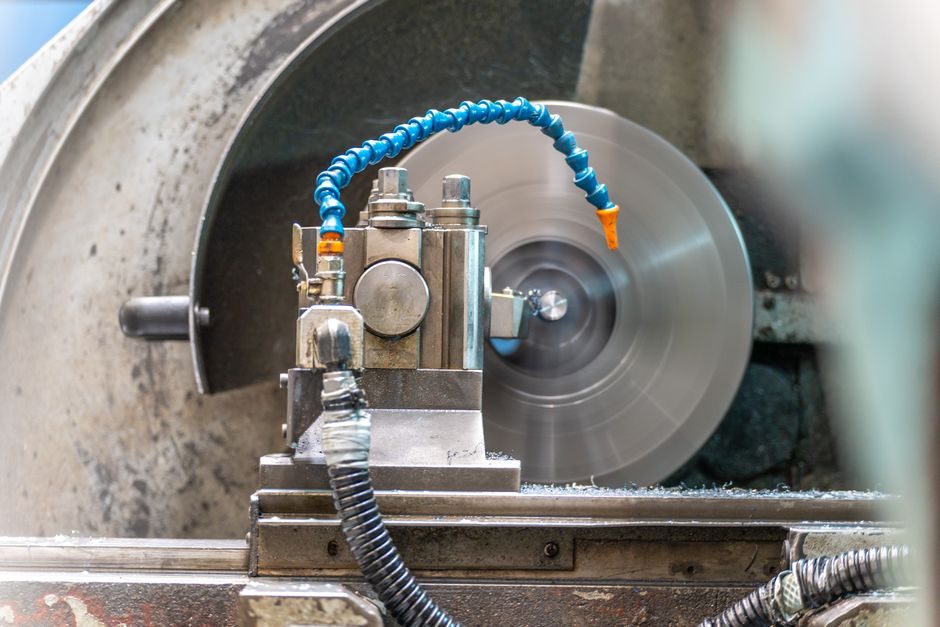
Coating machines apply slurry to current-collector foil with controlled wet-film weight and are typically the rate-limiting step on prismatic and pouch lines; Tianyong's lineup couples a coater directly to a slitter, so web tension and edge-trim geometry stay in one supplier's control loop [S2]. Slitting machines rewind the dried, calendered electrode web into narrower strips matched to the cell width, with knife clearance, burr height, and dust control dictating downstream winding yield.
Winding machines (cylindrical) or stacking machines (pouch/prismatic) build the jellyroll, and Tianyong bundles them with electrode making machines so the alignment of anode/cathode/separator is governed by one kinematics chain [S2]. Electrolyte filling, formation, and grading then form the back half: filling under vacuum, followed by formation cycling that locks SEI chemistry, and grading that bins cells by measured capacity. Vacuum drying ovens, such as the lithium-battery-grade unit shipped from Guangdong, are the bridge between coating and the dry room, with moisture load on the electrode a direct yield driver [S5].
Who it is for — and who it is not
One-stop turnkey suppliers such as Tianyong, with 26 years of integrated line experience, fit mid-to-large cell makers that want a single process guarantee from coating through formation [S2]. Dedicated automation houses like Wuhan Great, focused on laser welding and automatic soft-pack assembly, suit buyers who already have upstream process tools and need high-precision pack-level joining [S3].
End-product OEMs that only need finished packs — for example VTCBATT's golf-cart, ESS, and RV custom battery lines — are <em>not</em> the target customer for cell-manufacturing equipment; they source cells or modules and integrate them into 6000-cycle, modular ESS products [S4]. A buyer without hazardous-materials qualification, or without a Class 1,000 or better dry room, is also not the right fit for filling and formation equipment because cell yield collapses above roughly −40 °C dew point [S1].
Vendor tier and capability comparison

Three capability tiers are visible in the public supplier set. Tier 1 — full-line integrators (e.g. Tianyong, 26 years, nine equipment categories from coating to grading) cover the whole electrode-to-cell chain [S2]. Tier 2 — process specialists (e.g. Pioneer Drying Equipment in Changzhou, Jiangsu, listed as a ChemicalBook supplier under CB73016049 with 160 catalog products) supply drying and vacuum oven sub-processes [S1]. Tier 3 — pack-level automation (e.g. Wuhan Great, registered 2016, laser welding and soft-pack lines) handle module and pack joining [S3].
On the four decision criteria a process engineer weighs — throughput, dry-room compatibility, automation depth, and qualification scope — Tier 1 integrators win on throughput and single-vendor accountability, Tier 2 specialists win on sub-process uniformity (especially drying, where temperature uniformity and ultimate vacuum set cell quality), and Tier 3 pack houses win on laser-welding precision and soft-pack fixturing [S1][S2][S3]. Cross-referencing motion components, the precision of every slitter, winder, and stacker rests on the same class of linear guide rails that machine tool builders specify for repeatability under cyclic load. For high-speed winding where positional drift matters across millions of cycles, a crossed roller guide is the alternative when moment load exceeds what a profile rail can absorb without preload loss.
Selection criteria that actually move yield
Four specifications drive cell yield more than any marketing claim. First, coating dry-end moisture: residual moisture in the electrode web dictates SEI quality, and the vacuum drying oven class governs that residual — Pioneer Drying Equipment and similar Guangdong oven builders target sub-ppm web moisture at the exit of the drying stage [S1][S5]. Second, slitter burr and dust: edge quality on the cathode strip is a hard prerequisite for wound-cell yield, and integrated coating-to-slitting lines reduce web handling between stages [S2].
Third, formation C-rate and channel count: formation is the longest single step in cell production, and the channel density of the formation equipment — how many cells can cycle simultaneously — sets the line's true throughput [S2]. Fourth, dry-room dew point and electrolyte filling vacuum: filling must occur under controlled vacuum with moisture below roughly −40 °C dew point, and Tianyong bundles an electrolyte filling machine into the same supply contract so the vacuum and dosing setpoints are tuned to the formation profile [S2]. On the production line, static charge control is non-negotiable: dry-room air, separator film, and powder handling all generate static, and the right anti-static equipment class — ionizers, grounded rollers, ESD flooring — is what stops separator pinhole defects that show up only at formation.
Failure modes, constraints, and the qualification gate

The most common line failures are not mechanical but chemical-mechanical. Coating streaks and calendaring density drift cause capacity variance that grading can mask but not eliminate. Slitter burr creates internal micro-shorts that surface as field failures months later. Dry-room excursions above roughly −40 °C dew point ruin formation yield regardless of how good the rest of the line is. Tianyong's response is to keep the whole chain — coating, slitting, rolling, winding, formation — in one engineering scope, so when one stage drifts, the next stage's setpoints are tuned in the same FAT [S2].
Buyers of hazardous-material-related equipment must hold valid qualifications under the platform's terms of use, which is a legal gate in addition to a process gate [S1]. Geographic and standards constraints: Chinese cell-equipment exports to North America and Europe must additionally satisfy UL/CE machinery directives, but those conformity assessments are downstream of the underlying process spec, not a substitute for it. For module and pack builders, process-automation layers such as those sold by Wuhan Great typically already carry CE machinery conformity for the laser-welding subsystem, which shortens the buyer's own pack-level qualification cycle [S3].
Standards, sourcing signals, and what to track
Two sourcing signals from the public record matter for the next sourcing cycle. First, the consolidation of one-stop turnkey suppliers with 20+ years of line experience — Tianyong's 26-year, nine-category catalog is the template other mid-tier Chinese builders are copying [S2]. Second, the rise of dedicated automation houses for laser welding and soft-pack assembly — Wuhan Great is representative, registered 2016, with a focused product set rather than a full line [S3].
Two trackable signals for the next 6–12 months: (1) whether Tier 2 drying and vacuum-oven specialists such as Pioneer Drying Equipment expand into integrated formation-and-grading modules, which would compress the back half of the line; (2) whether Tier 1 integrators add dry-room turnkey packages — dew-point, flow meter-monitored gas handling, and electrolyte filling — so a buyer can source the entire moisture-controlled perimeter from one supplier. For buyers mapping additive manufacturing material supply for production tooling, jigs, and fixtures that touch cell components, the same qualification and traceability rules apply as for the cell itself, since fixture outgassing can contaminate the dry room just as badly as a process leak.
End-product applications such as golf-cart packs and stationary ESS racks — VTCBATT quotes 6000 cycles, modular design, and 10-year service life on its deep-cycle SKUs — are downstream of the cell-making equipment described above and are not the procurement target for the line builders profiled here [S4]. When this article is next updated, the two signals to revisit are the drying-oven/form-grading consolidation wave and the dry-room turnkey bundling trend.
This topic is covered further in Pillow Block Bearing TCO: 10-Year Cost Stack, Driver Map, and Spec Checkpoints.