
Lost foam casting is a green evaporative-pattern process that assembles polystyrene foam patterns into clusters, coats and dries them, embeds them in dry sand vibrated under a flask, and pours molten metal under negative pressure so the pattern decomposes and the casting forms in a single step [S2][S4].
Full turnkey LFC lines are organized into three colour-coded zones — white area for pattern production, yellow area for coating and drying, and black area for molding, pouring, and sand processing — and are commonly quoted at 3,000 t/yr or 5,000 t/yr capacity tiers with manual, semi-automatic, or full-automatic configuration options [S2].
Classification by Automation Tier and Capacity
Commercial lost foam casting lines are tiered first by automation: manual lines (lowest capex, suited to job shops under ~1,000 t/yr), semi-automatic lines (robotic coating/dipping, conveyor flask handling, mid-volume 1,000–3,000 t/yr), and full-automatic lines (closed-loop sand handling, robotic pattern assembly, vision-checked pouring, 3,000–5,000 t/yr and above) [S2].
Capacity is customised against part-mix and tonnage targets; suppliers typically benchmark 3,000 t/yr and 5,000 t/yr as standard reference outputs and scale floor space proportionally to that throughput target [S2]. Grede Holdings has documented the economic ceiling at the high end, with its LFC process producing heavy-truck components weighing up to 30% less and costing up to 40% less than the same parts made by conventional casting [S7].
Buyers should match tier to volume: a manual line is uneconomic above ~1,500 t/yr because flask cycle time dominates, while a full-automatic line needs a stable part-mix to recoup the robotic coating and sand-recovery investment [S2].
Classification by Alloy and Pattern Material
LFC works across ferrous and non-ferrous alloys — grey iron, ductile iron, steel, aluminum alloy, and copper — and the same line can typically be reconfigured by changing the pouring station, sand media, and refractory coating [S2]. Aluminum LFC is the most research-active subset because pyrolysis of the polystyrene pattern drives severe porosity; Bokhyun Kang et al. demonstrated that applying external pressure during solidification on A356.2 bar samples measurably reduced porosity and increased elongation [S3].
Pattern material is a second classification axis. Expandable polystyrene (EPS) is the default, but expandable polyethylene (EPE) and expandable polypropylene (EPP) foams at two different densities have been benchmarked against EPS in low-carbon steel A216 Grade WCB trials, with carbon contamination and surface quality varying significantly with foam chemistry [S6]. For higher-temperature alloys (steel, ductile iron), EPS with a heavier refractory coating is the common choice; for aluminum, lower-density EPS with a permeable coating reduces gas-defect risk [S2][S6].
The bead-filling simulation work of Jiang Junxia, Liu Mingjun, Wu Zhichao, and Chen Liliang established an Euler–Lagrange model of the dense gas–solid two-phase flow during pre-expansion and pattern molding, which is now used to size the steaming chest and aging storehouse in the white area of an LFC line [S5].
Three-Zone Process Map: White, Yellow, Black
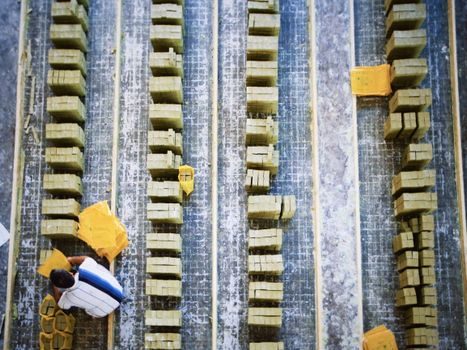
Every LFC line breaks into three process zones, and the equipment list flows directly from that split. The white area runs pre-foaming → aging storehouse → moulding → drying → assembly into cluster; the yellow area runs first coating → first drying → second coating → second drying; the black area runs molding → pouring → sand processing and recovery [S2].
Typical castings off such a line include motor bodies, cylinder heads, complicated pipe fittings, shells, housings, and engine blocks — all near-net shapes that would require cores in green-sand casting — and the line is described as suitable for engineering machinery, textile machinery, building, and automobile production [S2].
Sand processing in the black area is the throughput bottleneck; vibration-table compaction under negative pressure (typically –0.04 to –0.06 MPa gauge on commercial units) determines flask cycle time and therefore rated tonnage [S2].
Comparison of LFC Against Competing Casting Routes
Against the four primary alternatives listed in the GlobalSpec casting-services index — die casting, investment casting, permanent mold casting, and sand casting — LFC occupies a distinct cost/precision/lead-time niche [S1].
Die casting wins on cycle time for non-ferrous high-volume parts but loses on ferrous capability and tooling cost. Investment casting wins on surface finish and thin-wall complexity but loses on size and on per-part cost above ~5 kg. Permanent mold casting wins on metallurgical consistency for short-run non-ferrous but cannot match LFC on part complexity without cores. Green-sand casting wins on tooling simplicity and per-ton cost for very large parts but loses on dimensional accuracy and on the ability to consolidate assemblies [S1][S7].
LFC's specific advantage is near-net assembly consolidation: a cluster of foam patterns can be glued into a single pour, replacing what would be a multi-part welded or bolted assembly with one casting — a capability that Grede leverages to hit the 30% weight and 40% cost reductions cited above for heavy-truck axle, transmission, and chassis components [S7].
Limitations, Failure Modes, and Standards
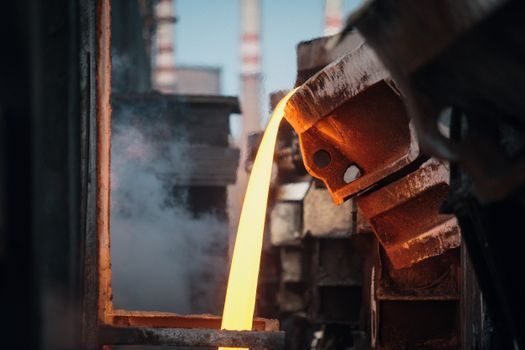
The dominant failure modes in LFC are foam-pattern defects (density variation, bead-fusion lines from incomplete steaming), coating failures (spalling, permeability loss), gas-related defects (blowholes, carbon pickup from incomplete pyrolysis), and metallurgical defects (micro-shrinkage, porosity) [S3][S6]. On low-carbon steel A216 WCB, foam chemistry (EPE/EPP vs EPS at two densities) measurably altered carbon contamination levels in the finished casting [S6].
For aluminum, slow solidification in the LFC process promotes gassing pinholes and micro-shrinkage; external pressurisation during solidification has been validated as a remediation path, with porosity and solidification time both decreasing as applied pressure rose in the A356.2 study [S3].
For an LFC line specification, buyers should verify: flask dimensions and cycle time, vibration-table amplitude and frequency, coating tank capacity and dip-rotation control, negative-pressure pouring hood rating, sand cooling and dust-removal capacity, and pattern-density tolerance (typically ±5% of nominal EPS density for ferrous pours) [S2].
Sourcing Logic and Project Structure
Turnkey LFC projects are commonly delivered as one-stop packages covering design, quotation, production, installation, and operator training to qualified-product acceptance, with payment terms typically T/T or L/C and shipping by sea, land, or multimodal transport [S2].
Specification discipline matters more than brand: a buyer chasing a 5,000 t/yr ductile-iron line should pin flask size, sand tonnage per hour, coating permeability target (typically 0.5–2.0 darcy for ferrous pours), and pour-station negative-pressure set-point in the RFQ, not just "full-automatic" [S2].
For deeper coverage of the casting line, molding line, and automatic molding line categories that an LFC plant sits inside, see the molding line, automatic molding line, and resin sand line reference entries. For the foundry-side melting equipment that feeds the black-area pouring station, the line frequency furnace entry is the relevant companion read.
Use Cases and Application Fit

LFC lines are the right answer for: near-net automotive castings (engine blocks, cylinder heads, transmission housings), heavy-truck axle and chassis components where weight and cost reduction are spec'd simultaneously, and complex pipe/manifold geometries that would otherwise need multiple cores [S2][S4][S7].
LFC lines are the wrong answer for: very high-volume thin-wall aluminum where die casting dominates on cycle time, ultra-large castings above the flask-size limit of the chosen line, and short prototyping runs where the foam-tooling lead time is not amortised across volume [S1][S2].
Grede's heavy-truck LFC work — engine, transmission, steering, chassis, and axle applications up to 30% lighter and up to 40% less costly than conventionally cast equivalents — is the canonical published benchmark for the segment [S7]. For related specification methodology on adjacent process lines, the molding line reference entry is a useful cross-read.
The next decision node for any LFC buyer is the flask size and the coating-permeability spec: those two numbers, more than the automation tier label, determine whether the line can hit the rated tonnage on the target part-mix [S2]. Track also the rapid-prototyping-LFC crossover work being published by Austin Group LLC, which is positioning LFC as a bridge from SLA/SLS/LOM rapid-prototype models directly into cast parts without re-tooling [S8].
For related coverage, see Concrete Pump Truck Types: Reach, Chassis, and Use-Case Map.