Low pressure die casting (LPDC) machine sizing is governed by four hard gates — maximum molten-metal shot weight, platen/clamp tonnage, holding furnace capacity, and rated cycle time — each of which must exceed the part, sprue and riser volume by a documented margin before downstream controls become meaningful.
Scope here covers gravity- and pressure-assisted aluminium and magnesium LPDC cells used for automotive structural nodes, wheel hubs, cylinder heads and similar mid-volume castings, where the low pressure die casting machine class sits between bench-top gravity rigs and full high-pressure die casting machine lines on both capital cost and shot-weight scale.
Shot Weight and Effective Casting Area as Primary Gates
Net shot weight — part + runner + riser — typically lands in the 2–60 kg band for production LPDC cells, with crucible capacities quoted in the 400–2,500 kg aluminium range and corresponding magnesium cells roughly 60–70% of that figure by volume [S2]. The first sizing arithmetic is therefore volumetric: required fill mass divided by alloy density (≈ 2.7 g/cm³ for Al, ≈ 1.74 g/cm³ for Mg) sets the minimum furnace draw, and the machine's rated shot weight must clear that figure by 15–25% to keep pressurisation ramp headroom and avoid starvation at the end of fill.
For thin-wall structural parts the gating decision migrates from pure mass to projected area × nominal intensification pressure, mirroring the logic used on squeeze casting machine selection, where the same force/shot-weight interaction governs cell choice. A 600 t-class LPDC machine will typically carry 0.3–0.9 m² of projected casting area, while a 1,200 t-class extends past 1.5 m²; running outside that envelope either wastes tonnage (poorly utilised machine, higher $/part) or trips tie-bar and platen fatigue well before the scheduled die-life target.
Clamp Force, Intensification Pressure and Cycle Architecture
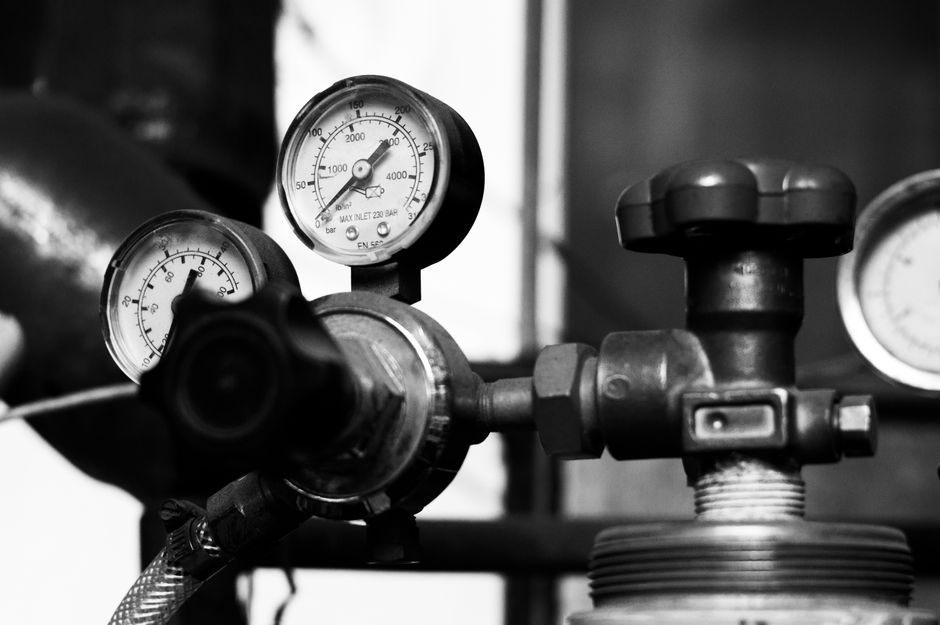
Hold pressure in LPDC is supplied by compressed air or inert gas acting on the melt surface in the sealed crucible, generally capped at 0.2–1.0 bar for aluminium and up to 2–4 bar for magnesium thin-wall work, while die-closure force is delivered by a separate hydraulic or hydraulic-mechanical clamp [S2]. Typical production LPDC platens run 200–1,600 tonnes of clamp force, with the larger frames reserved for one-piece automotive sub-frames and large transmission housings.
Cycle time on a properly sized LPDC cell is dominated by solidification and die-open/close, not by metal injection: 90–240 s per shot is common for 5–20 kg aluminium parts, dropping to 60–120 s for thin-wall magnesium housings where the lower heat content per unit volume compensates for faster-firing alloys. Platen size, tie-bar spacing, and die-height stroke must all clear the part on the diagonal — a frequent disqualifier during RFQ review when a customer's CAD envelope fits the projected area but not the die-set's daylight.
Safety Code GB 24391-2009 and What It Locks In

GB 24391-2009 — the Chinese national safety code titled 低压铸造机.安全要求 (Low-Pressure Casting Machine — Safety Requirements) — covers crucible-sealed and furnace-sealed LPDC machines in both horizontal and vertical parting configurations, and explicitly calls out requirements for the hydraulic system, pneumatic system, electrical system and the cooling provisions for the hydraulic pump [S3]. The standard is the de facto specification baseline for LPDC cells shipped to or built in China and is routinely cited in vendor compliance packs.
For European builds the equivalent pressure-vessel and machine-safety envelope is set by the Machinery Directive 2006/42/EC and the Pressure Equipment Directive 2014/68/EU on the crucible/pressure vessel side, with the vacuum die casting machine variants additionally governed by the ATEX 2014/34/EU framework when the process is run with reactive magnesium alloys in classified zones. A practical audit checklist — hydraulic-pump cooling, interlocked die-height clamps, dual-channel gas regulation, and emergency crucible depressurisation — maps one-to-one to GB 24391-2009 clauses and should be requested from any short-listed OEM before commercial terms are finalised.
Cell Layout: Vertical vs Horizontal Parting, Furnace Position
Vertical-parting LPDC cells are the default for symmetrical wheels, hub-bearing housings and clutch bells, because the parting line and metal feed path are coaxial with the furnace stack, simplifying automation. Horizontal-parting cells dominate long, flat geometries such as suspension links, battery trays and cross-members, where die access and ejection stroke are easier to engineer with the parting line parallel to the floor [S4].
Furnace position — bottom-filled (furnace under the die) versus side-fed (furnace beside the die with a riser tube) — changes the static metal head and therefore the unassisted fill pressure available. Bottom-filled arrangements give a more stable thermal column and shorter riser tube, which lowers melt-temperature loss per cycle by 5–10 °C in production data reviewed from LPM-class cells [S2]. This is the same trade-off that recurs in squeeze casting machine sizing, where the riser/shot geometry defines the practical pressure window.
Materials, Melt Hygiene and the Mg/Al Decision

Aluminium alloys dominate LPDC output by tonnage (A356, A357, AlSi7Mg, AlSi9Cu3, plus proprietary OEM variants for chassis nodes), while magnesium (AM60, AZ91, and the newer AJ-series creep-resistant grades) is specified where mass targets override cost-per-shot. The magnesium die casting machine class is typically configured with higher gas-purity coverage (SF6/SO2 cover gas, or N2+0.5% SF6 on newer cells), crucible-level filtration, and tighter emission interlocks than the aluminium equivalent. [S1]
For parts that later see food-grade low pressure die casting downstream validation, the melt-handling chain must additionally document alloy traceability and avoid contact with process chemistries that would fail the relevant migration tests.
Decision Matrix: LPDC vs Gravity vs High-Pressure Die Casting
Selecting between gravity die casting machine (GDC), LPDC, and high-pressure die casting (HPDC) lines is a four-axis problem: shot weight, mechanical-property target, annual volume, and tooling budget. The table below summarises the working envelope a sizing engineer should walk through during cell selection. [S2]
Decision axis | GDC | LPDC | HPDC. Typical shot weight: 1–30 kg, 2–60 kg, 0.05–10 kg. Mechanical properties (as-cast, indicative UTS for Al-Si): 170–220 MPa, 200–280 MPa (heat-treatable), 220–330 MPa (vacuum-assisted). Annual volume sweet spot: 1k–50k parts, 5k–500k parts, 50k–5M parts. Typical tooling cost relative to LPDC: 0.6–0.8×, 1.0× baseline, 1.4–2.2×. This same grid informs aluminum die casting machine class selection when the question is whether to step up to a high-pressure cell or stay in the LPDC band.
Failure Modes and Throughput Limits Buyers Miss

Three failure modes dominate the post-installation complaints reviewed across LPDC fleets: (1) tie-bar stretch and platen parallelism drift after 50,000–80,000 shots, which forces a re-shim cycle; (2) riser-tube erosion from oxide build-up, visible as Fe/Mn-rich inclusions downstream; and (3) gas-regulation drift on the pressurisation circuit, which translates directly into fill-velocity variation and shot-to-shot weight scatter above ±3% [S2].
Realistic OEE targets for a well-instrumented LPDC cell sit in the 65–80% range, well below the 85–90% OEE quoted by some sales literature; the gap is almost always die-change time, melt-temperature recovery after a long down-event, and the periodic crucible reline (typically 8,000–15,000 cycles for steel crucibles in aluminium service). Buyers should size for the 70th-percentile OEE, not the nameplate figure, when matching cells to annual volume.
Vendor Signals and Sourcing Posture (2026)
On the sourcing side, Chinese OEMs continue to dominate the 200–1,600 t LPDC band on price-performance, with published machine data covering shot weight, platen size, and standard safety compliance to GB 24391-2009 [S3]. Longhua's published OEM documentation for its die casting machine line lists fully automatic process cycles, permanent process monitoring, and a positioning of the LPDC cell inside a broader HPDC portfolio aimed at export markets [S5]. European and Japanese builders (the LPM Group among them) hold the high-end of the market on controls, vacuum-assist options, and turnkey cell engineering for automotive structural parts [S2].
Trackable signals to watch over the next two quarters: a fresh revision of GB 24391-2009 is the obvious safety-code milestone; further tightening of magnesium-handling interlocks under the ATEX framework for European-bound cells; and incremental roll-out of inline melt-quality sensors (oxygen-probe plus launder-level LiMCA-style particle counting) on production LPDC lines. Spec sheets citing cycle-time and OEE figures at the 70th percentile, not the 90th, will keep being the most useful single filter when short-listing.