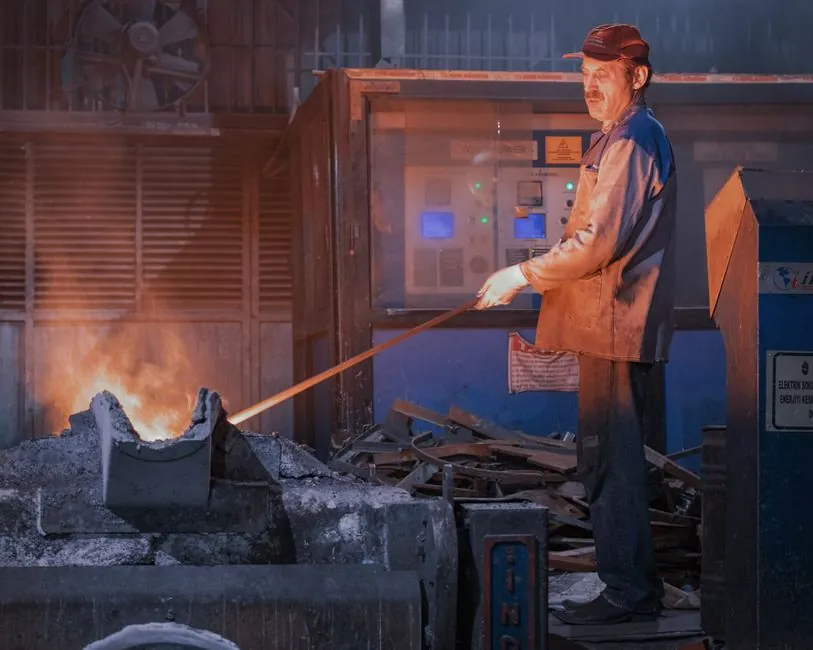
Energy-equipment castings are a strong fit for low-pressure die casting because the process pressurizes molten aluminum from a sealed furnace into the die (typically 0.3-1.0 bar gauge), filling from the bottom and feeding the shrinkage front during solidification [S3]. That bottom-up fill is exactly what limits gas entrapment in thick-walled hubs, motor housings, and inverter covers, and it matches the porosity targets that high-voltage and rotating-machinery specs demand [S2].
The 2025 LPDC machine market sits at $2.73 billion, with horizontal machines holding 58.5% of unit share and Asia Pacific taking 48.2% of revenue; the same market is projected to reach $4.54 billion by 2034 at 5.8% CAGR, with automotive at 42.3% of demand and electronics/industrial (which includes energy hardware) the second-largest pull [S3]. For buyers, that mix matters: the same OEM platforms that supply EV structural castings also supply wind and grid-storage housings, so machine models, platen sizes, and control retrofits are largely reusable across energy and EV programs [S1][S2].
Alloy envelope and process window for energy castings
Aluminum dominates LPDC at a 62.3% market share, with magnesium at 18.6% and zinc at 13.5%; specialty alloys (copper, titanium) account for the remaining 5.6% [S3]. For aluminum energy parts, crucible temperature must sit in the 680-750 degrees Celsius band and die preheat must reach 200-300 degrees Celsius, with graphite cooling water held at 30-60 degrees Celsius to control the solidification gradient [S3][S4]. Magnesium LPDC needs tighter melt control, 650-700 degrees Celsius, plus inert-gas cover to suppress oxidation, which is why magnesium machine cells add a sealed furnace module that the simpler aluminum cells skip [S3].
Alloy chemistry matters as much as melt temperature: a typical aluminum spec limits Fe and Sn each to under 0.21% to avoid hard spots and shrinkage cracks, sets a minimum Al content of 0.61% for fluidity, and uses boron (B) grain refinement when the ingot is not pre-treated [S4]. These ceiling/floor values are not optional on a Kurtz-class FSC/AL cell, where the low-pressure control system is the unit's defining subsystem and where alloy drift is what trips rejects on a long wind-hub run [S1][S4].
Machine architecture: horizontal, vertical, and tilt
Horizontal LPDC machines hold 58.5% of global share because the layout suits robotic ladle transfer, integrated trimming presses, and downstream heat-treatment cells, but vertical and tilt-frame designs still dominate for very tall single-piece castings like motor housings and inverter shells [S3]. The Kurtz FSC series (AL18-12FSC, AL28-18-18FSC) is a horizontal platform aimed at complex aluminum castings, with the AL28-18-18FSC variant adding clamping area and hydraulic power for larger frames, subframes, and battery housings [S1].
For a process engineer, the architecture decision is driven by three concrete numbers: platen size (must clear the part envelope plus 150-250 mm of overflow and biscuit allowance), clamping force (typically 200-2,500 kN on LPDC versus 5,000-20,000 kN on die casting machine HPDC cells), and furnace capacity (200-2,000 kg holding for energy-scale parts) [S1][S6]. When the part is an aluminum motor housing or a wind-pitch housing that needs high metallurgical soundness rather than thin-wall speed, LPDC's lower tonnage and slower fill beat a high-pressure die casting machine cell every time, because the LPDC cycle trades 10-20 seconds of fill time for measurably lower porosity [S2][S7].
Spec checklist for energy-equipment buyers
Use this shortlist when comparing an aluminum die casting machine bid to a vacuum die casting machine or a gravity die casting machine cell for the same energy part: [S2]
1) Clamping force and platen: must exceed projected area at 30-60 bar specific pressure for LPDC; undersizing is the number-one cause of flash and die deflection on long aluminum parts [S1][S6]. 2) Furnace and launder system: sealed pressurized furnace for magnesium (inert cover), open-stack furnace acceptable for aluminum with a 680-750 degrees Celsius melt window; verify hold capacity matches a full 8-hour shift at the rated cycle [S3]. 3) Low-pressure control loop: a stable electronic pressure-time profile, typically 0.3-1.0 bar fill pressure held during solidification, with closed-loop feedback on actual die-cavity pressure [S1][S7]. 4) Cooling circuit: graphite-cooled die with 30-60 degrees Celsius water and independent zone control for high-CTE aluminum alloy sections [S4]. 5) Automation hooks: robotic ladle, trim-press interface, and Industry 4.0 process data (real-time pressure, temperature, fill-time traces) for audit trails on safety-critical castings [S1][S3].
Where LPDC fits vs vacuum, gravity, and HPDC
For a wind-turbine hub, an EV battery enclosure, or a large motor end-bell, LPDC sits between vacuum die casting machine (cleanest metal, slowest cycle, highest cost) and gravity die casting machine (cheapest, highest porosity, limited to simpler shapes), with aluminum die casting machine HPDC cells covering the high-volume thin-wall end of the market [S2][S7]. LPDC is the right pick when the part has a wall-thickness range of roughly 4-25 mm, requires radiographic or dye-penetrant inspection per energy-sector QA, and the run is 5,000-100,000 parts per year, large enough to justify a $2-6 million cell but too low for a full HPDC automation line [S3][S7].
Cross-reference a related LPDC machine selection guide for automotive castings and an LPDC machine selection for electronics housings when energy parts overlap those segments, because EV battery housings sit at the automotive/energy boundary and share the same Kurtz AL-series platform [S1]. For non-ductile thin-wall consumer parts, the same report pool flags an LPDC machine selection map for hardware manufacturing as the closer fit than a high-tonnage HPDC cell.
What LPDC will not solve for energy buyers
LPDC is the wrong tool for high-volume thin-wall zinc or magnesium consumer hardware, where a magnesium die casting machine hot-chamber cell runs 4-8x faster, and it is also wrong for very short runs under 1,000 parts per year, where a gravity die casting machine cell with a hand-poured crucible is more economical [S3][S7]. Cycle time on LPDC is 3-10 minutes per shot for a typical 5-30 kg energy housing, versus 30-90 seconds on a hot-chamber magnesium cell, so any volume plan that crosses roughly 200,000 parts per year should benchmark against HPDC before locking in LPDC [S3][S7].
Energy buyers should also flag two real failure modes: (1) oxide entrainment from poor furnace sealing, which the Kurtz-style low-pressure control system is specifically designed to suppress, and (2) cold-shut and misrun on long-flow aluminum castings when the fill-pressure profile is not tuned to the part's thermal mass, which is why machine builders publish fill curves per platen size and alloy rather than a single number [S1][S4][S7].
Sourcing, standards, and verified 2026 signals
Three named players anchor the supply base: Bühler Group, Italpresse Gauss, and L.K. Group lead the global LPDC machine market, while Kurtz GmbH & Co. KG dominates the low-pressure segment with the FSC, AL, SC, TC, and SR series plus specialized sand-mold and investment-mold cells for ceramic-mold aluminum parts at 1 mm wall thickness [S1][S3]. Asian capacity, primarily Chinese (Yizumi, Zitai, Ningbo Dongfang, Mingzhi) and Japanese (Toshiba Machine, Ube Industries), accounts for over 60% of Asia Pacific LPDC capacity, which is the main reason energy buyers see 6-10 month lead times on new horizontal cells entering 2026 [S3].
Two trackable signals to watch into the next procurement cycle: the 2025-2034 CAGR of 5.8% and Asia Pacific's 48.2% revenue share both imply continued capacity expansion in Chinese machine builders, which will pressure Kurtz-class European pricing on the AL28-18-18FSC and equivalent models through 2027 [S3]. For alloy chemistry, Fe and Sn ceilings below 0.21% and minimum Al at 0.61% remain the most-cited rejects in 2025-vintage LPDC specifications for energy castings [S4]. Buyers specifying new LPDC cells in 2026 should lock the fill-pressure profile, the die-cooling zone map, and the alloy certificate requirements into the purchase contract, not as aftermarket add-ons.