
Specifying a slewing ring bearing starts with three mechanical decisions — rolling element (ball, roller, crossed roller), gear option (none, internal-toothed, external-toothed) and mounting geometry (plain or flanged) — because the part is a slow-speed, high-load rotational joint, not a high-rpm bearing, and its catalogue logic reflects that [S4].
Current DirectIndustry index pages list 27 manufacturers and 98 external-toothed slewing ring SKUs alone, with single-row ball units in widths as low as 10 mm (0.394 in) [S1][S2]. On the opposite end of the size band, the Luoyang SBI SLIR20 internal-toothed series covers inner diameters from 216 mm (8.5 in) to 1,310 mm (51.57 in) and outer diameters from 310 mm (12.205 in) to 1,517 mm (59.72 in), in four-point contact, double-row, roller and crossed-roller variants [S3]. That range is the working envelope most process engineers see in crane, excavator and tracker-turret duty.
Rolling Element Choice: Ball vs Roller vs Crossed Roller
Single-row four-point-contact ball slewing rings are the lightest and cheapest option, and they are the default for moderate radial + axial + moment load combinations; the EBI Bearings external-toothed single-row unit with 10 mm width is the size-floor example in current 2026 supplier listings [S1].
When radial load dominates and shock loads are present — typical of crawler crane upper-structure support — double-row ball or cylindrical roller slewing rings take over; SWBTEC publishes separate "Double Row Slew Bearing" and "Crosser Roller Slewing Ring" product lines specifically for excavator and crane duty, with 50Mn as the typical ring material on flange variants [S5][S6]. Crossed-roller designs deliver higher stiffness and smaller section height for the same load but cost more and demand tighter mounting tolerances [S3].
Gear Integration: Internal, External, or Gearless
External-toothed slewing rings pinion-drive from outside the ring and leave the inner race as a clean bolt circle — the dominant pattern in mobile crane and aerial-work-platform turrets, with Cone Drive, Kaydon, SKF, Schaeffler, Franke, Rotis and TGB among 27 indexed suppliers [S2].
Internal-toothed designs (e.g. the Luoyang SBI SLIR20 four-point contact, double-row and crossed-roller families) protect the gear teeth inside the ring envelope — useful when external contamination, ice or personnel contact is a concern, and standard in many wind turbine and enclosed positioner applications [S3]. For dynamic positioning accuracy on slow-scan solar trackers and radar mounts, gearless slewing rings (smooth bore on both races) pair with an external slewing drive, as defined in the slewing drive category. Flanged variants — outer or inner "L" edge — drop weight where the host structure cannot carry a full-section ring; XZWD publishes 50Mn and 42CrMo flange slewing rings in the same family as standard four-point contact ball units [S5].
Dimensional Envelope and Load Capacity Math

Selection is driven by three coupled numbers: pitch diameter, static load rating (C0) and moment load rating, all of which scale with section height and raceway count. The SLIR20 family crossing 216 mm to 1,310 mm ID gives a practical midpoint: a 600 mm pitch-diameter double-row ball slewing ring typically delivers axial capacity in the 200–400 kN range and moment capacity in the 80–200 kN·m range for excavator-class duty, though suppliers do not publish a single universal curve [S3][S6].
For mobile-crane jib roots, single-row four-point contact is often chosen over crossed roller because moment capacity per kg is higher, even at the cost of some torsional stiffness; this tradeoff mirrors the broader slewing bearing family logic. Always cross-check the moment rating against the worst-case combination of payload, wind, and dynamic acceleration — not against the static payload alone — because slewing ring failures in service are almost always moment-driven, not thrust-driven [S4][S6].
Material, Raceway Hardness and Sealing
Standard ring material across XZWD, SWBTEC and Luoyang SBI lines is 50Mn medium-carbon steel, with 42CrMo for heavier-duty or forged variants, induction-hardened raceways in the HRC55–62 range being industry-typical for excavator-class rings [S5][S6]. Sealing is typically a nitrile or polyurethane lip seal on both races; IP65-equivalent dust/water protection is common in mobile equipment, IP67 is optional on enclosed-positioner rings.
For corrosive environments (offshore, chemical, marine), specify plated or stainless variants up front — generic 50Mn will pit within one duty cycle in salt spray. For low-temperature or food-grade duty, change the grease and seal elastomer; the raceway material rarely needs to change. The general ball bearing material and lubrication logic applies, with the extra rule that slewing rings ship pre-greased for life in most mobile-equipment SKUs and are not designed for field re-lubrication cycles below 6 months.
Supplier Map and Lead-Time Reality (2026)
The 2026 DirectIndustry index lists 27 external-toothed slewing ring manufacturers with 98 SKUs; Cone Drive, DEFONTAINE-ROLLIX, Franke, IMO, Kaydon, SKF, Schaeffler, Rotis, TGB and Sunus anchor the European/US side, while Luoyang SBI, XZWD, SWBTEC and SHIJIAZHUANG RUISUO anchor the Chinese supply side [S2]. Lead time for catalogue external-toothed single-row units in the 500–1,000 mm OD band runs 4–8 weeks ex-China and 6–12 weeks ex-EU/US; crossed-roller and double-row variants push to 10–16 weeks, and custom-bore units consistently clear 16 weeks [S1][S2][S3].
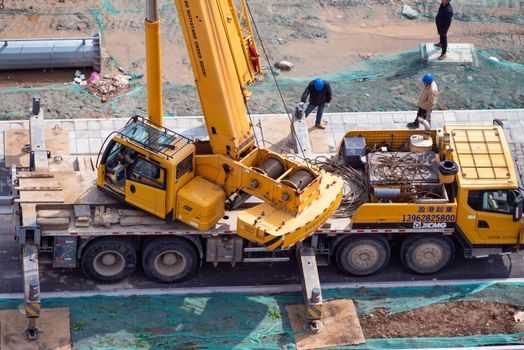
For excavator-class duty the same supplier set appears in the crawler crane sizing and truck-mounted crane spec conversations, because the slewing ring is the shared rotary joint on the upper-structure across both machine types. Sizing the upstream conveyor feeding the crane — payload, pitch, path — follows the same manufacturer-overlap logic discussed in overhead conveyor sizing, and adjacent heavy-mobility components such as spherical plain bearings often share the same forging and heat-treat suppliers.
Selection Checklist Before Releasing the PO
Run this 7-line gate before issuing a PO: (1) rolling element type matches dominant load vector; (2) gear option matches drive packaging and contamination exposure; (3) pitch diameter clears bolt-circle and pinion clearance; (4) static axial and moment ratings exceed worst-case load case with ≥1.25 safety factor for mobile equipment, ≥1.5 for personnel-carrying platforms; (5) raceway hardness and material match environment; (6) seal and grease match temperature and contamination; (7) mounting flatness ≤0.05 mm per 300 mm, and bolt pre-load follows the supplier's torque pattern [S4][S5][S6].
Mounting flatness is the silent killer: a slewing ring is a preloaded joint, and any twist in the mounting surfaces will preload one sector and unload another, shaving years off raceway life. Final checks — tooth backlash measurement on geared units, bolt torque audit, and a no-load rotation torque check before connecting hydraulics — belong in the commissioning sheet, not the PO [S1][S3][S6].
Limits, Misapplications and Failure Modes

Slewing rings are NOT a drop-in for high-rpm continuous-rotation duty: typical limiting speed is 10–30 rpm for ball types and 5–15 rpm for crossed-roller types, with thermal management and grease life both degrading sharply above these bands [S3][S6]. Pushing a slewing ring into high-rpm mixer or index-table service will burn the seals and brinell the raceways within weeks.
Other common misapplications: using a gearless ring where a pinion must engage (no teeth), using an external-toothed ring in a personnel-access zone (exposed teeth become a snagging hazard), and undersizing moment capacity because the payload number "looks safe" on paper. The slewing ring bearing category is structurally a slewing bearing by definition, but a retaining-ring stack or O-ring seal around the bolt circle is sometimes the only thing keeping grease in and water out — order them as a kit, not as separate line items [S4][S5].
Track these signals over the next two quarters: (a) any new catalogue releases from SKF, Schaeffler, Kaydon or Rotis in the 600–1,200 mm OD double-row band, where the bulk of crane and excavator demand sits [S2]; (b) lead-time movement on the 50Mn flange-slewing family, which is the most price-sensitive segment and the first to slip when forging capacity tightens [S5]; (c) cross-listed 42CrMo forged variants entering the European aftermarket, which historically signal upstream capacity shifts in the Chinese forging base [S6].