
The global machine tool market is sized at $123.7B in 2026 and forecast to reach $183.5B by 2033 at a 5.8% CAGR, with Asia Pacific holding 56.2% of 2025 revenue [S1].
That headline number hides the real competitive question: who supplies high-end CNC, and who is still catching up on the basic CNC penetration rate that separates a developed tooling economy from an emerging one [S1][S2].
Market sizing: $123.7B in 2026, $183.5B by 2033 at 5.8% CAGR
The machine tool market grew from $117.2B in 2025 to an estimated $123.7B in 2026, and is forecast to reach $183.5B by 2033 at a 5.8% CAGR over the 2026 to 2033 window [S1]. Asia Pacific alone held 56.2% of global revenue in 2025, confirming that the manufacturing capacity added in China, Japan, South Korea, and India is the single largest demand sink for lathes, machining centres, and grinding equipment [S1]. Demand-side drivers cited in the same estimate include high-precision manufacturing and downstream industrial cycles in automotive, aerospace, and electronics [S1].
For buyers, the implication is that lead times for five-axis machining centres and high-rigidity turning centres will not loosen through 2026, because the regional demand mix is structurally tilted toward capacity expansion rather than replacement [S1]. Sourcing teams comparing new CNC and used CNC should expect 16 to 24 week delivery on premium Japanese and German lines, while general-purpose Chinese lathes remain available in 4 to 6 week windows from stock.
CNC penetration: the 30% vs 90% gap that defines the race
China's CNC machine tool share sat near 30% as of 2015, while Japan exceeded 90% and Germany and the United States both sat above 70% [S2]. That penetration gap is the single most concrete competitive metric available across the major manufacturing economies, because it directly maps to the per-machine value-add, controller software stack, and servo/linear-motor content inside each shipment [S2].
For sourcing, a plant engineer comparing a Chinese-built VMC against a Japanese-built horizontal machining centre should expect differences in axis count, thermal stability, spindle taper (BT40 vs HSK-A63), and controller openness, and those deltas track the CNC penetration metric more reliably than any marketing brochure. Coverage of the broader machine tool demand 2026-2030 picture, including CNC lead times, India surge, and tariff drag, is consistent with this penetration framing. A VFD suppliers 2026 sourcing map is the natural companion reference, since spindle drives are the largest single electrical subsystem inside any CNC.
Competitive archetypes: Japanese, German, Chinese, Indian
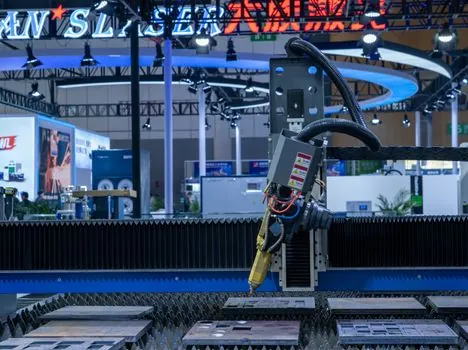
Four regional archetypes now contest the global machine tool market: Japan and Germany anchor the high-precision, five-axis, aerospace-grade tier; the United States holds a strong position in software-defined machine tools, additive-subtractive hybrids, and software stack integration; China dominates general-purpose lathes, machining centres, and lower-axis CNC by volume; India is the fastest-growing emerging base, with imports and domestic assembly both rising on the back of automotive and capital-goods capex [S1][S2].
A spec-first comparison lines them up against four decision criteria a process engineer actually weights:
1) Five-axis simultaneous accuracy: Japanese and German builders lead (positioning repeatability typically in the 3 to 5 micrometre band on premium HMC platforms); Chinese builders are closing the gap on entry-level five-axis but with looser thermal compensation.
2) Controller openness and OPC UA / MT-Connect support: this is the area where the machine tool Industry 4.0 story plays out, with digital-twin NC and OPC UA adoption still skewed toward SME laggards.
3) Spindle and axis servo content: high-end machines carry direct-drive torque motors on rotary axes and built-in spindle motors rated 15 to 37 kW; entry-level machines still use belt-driven spindles in the 7 to 11 kW range.
4) Lead time and after-sales coverage: European and Japanese brands command 16 to 24 week lead times on configured lines, while Chinese OEMs routinely ship standard VMC configurations in 4 to 6 weeks.
IMTS 2026: the September 14-19 Chicago cycle and what to watch
IMTS 2026 runs 14 to 19 September 2026 at McCormick Place, Chicago, and is positioned as one of the four largest machine tool shows globally, with a floor area above 100,000 square metres and a biennial cycle [S3]. The most recent prior edition logged 2,407 exhibitors from 107 countries and 115,612 visitors, a useful baseline for the 2026 cycle [S3].
Two themes flagged in the pre-show editorial build-up are worth tracking: industrial AI applied to toolmaking, and tooling for previously unmachinable geometry (thin-wall, deep-cavity, chuckless workholding) [S3]. Buyers planning a 2027 capex cycle should treat IMTS 2026 as the data point for price-list resets, since major Japanese and German builders typically release their next-year configuration sheets at the show.
Standards and technical anchors that govern the spec

Three standards families govern machine tool specification across the competitive field: ISO 230 series for geometric and positioning accuracy tests, ISO 10791 for machining centres specifically, and ISO 8688 for tool life testing. CE conformity under the EU Machinery Directive 2006/42/EC is the gating requirement for any machine sold into Europe, and the US equivalent is the ANSI B11 series for safety. Buyers who skip the ISO 230 test report routinely discover thermal-drift issues once the machine is installed outside the OEM's climate-controlled demo cell. The power tool encyclopaedia entry is a useful reference when comparing hand-held machine-adjacent tooling to fixed-base machine tools on duty cycle, while pneumatic tool entries cover the air-driven spindle and clamping subsystems that many machine tools still depend on for fixture actuation. [S2]
Limitations and failure modes buyers should price in
Three failure modes repeat across the competitive set and are worth pricing into a 2026 procurement decision. First, thermal drift on machines without chiller-cooled ballscrews and linear scales typically adds 5 to 15 micrometres of position error over a warm 8 hour shift, which kills tight-tolerance aerospace work. Second, controller obsolescence: a CNC running a controller the OEM has declared end-of-life becomes a 30 to 90 day repair lead time risk, and 5 to 7 year parts-availability windows are now standard. Third, supply-chain concentration on spindle bearings, Heidenhain scales, and Fanuc servo packs means that a single dual-source decision (Fanuc vs Siemens vs Mitsubishi) cascades into a 12 to 26 week logistics tail [S1].
Servo sizing is a related failure mode: a servo drive sizing and selection field guide should be cross-checked against the machine builder's stated axis torque, peak current, and regeneration resistor sizing, because builders at the low-cost end sometimes derate continuous torque to 60 to 70% of nameplate.
What to watch through the 2026 to 2027 cycle

Three trackable signals will define the competitive landscape through end-2026 and into 2027: IMTS 2026 floor density versus the 2,407-exhibitor 2024 baseline, the next round of Chinese CNC export volume data from customs (which will reveal whether China's CNC penetration is closing the 30% to 70%+ gap faster than the long-run trend), and the cadence of new five-axis product launches from Japanese and German builders at the show [S1][S2][S3]. A related trackable: how aggressively builders roll OPC UA, MT-Connect, and digital-twin NC into standard configurations rather than option-list add-ons, since that determines how fast the SME Industry 4.0 gap closes.
For the relevant spec sheets and selection criteria, see concrete tool.