
Machine tool manufacturing equipment in 2026 is dominated by 5-axis CNC gantry machining centers, vertical machining centers, CNC cylindrical grinders, multi-axis lathes, and press brakes, with 80% market share reported for the leading Chinese aerospace CNC supplier group in its home segment [S1].
For a process engineer specifying new capacity, the decision starts with workpiece envelope, axis count, repeatability, controller openness, and whether the line will run lights-out, not with brand. This guide walks through the machine classes, the cross-vendor selection criteria, and the practical limits that show up at the spindle, slide, and chuck, drawing on reference chapters on machine tools and manufacturing equipment (2025-08) [S2] and the 2026 trade press [S3].
Machine Tool Classes and What Each One Is For
Machine tools fall into seven functional families: turning centers, milling centers, grinding machines, forming machines (presses, press brakes, shears), saws, EDM machines, and additive/hybrid systems [S2] (2025-08). Each family maps to a workpiece feature: lathes generate axisymmetric surfaces, mills generate prismatic and 3D-contour surfaces, grinders hit the sub-10 µm Ra range that milling cannot, and presses form sheet and plate without removing chips.
On a 2026 used-equipment reseller's floor, the inventory mix is a useful proxy for installed base: 22 lathes, 12 drills, 11 saws, 9 presses, 5 mills, 5 benders, and 3 grinders across one regional dealer's listing [S4]. That mix shows where small and mid-size shops actually spend capex. For new aerospace structural parts, the dominant platform is a beam-moving gantry machining center with 5-axis simultaneous heads, a class exemplified by the moving-crossbeam and high-speed gantry mills in the 2026 aerospace CNC catalog [S1].
Core Selection Criteria Every Spec Should Carry
A defensible machine tool spec carries at least nine numeric fields: workpiece envelope (X/Y/Z travel in mm), spindle speed range (rpm), spindle power (kW continuous, not just peak), maximum spindle torque (Nm), rapid traverse rate (m/min), feed thrust at the ball screw (kN), positioning accuracy (mm, full stroke), repeatability (mm, per ISO 230/2 or VDI 3441), and controller I/O count including fieldbus nodes [S2] (2025-08). If a quote omits the difference between positioning accuracy and repeatability, walk away, because vendors quote the better number and it is almost never the one you need.
Second-tier criteria separate a good fit from a forced fit: axis count (3+2 vs full 5-axis simultaneous), table load capacity (kg), tool magazine capacity and chip-to-chip time (s), coolant pressure and flow (bar, L/min), chip evacuation, and enclosure IP rating for foundry or aerospace composite dust. The 2026 Mazak VC-Ez 20 vertical machining center showcase at IMTS 2026 (booth 338300) is positioned as a value-tier VMC for parts that exceed commodity-machine capability, a useful reference point for the lower bound of what a credible VMC spec looks like [S3].
Comparing the Main Platform Options
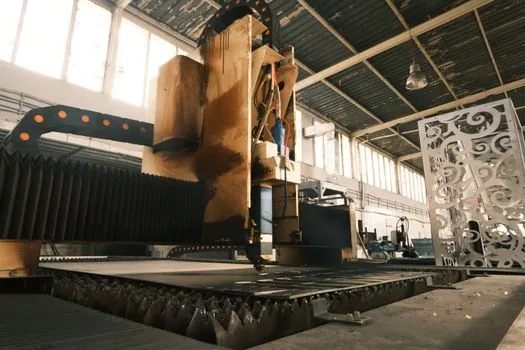
For a 1.5 m workpiece, three platforms dominate the shortlist: a 5-axis gantry machining center, a horizontal machining center (HMC) with pallet changer, and a CNC cylindrical grinder. The gantry mill wins on envelope and single-setup 5-sided access, with beam-moving designs giving the rigidity needed for titanium and Inconel aerostructures [S1]. The HMC wins on chip-to-chip time, lights-out automation via pallet FIFO, and thermal stability because the spindle sits inside the column rather than overhanging a moving table. The cylindrical grinder, exemplified by the FERMAT BUBR 50/3000 deployed at Blanik Aircraft in 2026, wins on surface finish and dimensional control of round features, with swing diameter and distance-between-centers defining the workpiece envelope [S3].
For springs, wire forms, and small precision parts, a different comparison applies: a CNC spring coiler (WAFIOS Performance Machine SCM 08, 2026) is rated for economical runs and integrates with downstream machines, beating a mill or lathe on cost-per-part at high volume [S3]. For sheet metal, a press brake rated in tonnage and stroke length beats any chip-cutting machine, and the tonnage curve must match the bend length, material yield, and die opening. The general rule: match the machine's native geometry to the part's native geometry. Forcing a horizontal mill to do gantry-mill work, or a VMC to grind, is how 30% scrap rates start.
Use Cases by Industry and What the 2026 Market Signals Show
Aerospace structural parts drive demand for 5-axis gantry mills and high-speed gantry mills with moving crossbeams, where stiffness and thermal stability beat raw rpm [S1]. Photovoltaic and wind-power component machining uses similar gantry platforms but at lower spindle speeds and higher feeds, since aluminum alloys and FRP composites dominate the workpiece mix [S1]. New-energy-vehicle battery trays, motor housings, and structural parts are a 2026 growth pocket, with gantry mills and large VMCs taking share from dedicated transfer lines because batch sizes are smaller and model years are shorter.
Defense and large-engine machining is another 2026 signal: Fives signed a fourth V-STAR machine in FMS configuration with KNDS for the Roanne site, entering service in 2027, illustrating how a Flexible Manufacturing System scales a single process across multiple part numbers with shared tooling and automation [S3]. Desktop CNC, led by the LUNYEE 3020 Nova router launched in 2026, has crossed into a credible prototyping and low-volume production tier, with a 3020 mm envelope and a user base that a decade ago would have bought a manual mill [S3]. The cross-industry pattern: envelope and rigidity of the moving structure, not spindle speed, are the binding constraints.
Linear and Roller Guide Considerations Inside the Machine

Every CNC machine tool is a packaged assembly of structural components, and the linear guide system is one of the most spec-sensitive. A moving-crossbeam gantry mill needs a crossed-roller guide or a heavy-duty linear guide on the beam axis to control deflection under cutting load, since the beam acts as a cantilever and its stiffness, not the spindle, sets the surface finish. For a VMC, the choice between a linear guide and a box way on each axis trades speed for dampening, with linear guides winning on rapid traverse and box ways winning on chatter suppression in heavy roughing. [S1]
For buyers retrofitting older equipment or evaluating a new machine's bill of materials, the linear guide and crossed-roller guide specifications, including rated dynamic load (C), static load (C0), and preload class, are the underlying numbers that determine positioning accuracy and service life. A 2026 retrofit playbook for CNC Industry 4.0 adoption, covering sensor retrofits, controller upgrades, and OPC UA connectivity, is a natural complement for plants that already own the iron but need to add data, as detailed in the CNC machine Industry 4.0 adoption spec-level retrofit playbook for 2026.
Limitations, Failure Modes, and Sourcing Standards
The dominant failure modes on a CNC machine tool are thermal growth of the spindle, backlash in the ball screws, loss of preload in the linear guides, and encoder drift, in roughly that order of frequency on installed fleets [S2] (2025-08). Specifying a chilled-spindle option, a thermally stable column design, and absolute encoders with battery backup addresses the first three; the fourth is a maintenance and metrology issue, not a specification issue.
For sourcing, the standards that bind a machine tool spec are ISO 230/2 for positioning accuracy and repeatability, VDI 3441 as an alternative test code, ISO 10791 for machine tool vibration evaluation, and the relevant CE machinery directive plus, where applicable, the lighting equipment and electric lamps standards that govern the work-area and enclosure lighting. For process engineers also evaluating NDT equipment on the same shop floor, the metrology-grade granite, encoder resolution, and temperature-controlled environment overlap with machine tool requirements, so a shared spec baseline reduces capex on calibration equipment.
Who This Guide Is For, and Who It Is Not For

This guide is for process engineers, manufacturing engineers, and procurement staff at OEMs and Tier-1 suppliers who need to translate a workpiece drawing into a defensible machine tool RFQ in 2026. It is for plant managers running lights-out lines, defense shops scaling FMS capacity, and Tier-2 automotive suppliers moving into NEV battery and motor housings. It is also a useful starting point for a controls engineer or motion controller specifier evaluating where the machine stops and the line begins, since the same motion controller suppliers 2026 lineup specs and selection criteria covered in the related article also govern the machine's servo loop and fieldbus. [S1]
It is not for hobbyists buying a 3018-class desktop CNC, not for buyers in segments dominated by additive manufacturing where a additive manufacturing material selection guide is the right entry point, and not for facilities whose bottleneck is material handling rather than spindle time, where the right next step is a gantry crane selection for urban infrastructure projects analysis. Within those boundaries, the 2026 market signals point to a stable supplier base, rising 5-axis adoption in aerospace and defense, and a clear value tier at the VMC level for general machining [S3].
The trackable signals to watch in the next 6 to 12 months are: IMTS 2026 announcements from Mazak and competitors on the value-tier VMC class, Fives' commissioning of the fourth V-STAR at KNDS Roanne targeted for 2027, and any second-tier Chinese aerospace CNC suppliers entering the export market beyond their domestic 80% share, which would shift Western buyer shortlists materially [S1][S3].