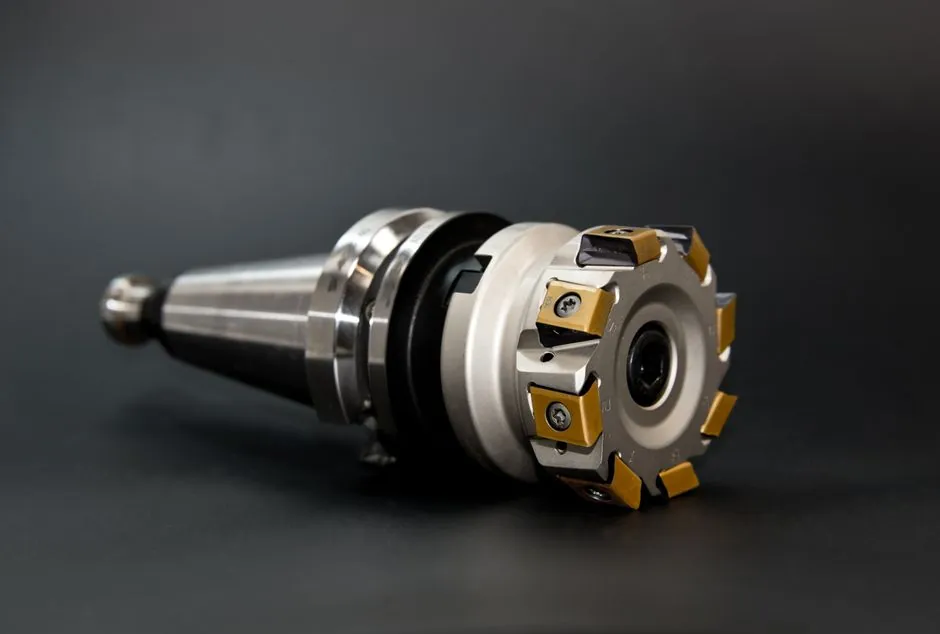
A CNC machine production line is an engineered arrangement of CNC mills or lathes, automated loading devices, work-in-progress handling, and supervisory software, sized against a target cycle time [S1]. Production-line layouts in 2026 typically pair three to twelve machining centres with a robotic tending cell, and envelope the work in a workpiece length of 20–100 mm and a workpiece diameter of 4–32 mm on small-batch lathe lines [S3].
Design drivers in mid-2026 have shifted from isolated machine spec sheets to throughput math, with takt-balanced cell sizing and 5-axis capable VMCs becoming baseline on tier-one automotive and aerospace contracts [S5]. Virtual-prototype modelling, introduced over a decade ago for CNC line design, is still the planning tool of choice for sequencing machines and robots before floor-pour [S1].
Core building blocks: machines, robots, and material flow
A modern CNC line is built from four blocks: the machine tool, the parts-handling system, the work-holding or pallet pool, and the supervisory control layer [S1]. Vertical machining centres on the 2026 market span a Y-axis travel of 500–700 mm in the mid-range, while small VMC frames sit below 450 mm and large gantry frames exceed 1,500 mm of Y travel [S4]. Lathes split into horizontal, slant-bed, and vertical (turning/milling) beds, with swing diameters from 260 mm on a CK-class lathe up to 700 mm and above on heavy large-late lines [S4].
Robotic machine tending and automatic loading/unloading are now standard rather than optional on production lines, with manipulator-tended cells handling 4–32 mm diameter shaft-type workpieces without operator intervention [S3]. Pallet-pool flow and inline conveyors link the cells, and a typical automotive cell uses 6-axis articulated robots rated 10–20 kg payload to swap pallets in under 10 seconds. For spec-first engineers moving from prototype to production, this is where the CNC machine process control: 2026 spec map for engineers reference fits, because the controller, the robot and the safety perimeter must be speced as one package.
Selection criteria: takt, mix, and tolerance
Three numbers drive the entire line layout: takt time, part mix (high vs low variety), and the tightest geometric tolerance on any part in the family [S5]. High-mix prototype shops with tolerance bands of ±0.025 mm favour 3-axis VMCs in the 500–700 mm Y-travel class; high-volume tier-one production with tight ±0.01 mm runs trend to 5-axis ME850-class centres with travels of 850×500×550 mm [S4]. The GQ-series gantry machine is specced with rigidity claimed at 50% higher than C-frame VMCs and machining efficiency 35% higher, per the OEM [S4].
Engineers running the throughput math on 2026 spec sheets can use the CNC capacity planning: spindle hours, axis count, and 2026 throughput math reference to cross-check the takt-vs-axis-count trade-off. Footprint usually runs 15–25 m² per machine cell including robot reach and chip-pan access.
Comparison: line type vs production profile
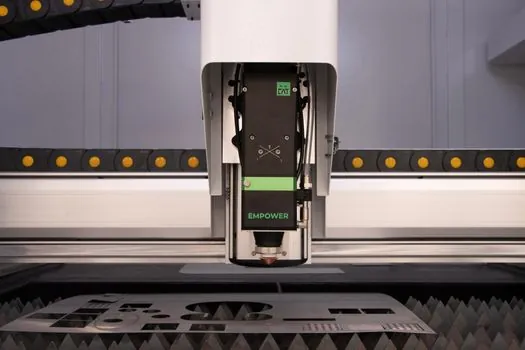
Four canonical line types cover the 2026 market, and the right one is set by part mix and annual volume rather than by machine brand. A transfer line wins on single-part volumes above 50,000 units/year with sub-30-second takt, but loses to a flexible cell once part variety exceeds ten variants. A robotic-tended FMS cell handles 200–5,000 units per part number with five to twenty variants and a 60–180 second takt, which is the dominant 2026 mid-volume configuration [S3].
Manual batch production still fits prototype and low-volume runs under 200 units/year, with lead times measured in days rather than hours [S5]. For 5-axis prismatic parts, a gantry-type VMC with 1,000×600×500 mm travel (GQ600) replaces two or three 3-axis machines, cutting floor space roughly in half [S4]. Conveyor and sorting automation that ties cells together falls under the automatic molding line and conveyor sorting line categories, and the same WIP-handling logic applies when the CNC cells feed a downstream assembly or heat-treatment aisle.
Standards, control, and integration
Line-level integration leans on MTConnect for machine data, OPC UA for cell-level control, and ISO 23247 for digital-twin frameworks in discrete manufacturing [S5]. Fanuc and Siemens controllers remain the two dominant CNC kernels on 2026 VMCs, with optional linear-guide and high-speed spindles offered as a configuration choice rather than a base spec [S4]. On the cell side, robotic-tending controllers are typically PLC-based (IEC 61131-3) and tie into the line SCADA via Ethernet/IP or PROFINET.
For the safety perimeter around robotic cells, ISO 10218 (industrial robots) and ISO/TS 15066 (collaborative robots) apply, with light curtains or safety scanners rated to PL d or PL e. A line that needs inline non-destructive testing or hardness checks after heat-treat falls outside the line frequency furnace envelope and should be speced to a separate in-line NDT module.
Limitations and failure modes
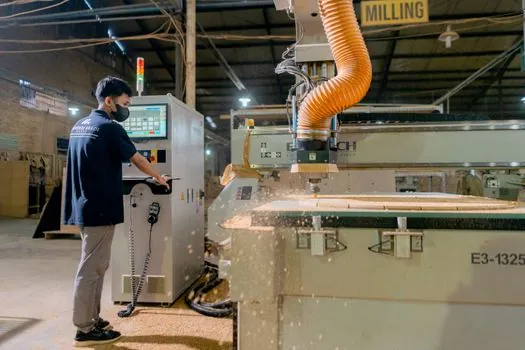
The dominant failure mode on a robotic CNC line is not the machine tool, it is the work-holding and the upstream material presentation; mis-stocked pallets and inconsistent blank dimensions are the leading cause of unplanned stoppages [S3]. Chip evacuation is the second failure mode: deep-pocket 5-axis work on ME850-class centres generates chips faster than a single auger can clear, and a line speced without a high-pressure coolant through-spindle (≥70 bar) will stop every 4–6 hours on chip wrap. Thermal stability is the third, with spindle warm-up cycles of 15–30 minutes needed before tolerance-tight parts can run, and a chilled coolant supply at 18–22 °C is standard on tier-one lines.
Floor-vibration and utility stability are commonly under-specced at design stage: a gantry VMC with 1,000×600×500 mm travel needs a foundation raft of at least 200 mm reinforced concrete, and compressed air at 6–8 bar with dewpoint below -20 °C for the pneumatic pallet clamps [S4]. Plants running resin sand line or molding line cast blanks nearby should isolate the CNC cells by at least 15 m to keep cast-dust off linear guides and glass scales.
Vendor and integrator landscape (2026)
Haishu Machinery has been a dedicated CNC machine manufacturer and exporter since 2001, running more than 60 CNC machine specialists out of a 12,000 m² facility, which is the size class typical of a tier-two Chinese OEM serving mid-volume lines [S6]. DATAN CNC ships a TX-series milling machine that has been on the market for more than 15 years, alongside newer NX and ME lines targeting the small-VMC and 5-axis niches [S4]. Roberson Machine Company in the US Midwest is a representative job-shop integrator running multi-axis milling, turning, wire EDM, and value-added services since 2002, useful as a reference for the prototype-to-production ramp [S5].
BLKMA in the duct-making segment ships a different kind of CNC line, the auto duct production line 2 through 5 family, paired with CNC plasma cutting and CNC angle steel lines, and the same line-balancing logic applies when the workpiece envelope is sheet metal rather than billet [S2]. For a spec-driven line in 2026, the practical play is to fix takt and tolerance first, then choose the machine envelope and robot payload to match, not the other way around. Two trackable signals for the next 12 months: wider 5-axis VMC adoption below the 850 mm travel class, and a move from PLC-tended cells to OPC UA-tended cells as the IEC 63278 digital-twin standard matures.