
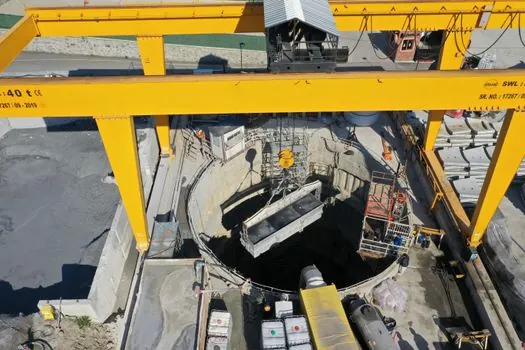
Urban-infrastructure gantry cranes span 5-630 t, with single-girder builds serving precast yards and double-girder units covering bridge-beam and metro-tunnel erection [S2].
Selection pivots on six levers: lift capacity, span, travel mode (rail-mounted vs wheel/rubber-tyre), girder count, duty classification per FEM/ISO 4301, and indoor/outdoor environmental rating [S1][S2][S5].
Urban jobsite constraints that drive the spec
City sites typically cap gantry crane span at 40 m on rail-mounted overhead gantries, with custom spans quoted beyond that, and impose noise, wind, and night-shift limits that push the duty class lower than the rated capacity would suggest [S2].
Road-rail and metro stations rarely have runway beams, so the gantry's own legs carry the load; the engineering trade is whether to spec a single-girder unit (cheaper, lighter, limited to lighter hook duties) or a double-girder build (heavier hook paths, higher SWL, better for tandem lifts of bridge segments) [S2].
Single-girder vs double-girder gantry: decision criteria
For a metro precast yard, single-girder gantry cranes with electric wire-rope hoists dominate the 1-20 t range; double-girder units take over from 20 t upward, where higher hoist lift heights and heavier hook blocks are required [S2][S5].
For a bridge-beam erection over an active road, the working point is the lift height plus the need for two-hook (main + auxiliary) operation, which only double-girder gantries can host without derating [S2]. Compared on four criteria, single-girder gantries win on headroom and cost per ton lifted, double-girder wins on hook path, service duty, and wind rating, and rail-mounted units beat rubber-tyre for cycle intensity while rubber-tyre wins on site mobility [S2].
Duty class, FEM 1.001, and ISO 4301 mapping

Duty classification drives the structural sizing: FEM 1.001 and ISO 4301 group mechanisms by load spectrum and operating hours per day, and most export-grade gantries (including 5-630 t units exported from Turkey) are rated to FEM 1.001 / DIN 15018 expectations [S2].
For a typical urban-infrastructure gantry running two shifts with frequent cross-travel, FEM group 1Cm or 2m is the realistic floor; under-sizing it is the single most common way urban projects end up with cracked girders within five years [S2].
Travel mode: rail vs rubber-tyre vs trackless
Rail-mounted gantries are the default for long-term yards (rail depots, container terminals, precast casting beds) because the rail handles the wheel loads and keeps the structure stiff under repeated cross-travel [S2].
For short-duration urban sites (viaduct rebuilds, station box erection) rubber-tyre gantries or trackless battery transfer carts trade rail infrastructure for mobility, and Australian gantry specialists actively supply both single- and double-girder rubber-tyre builds for sites without embedded rails [S3]. For mega-span and heavy-tandem lifts above 100 t, expect to fall back to a gantry crane on temporary rail, not a mobile unit, because the rail returns predictable wheel-load data to the structural engineer.
Hoist, brake, and electrical subsystems that fail first
On urban-infrastructure gantries, the most failure-prone assembly is the hoist brake: a wire-rope hoist that drifts after the stop command usually points to worn brake linings, incorrect air gap, or a VFD brake-release timing mismatch [S6].
Specify a VFD with programmable brake-delay, an electromagnetic shoe brake with wear-indicator, and a second-of-two contactors in the safety circuit; the OEM selection of electric chain hoist (0.25-50 t) vs wire-rope hoist depends almost entirely on cycle frequency and headroom [S2][S6].
Standards and certifications to require on the data sheet
For European-funded urban projects, require the gantry to be designed to EN 13001 (safety of cranes) with FEM 1.001 mechanism classification and CE marking under the Machinery Directive; for North-American-funded work, the same crane should also be checked against ANSI/ASME B30 [S2].
For Australian and Asia-Pacific urban work, look for ISO 4301 duty classification and an AS 1418 series reference on the general arrangement drawing, and confirm the wire-rope sheaves and drum comply with the OEM-specified rope grade (typically 6x36 WS or 8x36 WS for general-purpose builds) [S2][S3]. For owners comparing a gantry to an overhead bridge option, the overhead crane vs gantry crane trade is essentially: overhead needs building steel, gantry needs ground preparation; on greenfield urban sites without a steel superstructure, the gantry wins on total installed cost.
When a gantry is the wrong tool

A gantry is the wrong tool when the lift point moves between non-collinear sites faster than the gantry can be dismantled and re-erected; in those cases, a mobile crane or crawler crane is the correct machine, and forcing a gantry into the scope inflates the project schedule by weeks of civils work [S2].
A gantry is also the wrong tool for very tall hook lifts (above ~30 m) where a tower crane returns better hook-path economics, and for warehouse racking where a stacker crane on aisle rails gives higher storage density than any ground-level gantry.
Trackable signals for the next planning cycle: a) FEM 2m / ISO M5 minimum on any urban-infrastructure gantry rated above 50 t with two-shift operation, b) rubber-tyre gantries with hydraulic outriggers expanding in metro-station rebuilds, c) integrated load-moment indicators tied to SCADA on every export-grade unit shipping to EU-funded urban projects [S2][S3]. For a deeper dive on span and mobility tradeoffs in similar jobsites, see gantry crane selection for pipeline construction, and for raw-material-side specs feeding the same fabrication supply chain, the tapered roller bearing selection for cement plants reference covers the slew-bearing duty classes that show up on heavy-duty gantry end-carriages.