
Industrial buyers frequently conflate the two, but a manometer is a complete instrument with a readout, and a pressure sensor is the bare transducer that needs downstream electronics to become useful [S1][S4].
The distinction matters for signal type, integration cost, and accuracy budget. Handheld digital manometers from RS list LCD readouts with backlights and onboard microprocessors for spot readings, while a piezo-resistive pressure sensor such as the AS23F ships in a 2.5×2.0×1 mm package with a 24-bit ADC for embedded designs [S1][S4].
What Each Device Actually Is
A manometer, also labelled a pressure meter, is a self-contained gauge with housing, signal conditioning, and a display, designed for direct human reading of air, gas, or fluid pressure [S1]. RS categorises battery-powered handheld units with LCD readouts and backlights as portable manometers, with internal hi-tech sensors and microprocessors doing the conversion [S1].
A pressure sensor is the sensing element itself, normally a piezo-resistive, ceramic, or MEMS die that produces a millivolt, voltage, or digital output proportional to applied pressure [S4][S6]. The Chinese-English dictionary entry defines a pressure sensor (压力传感器) as a sensitive component that transduces pressure into an electrical signal, not a complete instrument [S6]. ManyYear Technology in China builds both categories, with annual sensor output exceeding 1,000,000 units from its in-house industrial park [S2].
The practical split: a manometer gives you a number on a screen, a pressure sensor gives you a signal on a wire. For a deeper look at the instrument side, see the manometer reference page.
Sensing Principle and Output Signal
Manometers used as portable digital units internally rely on a differential pressure sensor front-end, then digitise the result through an onboard microprocessor for the LCD [S1]. This is why a digital manometer can claim percent-of-reading accuracy in the field without any external wiring.
Standalone pressure sensors use piezo-resistive bridges on a silicon diaphragm as a common principle, and package them with a 24-bit ADC for high-resolution digital output, as in the AIoTSensing AS23F barometric unit sized at 2.5×2.0×1 mm [S4]. For downhole oilfield service, ChampionX markets quartz resonant pressure sensors that exploit the frequency-shift of a quartz crystal under stress for long-term stability [S3].
Output types diverge sharply. A manometer shows engineering units on its display, with optional data hold or USB download in premium units. A pressure sensor outputs a raw analogue mV/V ratiometric signal, a 0-5 V or 4-20 mA amplified signal, or a digital I²C/SPI stream that the host system must interpret. This is why the pressure measurement workflow diverges at the wiring cabinet.
Accuracy, Range, and Resolution

Manometer accuracy on RS handheld units is typically quoted as a percent of full scale or percent of reading, with common ranges from a few mbar (draft measurement) up to several bar (line pressure). Battery-powered portable gauges prioritise repeatability for HVAC balancing over laboratory-grade linearity. [S1]
Pressure sensor resolution is set by the ADC and the inherent noise floor. The AS23F specifies a 24-bit ADC for high pressure resolution, paired with claimed long-term stability and EMC robustness from the piezo-resistive die [S4]. Quartz resonant sensors, by contrast, derive their resolution from frequency counting, which is intrinsically high and drift-stable over temperature [S3].
For comparison on a decision axis: a digital manometer buys you display integration and field portability at moderate accuracy; a bare piezo-resistive sensor buys you small size and high resolution at the cost of needing a host board; a quartz resonant sensor buys you long-term stability and high accuracy at higher unit cost. The pressure gauge family sits between the manometer and the sensor, often using a Bourdon or diaphragm element with a mechanical pointer.
Integration Effort and System Cost
A manometer is effectively a turnkey purchase: power on, connect to the test point, read the value. Cabling, signal conditioning, and display are all inside the box, which is why RS lists them as ready-to-use handheld instruments [S1].
A pressure sensor is a component that needs a regulated supply, an amplifier or ADC stage, a microcontroller or PLC input, and firmware to convert counts to engineering units. That integration cost is justified only when the sensor is part of a larger system, a data logger, a pressure transmitter loop, or an embedded altitude estimator on a quadcopter, as the AS23F is explicitly designed for [S4].
For a hands-on field selection walkthrough that complements this comparison, the manometer selection criteria spec map breaks down process and utility use cases. For broader instrument selection at the line-pressure level, the vacuum gauge vs manometer range and principle guide covers the negative-pressure half of the same family.
China HS Code Classification and Sourcing Reality
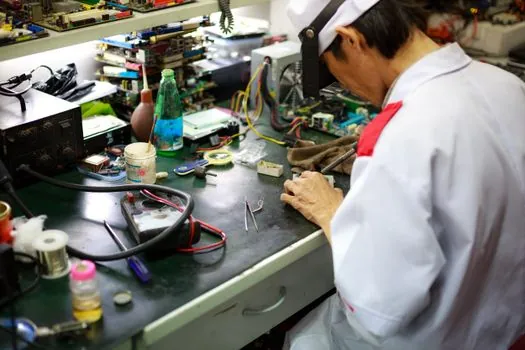
Customs HS codes for manometer-style products fall under 9026.20.90.90 (other instruments for measuring or checking pressure), with a 17% general tariff, 13% VAT, 0% MFN where applicable, and 20% additional tariff on U.S. imports [S5]. A unit such as a complete pressure-sensor manometer is declared in pieces per kilogram, with declaration norms covering brand, model, function, and tested object [S5].
Sensors and accessories split into other categories: 9031.80.90.90 covers other measuring and testing equipment not specified in chapter 90, while 9026.90.00.90 covers parts and accessories of pressure-measuring instruments, both at 17% general rate, 0% MFN, 13% VAT, and 20% U.S. additional tariff [S5]. These three lines are the realistic customs paths when importing a finished manometer versus a bare sensor plus accessories.
For sourcing, ManyYear Technology in China advertises more than 1,000,000 sensors and system solutions per year with its own industrial park, covering weight, pressure, and temperature measurement [S2]. Buyers comparing manometer imports should also budget for CCC certificate requirements where the goods fall under mandatory China Compulsory Certification lists, viewable per HS code on the customs database [S5].
Who Each Device Is For, and Who It Is Not
Pick a manometer when the job is a one-off or periodic spot check: HVAC airflow balancing, gas-line leak testing, laboratory differential measurement, field calibration of a pressure gauge, or technician troubleshooting. The all-in-one form factor with display, backlight, and battery removes any integration overhead [S1].
Pick a pressure sensor when the job is continuous monitoring, closed-loop control, or embedded sensing: a PLC reading line pressure, a quadcopter altitude hold using barometric data, a downhole pressure gauge in an oil well, or a data logger recording process trends [S3][S4]. The sensor becomes useful only once wired into a host.
Do not pick a manometer for high-channel-count SCADA: the per-point cost and lack of native 4-20 mA or HART output in handheld units make it uneconomic. Do not pick a bare pressure sensor for a quick field audit: without a display, a host board, and firmware, the signal is unreadable. For loop-powered 4-20 mA or HART applications, a pressure transmitter sits between the sensor and the manometer in functionality.
Decision Criteria, Side by Side
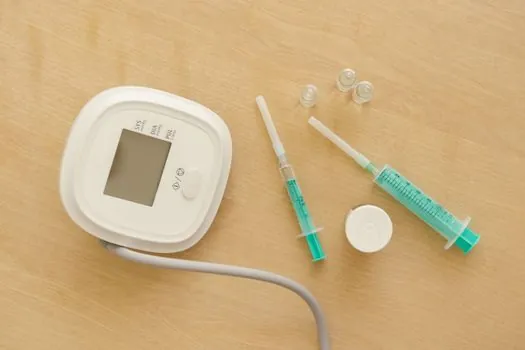
On display: manometer has an integrated LCD with backlight, sensor has none, it outputs a signal only [S1][S4]. On output type: manometer offers local indication plus optional data hold or USB, sensor offers mV/V, 0-5 V, 4-20 mA, I²C, or SPI [S1][S4]. On package size: manometer is a handheld box sized for a technician, AS23F sensor is 2.5×2.0×1 mm, quartz resonant downhole sensors are sized for the production tubing [S3][S4]. On power: manometer runs on internal batteries, sensor needs a regulated 3.3 V or 5 V supply plus ADC excitation [S1][S4]. On integration effort: manometer is zero, sensor is non-trivial, requiring host firmware, calibration coefficients, and mounting. On best-fit use: manometer for spot and field, sensor for embedded and continuous.
For a complementary view on the loop-powered side of the same family, the pressure transmitter vs pressure switch wiring and spec fit article maps the territory above the bare sensor. For barometric and altitude applications specifically, the absolute pressure transmitter vs vacuum gauge spec map covers the negative and absolute ranges this comparison only touches.
Selection Traps and Failure Modes
Common trap 1, the terminology trap: calling any digital gauge a manometer when it is actually a digital pressure gauge with a different sensing element. RS notes that digital manometers use hi-tech sensors and microprocessors, which means the manometer is a category, not a single technology [S1].
Common trap 2, the resolution trap: a 24-bit ADC on a sensor does not buy field accuracy unless the reference, the thermal compensation, and the mechanical mounting are all controlled [S4]. A handheld manometer with percent-of-reading accuracy may outperform a bare sensor with a noisy reference on a real measurement.
Common trap 3, the output trap: assuming all pressure sensors output 4-20 mA. Many sensors output mV/V ratiometric signals that need an amplifier before they can drive a long cable, and the AS23F explicitly ships digital, not current-loop [S4]. For a current-loop loop-powered device, you need a transmitter stage, not a bare sensor. Buyers should also confirm whether a pressure calibrator is required to validate the installed sensor chain, since handheld manometers are often used as the field reference.
Common trap 4, the customs trap: importing a finished manometer and a spare sensor under the same HS code, which is incorrect. The finished instrument falls under 9026.20.90.90 while a spare sensor or accessory falls under 9026.90.00.90, with different declaration norms [S5].
Final signal to track: the next China customs revision cycle for 9026.20 and 9031.80, since the current 17% general rate and 0% MFN band govern landed-cost math on every cross-border manometer shipment [S5]. Confirm CCC applicability on the specific model before PO release, as the database flags it per HS code [S5].