
A pressure transmitter converts the measured pressure into a continuous industry-standard analog signal (typically 4-20 mA, 0-10 V, or a digital HART overlay) and is the right device whenever the control system needs the actual process value, not just a go/no-go decision [S1][S5].
A pressure switch converts the same physical quantity into a discrete switch-state change once a preset setpoint is crossed, using elastic elements such as a Bourdon spring tube, diaphragm, capsule, or bellows to actuate the contact [S7][S8]. In practice, the two are not interchangeable: a transmitter costs more per point, needs a powered loop, and only earns its keep when the value, not the threshold, is what the downstream system acts on [S5].
Signal Character and What Each Device Actually Returns
A pressure transmitter returns a continuous, calibrated, linearised output that is proportional to the measured pressure across its calibrated range, with reference accuracy figures from 0.05% of full scale upward in modern industrial lines [S1]. The output is suitable for direct feed to a PLC analog input, a DCS card, a recorder, or a PID loop, and modern HART-capable units superimpose a digital signal on the same two wires for remote ranging and diagnostics [S5].
A pressure switch returns a binary state (contact open or closed, or PNP/NPN high or low) once the process pressure crosses a single user-adjustable setpoint, and the setpoint is normally expressed in bar, psi, or MPa with a small adjustable deadband to prevent chattering [S7][S8]. The output is suitable for relay coils, contactor inputs, alarm horns, and pump motor starters, but it cannot tell you whether the system is at 3.2 bar or 4.1 bar, only that it has crossed (or fallen back below) the threshold.
Power Supply, Wiring, and PLC Integration
Most industrial pressure transmitters need a loop supply of 16-30 V DC at 4-20 mA, which is incompatible with a 12 V DC logic-relay input that only accepts 0-10 V; the documented workaround in the field is to insert a 500 ohm precision resistor in the loop, converting 4-20 mA into 2-10 V for the analog input card [S2]. This is a generic engineering pattern, not a manufacturer feature, and it has the side effect of loading the loop, so the resistor tolerance (typically 0.1% or better) directly limits measurement accuracy.
Pressure switches are much simpler to wire because they are passive contacts in the common case: a mechanical switch needs no supply at all (just a dry contact into the PLC digital input or relay coil), while a solid-state or PNP/NPN electronic switch typically needs a 10-30 V DC supply and returns a sourcing or sinking output [S3]. For OEM machines on a 12 V DC rail, the electronic pressure switch is usually the lower-effort drop-in compared with a 4-20 mA transmitter plus loop resistor plus 24 V supply [S2].
Decision Criteria: When Each Device Wins

The selection reduces to four concrete criteria: whether the application needs the process value or just a threshold, what the power rail looks like, what the I/O card accepts, and what the unit cost plus wiring effort is allowed to be [S5]. A pressure transmitter wins when trend logging, PID control, or remote re-ranging is required, when the same signal must feed both display and control, or when a single device must cover two setpoints (low-low and high-high) with full visibility in between [S1][S5].
A pressure switch wins on simple pump cut-out, compressor unload, low-lube-oil alarm, fire-sprinkler pressure supervision, and HVAC high-cut safety duties, where the wiring is two conductors to a coil and the local cost of a general-purpose unit is in the US$10-70 range in 2026 China wholesale listings, versus the higher cost and effort of a transmitter with isolation, loop supply, and analog input module [S3][S6]. Verbatim from Setra's working definition: a pressure switch delivers a switched output, not a proportional one, and that single fact is what separates the two device classes on a P&ID [S5].
Specification Comparison: Transmitter vs Switch
On output type the transmitter gives continuous 4-20 mA / 0-10 V / HART, the switch gives discrete contact (SPDT, DPDT, PNP, NPN); on accuracy the transmitter is specified at 0.05-0.5% FS in the WIKA industrial line, while a switch is specified by setpoint repeatability (typically 1-2% FS) and deadband [S1]. On range the transmitter covers 0.05 bar to 15,000 bar in one catalogue, while a switch is normally ordered for a narrower process range with a fixed or adjustable setpoint inside it [S1][S3].
On supply, a 4-20 mA transmitter needs 16-30 V DC loop power and a 500 ohm resistor or analog-input module for 0-10 V PLCs, whereas a mechanical switch needs no supply and an electronic switch needs 10-30 V DC [S2][S3]. On typical unit cost in 2026 China wholesale, a generic electronic pressure switch is US$10-70 per piece, a four-digit industrial transmitter sits considerably higher, and the wiring labour for the transmitter is roughly double that of a dry-contact switch [S3]. For applications such as compressed-air line monitoring, the related pressure transmitter selection criteria for compressed air guide goes deeper on range, accuracy, and output choice for that specific service.
Common Failure Modes and Application Limits
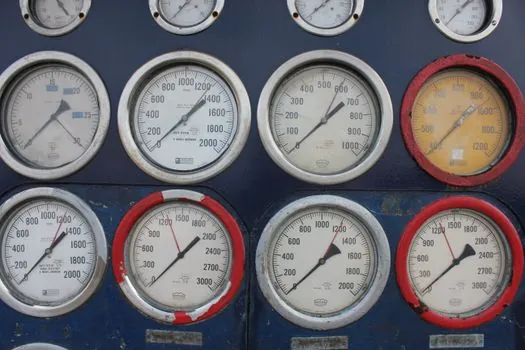
Transmitters fail mainly in three patterns: drift of the zero or span over time (requiring periodic re-calibration), over-range damage to the diaphragm when the process exceeds the rated maximum by more than the documented proof-pressure factor, and water ingress at the cable gland in outdoor service. The standard precaution is a stainless wetted parts option and IP65/IP67 housing, both of which are widely available in 2026 industrial lines [S1].
Switches fail mainly by contact welding under high inductive load (motor starters, solenoid coils), by setpoint drift from mechanical fatigue of the elastic element, and by slow response on dirty or viscous media where the sensing port can plug. Mitigations are snubbers on inductive loads, diaphragm seals for dirty media, and a low-cycle-rate application to extend mechanical life [S7][S8]. For outdoor installations where corrosion is a concern, a related outdoor tank farm manometer selection article cross-checks the same environmental requirements against mechanical gauges.
Sourcing, Standards, and What to Confirm Before Order
For industrial buys, confirm the wetted material (typically 316L stainless for general process, Hastelloy or tantalum for aggressive chemicals), the process connection (G1/4, G1/2, 1/2 NPT, or flanged), the electrical connection (M12, DIN 43650A, cable gland), the IP rating, and the output type (4-20 mA two-wire, 0-10 V three-wire, HART, IO-Link, or PNP/NPN switch) [S1][S3]. For the fire-protection branch, GB 16838-style pressure switches for automatic sprinkler systems are governed by a dedicated national product standard, and the planned 60-month revision cycle in plan 20020011-Q-312 is the formal Chinese standardisation track for that device class [S6].
For OEM high-volume sourcing in 2026, the Made-in-China catalog lists general-purpose electronic pressure switches at US$10.50-11.10 per piece with a 204-piece MOQ, and combined 4-20 mA plus two PNP digital-output units at US$65-70 per piece at one-piece MOQ, both with documented 4-20 mA two-wire loop compatibility [S3]. On the supplier side, audit for ISO 9000 and ISO 20000 management certification as a baseline, since these are the two certifications most often listed by Chinese instrument vendors in 2026 catalog data [S4]. The next concrete node to track is the IO-Link and Ethernet-APL rollout on mid-range transmitters, which has been visible in OEM catalogs since 2024-2025 and is the obvious upgrade path for plants that want single-cable digital pressure plus discrete switching in one device.
Spec-level background on the components involved: absolute pressure transmitter.