
For metal-building panel fastening, a clutched screw gun rated 0-2500 RPM and at least 6 A is the Metal Construction Association's stated tool of choice, while impact drivers are explicitly listed as "not recommended" for the same duty cycle [S3].
The hard RPM ceiling for the workpiece, not the tool, is the governing spec: 2000 RPM max on self-drilling screws and 900 RPM max on Type 300 stainless steel fasteners, both limits repeated by every metal-building screw manufacturer surveyed [S2][S3]. A tool that cannot be dialled below those numbers will over-torque, strip the head, and crack the EPDM sealing washer, the three failure modes that turn a fast install into a leak path.
Where an impact driver fits, and where it does not
An impact driver delivers two to three times the rotational torque of a typical cordless drill/driver of the same class, by stacking a rotary hammer action on top of the spin, which is why it shines on frozen bolts and dense timber, but is rejected for sheet-steel panel screws [S3]. The Canadian Sheet Steel Building Institute tested the combination and reported that the impact driver was the worst performer of any driver style, on every evaluation criterion, with damage concentrated at the screw head and on the paint finish [S3]. A general comparison of drill, hammer drill, and impact driver roles lines up the same way: an impact driver is a high-torque pulse tool, a hammer drill is a rotary-plus-ram tool for masonry, and a conventional drill/driver is a continuous-rotation tool, and only the last is the safe match for self-drilling metal screws [S5].
For structural steel erection, the same rule scales up: a clutched screw gun with depth-sensing nosepiece, or a low-RPM nut runner on calibrated torque, beats an impact driver because the impact cycle cannot be trimmed to the fastener's clamp load. The 900 RPM stainless cap is non-negotiable; 300-series heads work-harden under impact and the driver pulse strips the recess before the joint reaches seating torque [S2][S3].
The four spec axes that decide the buy
Selection on a steel site collapses onto four numbers, and the order matters: [S2]
1. RPM range with a verified low end. The tool must bottom out at or below 900 RPM for stainless and 2000 RPM for coated self-drillers; anything that starts at 1500 RPM is unusable on 300-series screws [S2].<br>2. Clutch or depth-sensing nosepiece. MCA's 2013 technical bulletin specifies an adjustable clutch or a depth-sensing nosepiece as part of the recommended tool definition, which is what stops over-drive and washer crush [S3].<br>3. Power draw. Minimum 6 A corded, or a brushless cordless platform rated for sustained high-torque output; sustained, not peak, is the number that matters on a long deck of panels [S3].<br>4. Chuck and driver fit. A 1/4-inch hex quick-change for dedicated driver bits, or a keyed/keyless chuck if the duty includes pilot-hole drilling in carbon-steel plate up to about 6 mm; the chuck must accept the magnetic nut-setter that holds the tek screw during start [S3][S4].
Weight and ergonomics matter on a 12-hour shift, but they are second-tier: a 1.2-1.6 kg 18 V cordless drill/driver is the sweet spot for one-handed panel work, while a heavier 1.8-2.2 kg hammer drill is justified only when the sheet is doubled or backed by bar stock [S4].
Decision matrix: tool type against duty on steel
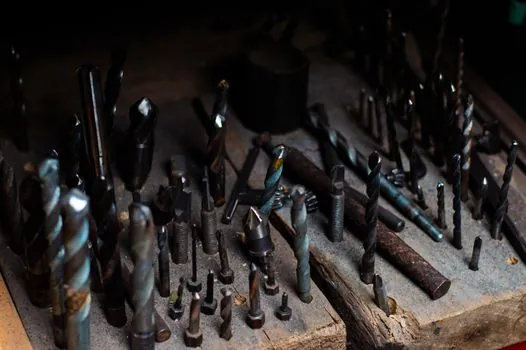
Reading the three credible sources side by side, the tool-to-task fit sorts cleanly. On self-drilling screw installation into painted or galvanised carbon-steel sheet up to about 1.5 mm, a clutched screw gun at 1800-2000 RPM is the correct pick, and a conventional cordless drill/driver at 0-2000 RPM is the acceptable substitute when the operator controls the trigger [S2][S3]. On 300-series stainless fasteners, the same screw gun or drill/driver is required, with the speed dialled under 900 RPM, because impact action work-hardens the head and strips the recess [S2][S3]. On structural-steel erection with through-bolts and wedge anchors, a low-RPM nut runner or a 1/2-inch corded drill with a torque-rated socket is correct, and impact wrenches are reserved for break-loose duty, not final torque [S3]. On hole-making in plate 3-10 mm, a corded or brushless drill/driver at 0-1500 RPM with a cobalt or carbide Jobber bit is the right tool, because impact drivers at 2500-3500 RPM burn the bit and the workpiece [S2][S5]. The air impact wrench family, covered separately, is for high-cycle production bolting with calibrated torque rather than for fastening sheet steel.
Failure modes the spec must prevent
Every governing body in the source material lands on the same three failure modes when an impact driver is misused on sheet steel, and each one maps back to a number to control. First, screw-head damage: the impact pulse shears the drive recess before the clutch releases, which is the failure CSSBI tied directly to the impact driver being "the worst performer" in their test series [S3]. Second, over-driven seating and EPDM washer crush: an impact driver has no depth stop, so the washer is loaded past its design compression and the seal path opens, which is the failure mode MCA and NAFB called out in their 2013 and 2014 technical bulletins [S3]. Third, stripped Type 300 stainless threads: at 300-series hardness, the impact pulse gall's the threads during run-up, so 900 RPM is treated as a hard ceiling, not a guideline [S2].
On painted and pre-finished panels, the same logic adds a fourth failure: impact spalling of the paint around the fastener head, which is what CSSBI flagged as the corrosion initiation site on otherwise coated fasteners [S3]. A general look at the construction tools family reinforces the point: the right tool is the one whose control loop, whether mechanical clutch, depth nose, or calibrated torque, matches the fastener's clamp-load window.
What the standards say, and what they do not
The cited guidance comes from industry technical bulletins, not from a national or international standard body. The Metal Construction Association's Technical Bulletin dated 28 August 2013, "Proper Tools for Fastening Metal Panels," sets the 0-2500 RPM and 6 A minimum; the National Frame Building Association's 2014 bulletin repeats it; the Canadian Sheet Steel Building Institute's Sheet Steel Facts 42, March 2015, adds the comparative test data [S3]. The 2000 RPM screw cap and 900 RPM stainless cap come from screw manufacturers individually, summarised in fastener-distributor guidance [S2]. There is no IEC, ISO, or ASME standard in the source set that assigns a specific RPM or torque number to a panel-fastening driver, which is why the spec sheet is built from industry bulletins and OEM data, not from a standards clause.
Field selection workflow on a steel job
Step one is to read the screw data sheet and lock in the maximum allowable RPM, which is 2000 for coated self-drillers and 900 for 300-series stainless [S2]. Step two is to confirm the driver can be adjusted below that ceiling with the clutch or depth-sensing nosepiece working, which is the MCA minimum-tool definition [S3]. Step three is to confirm sustained power: 6 A minimum corded, or a brushless cordless platform rated for the duty, because peak ratings on the box do not reflect a 200-screw-per-shift load [S3]. Step four is to verify the bit and magnetic socket fit; a mismatched hex is a stripped-head failure waiting to happen [S3]. Step five is the install check: drive a test fastener, confirm the EPDM washer seats flat without extrusion, and only then sign off the tool. Side issues such as matching the driver to a plasma cutter trade-off for hole-prep, or to a cuplock scaffolding spec for the work platform, are downstream of the fastener-tool match and are addressed in their own spec maps.