Marble cutters and rotary hammers occupy different slots in a contractor's tool crib: a 1100-1500 W marble cutter spins a 110-180 mm continuous-rim diamond blade at 11 000-13 000 rpm to score stone, tile and cured concrete, while a 600-1500 W rotary hammer drives an SDS-Plus or SDS-Max bit with 2-20 J of impact energy through masonry, concrete and brick [S1][S4].
Chinese OEM catalogues routinely list both product lines in the same factory portfolio: Zhejiang Jingli Tools Co., Ltd. (founded 1992, Wuyi County, Zhejiang) ships angle grinders, marble cutters, rotary hammers and demolition hammers from a single plant, and Yongkang LingWei Electric Co., Ltd. pairs a 1000-piece/day marble-cutter line with rotary-hammer, wall-chaser and demolition-hammer output [S1]. That co-listing is useful for sourcing comparison but it is not evidence the two tools are interchangeable on the job.
Definition and Mechanical Frame
A marble cutter is a single-purpose cut-off saw: a side or top handle, a guarded diamond or abrasive wheel, and a 100-180 mm blade bore, typically 20 mm or 22.23 mm, with motor ratings quoted at 1100 W, 1200 W, 1400 W and 1500 W [S4][S6]. The published 6261A spec is a 110 mm, 1400 W marble cutter priced around US$20 FOB at 1 000-piece MOQ from a Yongkang, Zhejiang OEM holding ISO 9001 certification [S6].
A rotary hammer is a percussive drill using an SDS-Plus (10 mm shank, 2-5 J per blow) or SDS-Max (18 mm shank, 5-20 J per blow) chuck. Energy is delivered as rotation plus axial impact, not free rotation, so it can break up cured concrete, brick and natural stone by chipping rather than grinding [S1]. Both tool classes sit at the 1000-1500 W motor tier, but their gearing, RPM and torque envelopes are different by design.
Selection Criteria: Blade vs Chuck, Speed vs Impact
The first gate is the working interface: a marble cutter is specified by blade diameter (110/125/150/180 mm), bore, max RPM, and whether the wheel is segmented, turbo or continuous-rim. A rotary hammer is specified by chuck system (SDS-Plus vs SDS-Max), impact energy (J), no-load speed (rpm) and blow frequency (bpm) [S4][S6].
Marble-cutter RPM runs 11 000-13 000 rpm with shallow cutting depth, usually 25-40 mm in a single pass on stone; rotary-hammer RPM sits at 400-1100 rpm with impact rates of 4 000-4 500 bpm for a typical 800 W class. The two spec sheets are not adjacent: a buyer comparing a 1400 W marble cutter and an 800 W rotary hammer is not buying two sizes of the same tool, they are buying two different machines [S6][S1].
Who a Marble Cutter Is For — and Who It Is Not
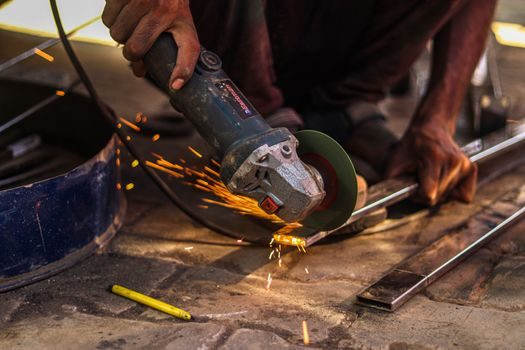
The marble cutter fits tile installers, stone-fabrication shops, masonry trim-out crews and thin-brick landscapers who need straight, shallow cuts in 5-30 mm tile, marble, granite, slate and pavers [S4][S6]. It also covers light cured-concrete scoring when paired with a diamond blade rated for concrete.
It is the wrong tool when the job needs a 30-100 mm deep hole in concrete, anchor or rebar drilling, light chiselling of plaster, or chasing walls for conduit — those are rotary-hammer or demolition hammer work. Likewise the rotary hammer is the wrong tool when the spec calls for a long, straight cut in stone: it chips, it does not slice, and the bit geometry destroys finish quality on visible stone edges.
Comparison Table: Marble Cutter vs Rotary Hammer vs Adjacent Classes
Side-by-side, the three classes diverge on the four criteria that drive specification: cutting interface, primary motion, typical motor power, and the failure mode if the tool is misapplied [S1][S4][S6].
Marble cutter vs rotary hammer: marble cutter = diamond blade, pure rotation at 11 000-13 000 rpm, 1100-1500 W, mis-use failure is cracked tile or segment loss; rotary hammer = SDS-Plus/SDS-Max bit, rotation + 2-20 J axial impact at 400-1100 rpm / 4000-4500 bpm, 600-1500 W, mis-use failure is a jammed bit, safety-clutch trip, or unthreaded anchor socket. A marble cutter cannot drill a 16 mm sleeve anchor hole; a rotary hammer cannot produce a 25 mm-deep clean cut in 20 mm porcelain tile without chip-out.
Real Use Cases and Sourcing Signals
Yongkang and Wuyi, both in Zhejiang, dominate the small-format marble-cutter supply chain. The 6261A-spec 110 mm / 1400 W marble cutter at US$20 FOB and 1 000-piece MOQ is a typical export entry point, while larger 180 mm / 1500 W units from the same supplier pool carry proportionally higher price and freight costs [S6].
The rotary-hammer supply chain overlaps geographically — LingWei quotes a 200-piece MOQ and 1 000-piece/day capacity on rotary hammers from the same Yongkang base — but the bill of materials diverges: a marble cutter needs a guarded wheel-housing assembly and high-RPM bearings, a rotary hammer needs a crank-piston impact mechanism and a sealed SDS chuck [S1]. Procurement teams can negotiate combined shipments, but should keep part numbers and QC plans separate.
Limitations, Failure Modes and Safety Boundary
The defining safety boundary is the tool's primary energy vector. A marble cutter's energy is rotational, concentrated at the blade periphery; a kickback event throws the blade and workpiece upward and toward the operator. A rotary hammer's energy is axial-impact plus rotation; if the bit binds in cured concrete or hits rebar, the safety clutch slips or the body jerks — which is the same failure mode that triggered the 2017 Biltema rotary-hammer recall (item 17-384, EU, 2017-10-20), where the anti-rotation clutch could fail to limit start-up torque and a jammed bit could spin the tool toward the user [S2].
Operators must not substitute a diamond blade in a rotary hammer or an SDS bit in a marble cutter: chucks, RPM ratings and guarding are not matched. For broader bit-system background, the rotary drilling rig entry covers larger-format rotary tools, while the plasma cutter and rotary encoder pages sit on the other side of the cut-vs-drill boundary.
Buyers cross-shopping marble cutters and rotary hammers in 2026 should anchor the spec on the job (cut depth + material for the cutter; hole diameter + substrate + impact energy for the hammer), then match the OEM's motor and chuck data, and require a sample cut or sample bore before the production run. A 10-piece paid trial from a Yongkang or Wuyi factory at US$20-50 FOB is the cheapest way to fail fast, and recent listings show response times of 3 hours or less on major RFQs [S3][S6].
For related coverage, see Spherical Plain Bearing vs Slewing Bearing: Scale, Load Type, Spec Frame.