
Spherical plain bearings are assembled sliding units — a spherical OD inner ring seated in a spherical ID outer ring — built to absorb static misalignment and oscillating pivots on shafts with bore IDs commonly between 5 mm and 200 mm depending on series [S2][S3]. Slewing bearings are large-ring rolling-element or plain bearings that handle combined axial, radial and overturning-moment loads on equipment that rotates a payload above a fixed base.
For a process engineer the real question is not which is "better" but which load envelope the joint actually sits in. Below 200 mm bore with predominantly radial/oscillating motion, a spherical plain bearing is in its design space. Above that, on a turntable, crane, slew drive, wind nacelle yoke or radar pedestal, you are in slewing bearing territory.
Construction and Material Options
Spherical plain bearings in the GE series pair a phosphate-treated inner ring with a coated molybdenum sliding contact, with a 30–50 mm (1.18–1.97 in) inside-diameter window on the GE product shown [S1]. The DG-PW series is a steel/PTFE maintenance-free construction with bronze and brass alternatives, also sized 5–50 mm ID, and built to DIN ISO 12240-1 series K [S2]. The DGE-SX angular-contact spherical plain bearing uses a steel/steel oil-impregnated sliding contact for heavy loads and pushes the ID range to 25–200 mm, qualified under DIN ISO 12240-2 [S3].
Slewing rings are a different construction: a large ring with internal or external gearing, with rolling elements (typically ball bearing or roller) running on hardened raceways, or — in plain/slewing-ring variants — a PTFE or bronze sliding layer. Diameters commonly start around 200 mm and run up to several metres, with through-bolt patterns and gear teeth integrated into the ring. The slewing ring bearing form is essentially a turntable bearing sold as a finished ring with mounting holes.
Load Envelope and Misalignment Role
A radial spherical plain bearing is rated primarily on static and dynamic radial load, with limited axial capacity and a defined misalignment angle (commonly up to a few degrees for the standard series). The DG-PW is intended for sliding combinations that need to be maintenance-free; the DGE-SX angular-contact geometry adds a defined contact angle so it can take combined radial + axial load and is positioned for heavy-load pivots [S3].
A slewing bearing is rated on three loads simultaneously: axial force (Fa), radial force (Fr), and overturning moment (M). For a given ring diameter, the static load chart is the controlling spec — a small 500 mm four-point-contact ball slewing ring can carry tens of kN axial and a several kN·m moment, while a 2 m three-row roller slewing ring moves into the hundreds of kN and tens of kN·m. If your load case has any meaningful moment, you are in the slewing-ring spec, not the spherical-plain spec.
Selection Criteria: When Each Is the Right Part

Spherical plain bearing fits when the bore is small-to-medium, the motion is oscillation or slow pivot, alignment between shaft and housing is poor, and the environment rules out rubber-cushioned alternatives — typical on hydraulic cylinder rod ends, king-post steering joints, agricultural linkage, and tail-boom pitch pivots. Slewing bearing fits when the structure rotates a payload above a fixed frame, takes significant overturning moment, needs integrated gear drive or slewing drive interface, and the diameter is in the turntable range. [S1]
For a process-engineer selection gate, the four decision points are:
1. Bore/diameter: under ~200 mm → spherical plain; 200 mm and up → slewing ring.<br>2. Load type: pure radial or radial + axial with small misalignment → spherical plain; axial + radial + moment → slewing.<br>3. Motion: oscillation, slow pivot → spherical plain; continuous rotation or partial rotation with positioning accuracy → slewing.<br>4. Mounting: shaft-and-housing press fit → spherical plain; bolted flange pattern on a large ring → slewing.
Anything that requires a gear cut into the bearing itself, or a hollow shaft through the centre, is slewing territory. A plain pin joint is spherical-plain territory. The two rarely compete head-to-head on a given drawing.
Comparison: Spherical Plain vs Slewing Bearing
On the same four criteria: [S2]
• Diameter / bore: Spherical plain 5–200 mm ID (series-dependent) [S2][S3]. Slewing ring 200 mm–several metres OD.<br>• Load mix: Spherical plain = radial-dominant, limited axial, defined misalignment angle. Slewing = axial + radial + moment all rated on the static load chart.<br>• Motion: Spherical plain = oscillation, slow pivot. Slewing = rotation (continuous or indexed), often with gear drive.<br>• Material/sliding contact: Spherical plain = steel/PTFE, steel/steel, bronze/PTFE, coated Mo [S1][S2][S3].
Cost per unit follows diameter and load roughly linearly for spherical plain bearings and roughly with the cube of diameter for slewing rings because raceway grinding, gear cutting and bolt-pattern machining dominate cost as OD grows.
Standards and Sourcing

Spherical plain bearings sit under DIN ISO 12240-1 (radial) and DIN ISO 12240-2 (angular-contact) for the geometry and load-rating framework shown on the Nadella DG-PW and DGE-SX product pages [S2][S3]. The GE-series phosphate/molybdenum product is described by the manufacturer as a coated spherical-plain unit with the inner/outer spherical surface treatment stated in the catalogue copy [S1].
Slewing rings are not governed by a single ISO part-number spec the way rolling-element deep-groove bearings are. Vendor static-load charts, gear-tooth quality per ISO 1328 or AGMA equivalent, and bolt-pattern drawings are the spec. Luoyang Bearing (LYC) lists slewing bearings inside a 10,000-variant product range covering miniature through to large-diameter rings, with the corporate catalogue organised by nine categories.
For procurement, the tapered roller bearing buying guide covers a related rolling-element family with the same load-rating-discipline approach (series, load, tolerance, lead-time) that applies when you size a slewing ring static chart. Material and cost context for the bronze sliding layer in plain slewing rings is covered in the tin bronze 2026 price guide, and the carbon steel vs cast iron comparison frames the housing/yoke material choice that the slewing ring bolts into.
Failure Modes and Operating Limits
Spherical plain bearings fail by adhesive wear on the sliding contact, brinelling under static overload, and edge loading when the misalignment angle is exceeded. PTFE-lined variants lose the sliding layer if the PV (pressure × velocity) product goes above the catalogue limit, which is why maintenance-free is "maintenance-free within the published PV envelope" — not "fits everything". Oil-impregnated steel/steel variants (DGE-SX) tolerate higher temperatures and PV but require relubrication access [S3].
Slewing rings fail by raceway brinelling (overload or moment overload), gear-tooth wear (lubrication failure on the gear), bolt-loosening (bolt preload loss on the mounting flange), and sealing failure (water or dust ingress on the raceway). For slewing drives used in solar trackers and small cranes, the slewing drive spec sheet bundles the slewing ring with an integrated worm or pinion drive, and the failure-mode analysis moves to the drive's backlash and the ring's static-load margin.
When to Walk Away From One and Pick the Other
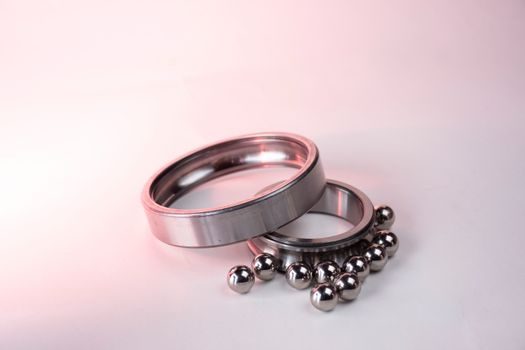
If the spec calls for a 600 mm OD turntable with a 50 kN·m moment load and an integrated external gear, no spherical plain bearing — at any size in the published ID range — will meet it. Conversely, if the spec is a 40 mm bore king-post joint on a tractor linkage oscillating ±25°, no slewing ring — at any OD — is the right part. The wrong part in either direction inflates cost, adds weight, and shortens service life. [S3]
Track for the next 6–12 months: (a) the migration of PTFE-lined spherical plain bearings into higher-PV hydraulic cylinder rod ends as static-load charts are republished by EU and Asian vendors, and (b) the publication of new three-row roller slewing-ring static charts in the 1.5–3 m OD band as the wind and crane-telescope sectors refresh their drivetrain specs.