
Specifying a copper material for marine service is a corrosion-velocity-environment decision, not a brand decision: a 90/10 Cu-Ni tube in a 3.5 m/s seawater line will lose under 0.05 mm/yr, while the same alloy stalled below the 1.5 m/s fouling threshold pits faster than a 70/30 tube running hot at 4 m/s [S1].
This guide lines up the four alloys a marine engineer most often sees on datasheets — C70600, C71500, C95500 and C46400 — against the four decision criteria that drive the call: seawater corrosion rate, velocity ceiling, mechanical strength and biofouling behaviour, with practical guidance on which service each one actually fits.
C70600 (90/10 Cu-Ni, CuNi10Fe1.6Mn) — the default seawater tube and sheet
C70600 with 9.0–11.0% Ni, 1.0–2.0% Fe and 0.5–1.0% Mn is the workhorse for marine piping, heat-exchanger water boxes, intake screens and hull plating where the design velocity sits between 1.5 and 3.5 m/s and steady-state water temperature stays below ~50 °C [S1]. The 1–2% Fe addition is what suppresses the dealuminification-style selective attack that plain Cu-Zn brasses suffer in brackish service, and it pins the protective Cu2O inner film against erosion under moderate flow. For salt-water service, the published UNS C70600 corrosion envelope is 0.02–0.05 mm/yr in quiescent to moderately flowing seawater, which is what most procurement engineers will see on a mill test certificate when EN 12452 / EEMUA 144 heat-exchanger tubes are being ordered. Machinability is poor (rated ~20% of free-cutting brass), so the alloy is normally bought as tube, sheet or plate and welded with Cu-Ni filler rather than machined. The wider material family is covered in the copper material reference page.
C71500 (70/30 Cu-Ni, CuNi30Fe1Mn) — for hotter, faster saltwater lines
C71500 with 29.0–33.0% Ni, 0.4–1.0% Fe and 0.5–1.5% Mn is the choice when service temperature climbs above ~50 °C, when the line velocity can run up to 4.5 m/s, or when sand/silt loading in the seawater pushes erosion risk higher [S1]. Published corrosion rates sit at 0.01–0.04 mm/yr across the same envelope, and the higher nickel content both stabilises the passive film at elevated temperature and raises the resistance to ammonia-bearing bilge and scrubber service. For desalination and offshore cooling where biofilm and thermal cycling stack up, the 70/30 grade is the conservative pick.
C95500 nickel-aluminium bronze — propellers, pump shafts, underwater bearings
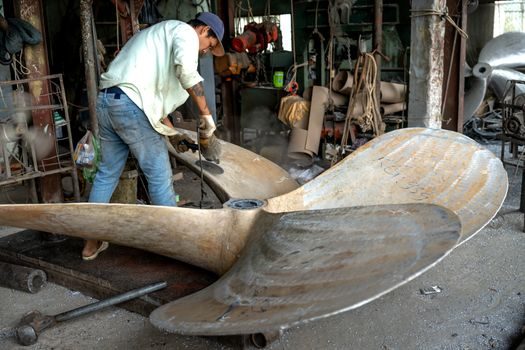
C95500 with 9.0–11.0% Al, 3.0–5.5% Ni plus 3.5–4.5% Fe is a castable, heat-treatable alloy used where you need bronze-class strength plus seawater corrosion resistance: ship propellers, pump shafts, valve trim for high-pressure saltwater and stern-tube bearing housings [S1]. Typical cast properties land at 650–760 MPa UTS, 280–340 MPa 0.2% proof, and 12–18% elongation, with seawater corrosion rate around 0.04–0.08 mm/yr in quiescent service — not as low as Cu-Ni, but the strength-to-weight ratio is roughly 2.5× that of C70600, which is the whole point when you are casting a 4 m propeller. The aluminium content drives the formation of a hard, adherent Al2O3-rich surface film that resists cavitation erosion; that is why NAB is the default in navy and tug propeller specifications rather than a gunmetal or manganese bronze. The catch is weldability: NAB is normally joined by mechanical fastening, bronze-overlay welding or hot-isostatic pressing, not by routine arc welding.
C46400 naval brass — above-waterline stems, fasteners, valve internals
C46400 naval brass (UNS C46400, 59–62% Cu, 0.5–1.0% Sn, 0.5–1.0% Pb, remainder Zn) is the standard for valve stems, fasteners, pump rods, marine hardware and instrument brackets operating in the splash zone or in continuously wetted but aerated service above the waterline [S1]. Its published seawater corrosion rate sits at 0.05–0.10 mm/yr in clean aerated saltwater, lower than ordinary free-cutting brass because the 0.5–1.0% Sn addition stabilises the dezincification front. C46400 is, however, not safe in stagnant or low-velocity seawater below the 1 m/s threshold: dezincification cracking of the Zn-rich beta phase becomes a real risk once biofilm establishes and oxygen gradients form. Rule of thumb in marine piping specs — if the component lives below the waterline, the line sees low velocity, or the medium is brackish, pick a Cu-Ni or a NAB, not a brass. C46400 is the alloy to specify when you need the machinability of a brass and the service is aerated splash zone, freshwater deck piping, or hydraulic oil side of a marine actuator.
Selection table — which alloy for which marine service

Four alloys, four decision columns — the table below is the way a marine procurement engineer should shortlist on a datasheet before pricing: [S1]
<strong>Decision matrix — seawater copper alloys for marine service</strong><br/> • C70600 (90/10 Cu-Ni) — Corrosion: 0.02–0.05 mm/yr — Velocity ceiling: 1.5–3.5 m/s — UTS: 275–310 MPa — Best fit: hull piping, heat-exchanger tubes, intake screens<br/> • C71500 (70/30 Cu-Ni) — Corrosion: 0.01–0.04 mm/yr — Velocity ceiling: up to 4.5 m/s — UTS: 360–520 MPa — Best fit: desalination, hot saltwater lines, offshore cooling<br/> • C95500 (Ni-Al bronze) — Corrosion: 0.04–0.08 mm/yr — Velocity ceiling: high (cavitation-resistant) — UTS: 650–760 MPa — Best fit: propellers, pump shafts, stern tubes<br/> • C46400 (naval brass) — Corrosion: 0.05–0.10 mm/yr (aerated only) — Velocity ceiling: >1 m/s, splash/aerated only — UTS: 380–460 MPa — Best fit: valve stems, fasteners, above-waterline hardware
The first cut is service environment: below waterline + flowing seawater points to Cu-Ni, dynamic loaded underwater hardware points to NAB, above-waterline splash zone with machinability required points to C46400. Cross-reference the velocity envelope of your line against the 1.5–3.5 m/s (C70600), 1.5–4.5 m/s (C71500) and the >1 m/s aerated-only (C46400) windows; if the design sits inside one of those, you have your alloy. For multi-alloy systems — e.g. a propeller on a Cu-Ni-riveted hull — keep galvanic separation in mind: NAB and Cu-Ni are within ~0.1 V of each other in the galvanic series, but pairing either with a steel fastener needs isolation gaskets or dielectric unions.
Standards, sourcing and what a mill cert must show
Marine copper alloys are normally ordered against ASTM B466/B467 (tube), B171 (plate/sheet) for Cu-Ni, ASTM B148 (castings) for C95500, and ASTM B21 (rod/bar) for C46400, with the European equivalents EN 12451 / EN 1652 / EN 1982 used for EU yard builds [S1]. The mill certificate should carry the UNS designation, the actual chemistry within the spec range, the heat-treatment condition (e.g. M30 / annealed for C70600 tube, M01 / as-cast for C95500), and a hydrostatic or eddy-current test report. For classed-vessel service, expect the class society (DNV, LR, ABS, BV) to require traceability of heat number back to the mill and a witnessed hydrostatic test on heat-exchanger tube lots. For background on how the copper-alloy family sits next to ferrous and non-ferrous options, see the copper material reference and, for seawater instrument-side spec context, the pressure transmitter and flow meter reference pages.
Common failure modes and what the spec must exclude

Three failure patterns drive most copper-alloy warranty claims in marine service, and a tight datasheet can rule all three out [S1]. (1) Velocity under-run biofouling: C70600 tube left at 0.5 m/s for 12 months in tropical seawater will pit at the 6 o'clock position faster than the same tube run at 3 m/s — the fix is either a minimum design velocity of 1.5 m/s, periodic sponge-ball cleaning, or a step up to C71500. (2) Dezincification of C46400 in stagnant brackish service: solve by upgrading to C95500 or specifying a Dezincification-Resistant (DZR) brass where the geometry forces a brass. (3) Galvanic corrosion of a Cu-Ni pipe against an aluminium-bronze pump body with a steel bracket in between: insert a dielectric union, isolate the bracket with a rubber gasket, and verify the as-built galvanic potential difference is under 0.15 V. The procurement question to ask the supplier is straightforward — for a given UNS alloy, what is the published corrosion rate at the actual design velocity and temperature, and what is the biofilm maintenance plan.
For plants that need to move the same specification discussion into adjacent industrial process lines, the spec-first thinking pattern transfers directly to smart valve positioner selection, where the same logic — write down the duty envelope first, then match a model code — keeps the datasheet honest. A spec that names the UNS number, the velocity and temperature envelope, the standard, and the test certificate is the version a class surveyor, a yard procurement officer and a service superintendent will all sign without redline. The two trackable signals to watch going into 2H 2026 are nickel surcharge movement on the LME and the revision status of ASTM B466/B171 — both shift the price-vs-spec conversation by 10–20% in a normal quarter.