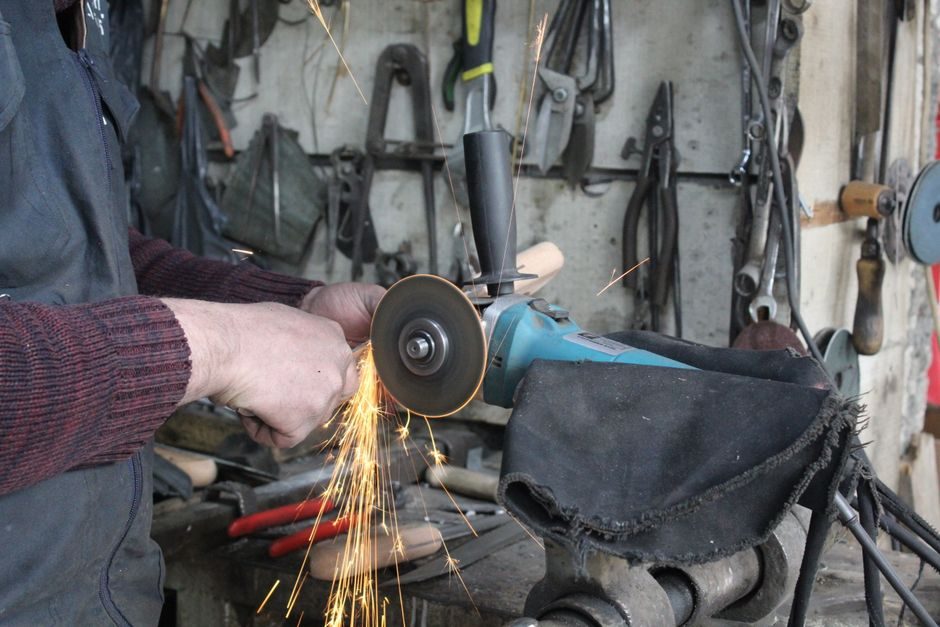
Masonry cut-off sizing is dominated by the abrasive or diamond blade diameter and motor class: 14-16 in (350-400 mm) handhelds cover brick, paver and standard CMU cuts, 20-26 in (500-660 mm) walk-behinds handle large block and refractory, and dry-cut diamond turbo blades are the default consumable where EN 12413 or oSa member-mark compliance is required [S1].
For factory environments, swing-frame abrasive cut-offs in the 762 mm (30 in) wheel class and 22 kW (30 HP) drive range belong to the foundry/casting-finishing line, not to masonry sizing, and selecting one for block work wastes both capital and floor area [S2].
Match Machine Class to Workpiece Geometry, Not Brand
The Rema PS 350/500/600 swing-frame grinding line is sold as a rotary-blade, electric, universal cut-off with a rated 60 m/s peripheral cutting speed and an 80 m/s option for harder wheel grades; its column-mounted slewing jib suspension and two-step speed recovery for wheel wear put it squarely in the large-workpiece foundry and steel-yard niche [S1].
The Fox 2-C swing frame from Vulcan Engineering ships with a 30 in x 1/4 in x 1-3/4 in (762 x 6 x 44 mm) wheel, a 14,200 SFPM (72 m/s) starting peripheral speed recovering to ~12,500 SFPM as the wheel wears, a 30 HP (22 kW) two-speed pulley drive, 1,130 lb (513 kg) mass, and 110 in (2,794 mm) length, with a full 90 deg clockwise and 75 deg counterclockwise swing for gate/riser removal [S2]. Specifications of this scale (mass above 500 kg, motor at the 20-30 kW band, abrasive wheel 750 mm+) are over-specified for typical masonry tasks and indicate an industrial casting-finishing duty cycle, not a block yard duty cycle.
Selection Criteria That Actually Move the Decision
Three criteria separate a workable masonry cut-off from a wrong purchase: (1) blade diameter vs. maximum cut depth, where a 14 in blade yields roughly 4-5 in (100-125 mm) depth of cut and a 16 in yields 5-6 in (125-150 mm), enough for one course of standard 8 in CMU when flipped; (2) power-to-weight ratio, with 15 A corded handheld units (about 1,800-2,200 W) the practical floor for continuous dry diamond cutting on concrete block; (3) dust control interface, since a 2 in (50 mm) dust port matched to an M-class extractor is now the default expectation on EN 60745-2-22 compliant masonry saws. [S1]
A practical comparison map: portable handheld 14-16 in dry saws win on cut depth 100-150 mm, manoeuvrability on scaffold, and capital cost, but lose on continuous run time and straight-cut accuracy over 1 m; walk-behind 20-26 in flat saws win on cut depth 200 mm+, straight-line accuracy for road and slab work, and water-feed dust suppression, but require a dedicated operator and clear access; swing-frame abrasive machines in the 30 in / 22 kW class win on heavy foundry cross-sections and gate/riser economics, and lose on every masonry metric (mass, footprint, abrasive vs. diamond consumable cost per metre).
Who This Specification Is For, and Who It Is Not For
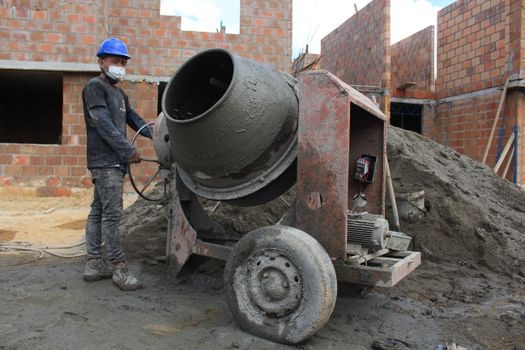
This map is for a project engineer, masonry foreman, or plant buyer sizing a cut-off for CMU, brick, paver, refractory, cast stone, or light concrete pipe — the typical 5-30 m/day cut regime on a commercial site or a precast yard. The dry diamond turbo or segmented blade on a 14-16 in handheld is the reference configuration. [S1]
It is not for a foundry cleaning room where the duty is removing feeders and risers from steel or iron castings; in that room, the right tool is a swing-frame abrasive machine with a 750-900 mm wheel and a 20-30 kW drive, suspended from a bridge or jib crane, as the Fox 2-C spec sheet specifies [S2]. For general metal and billet sectioning, a cutting machine class outside masonry sizing rules applies, and dry diamond blades are the wrong consumable.
Standards, Sourcing, and Documentation Trail
Portable masonry saws sold into the EU market are expected to carry EN 60745-2-22 hand-held diamond saw conformity, with oSa or equivalent third-party audit marking on the blade; bonded abrasive wheels on foundry swing-frame machines fall under EN 12413 for the wheel itself and the machine's rest guard / tongue guard geometry must comply with the same standard's safety factor tables [S1].
For sourcing, factory-direct OEM product pages (e.g. Vulcan Engineering for swing-frame, Rema for swing-frame grinding) provide the only reliable peripheral speed, motor, and wheel data; the labeling machine of these units is generally per EN ISO 7010 hazard pictogram sets, and the grinding wheel maximum operating speed must be permanently marked on every wheel. For dry diamond blade selection, the bond hardness (soft / medium / hard) and the segment height (7-10 mm standard, 10-15 mm for higher-yield consumables) drive both price and life; do not buy a blade without its declared maximum peripheral speed in m/s and its oSa / EN 13236 compliance line.
Failure Modes, Limits, and Trackable Signals
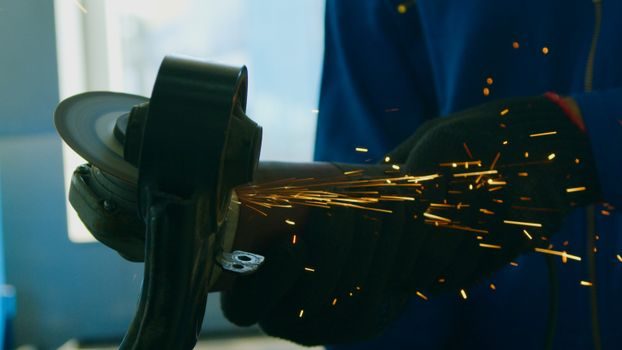
The three failure modes that kill a masonry cut-off purchase before year two: (1) running a continuous rim turbo blade in deep dry cuts without water feed or M-class extraction, glazing the segments and overheating the steel core; (2) under-powering a 16 in blade with a sub-15 A corded supply, which stalls under load and trips the breaker; (3) mounting a foundry-class swing-frame machine on a masonry duty cycle, where the abrasive wheel economics per metre are 5-10x worse than a dry diamond blade on a portable saw [S2].
Trackable signals to watch on the next 6-12 month buying cycle: oSa and EN 13236 audit updates for dry diamond blade members, EN 60745-2-22 revision work on dust-port geometry (any change shifts dust extractor coupling choices), and foundry OEM moves on swing-frame spindle sealing — Vulcan's "sealed for life" spindle is the published benchmark and any competitor move toward cartridge-seal designs is a procurement-relevant signal [S2]. For block-yard buyers watching the related Ready-Mix Concrete Selection for Commercial Buildings: 2026 Spec Map, the cut-off blade choice on a portable saw ties directly to the aggregate hardness in the supplied mix.
Component reference pages worth checking: coding machine.