
Medium-voltage switchgear requires 52–80 weeks for typical 15kV projects in 2026, while 38kV lineups require 78–104 weeks [S1][S2].
Data center planners must place manufacturer slot reservations, approvals, factory testing and commissioning ahead of the planned utility energization date, rather than treating switchgear as a routine construction procurement [S2][S5].
52–80 weeks defines the 15kV planning window
Published 2026 procurement ranges place 5kV and 15kV metal-enclosed switchgear at 52–72 weeks, while 15kV and 27kV metal-clad equipment requires 60–80 weeks [S2]. These ranges come from active manufacturer slot reservations and vary with manufacturer, voltage class, configuration and quantity [S2].
Medium-voltage switchgear in the 15kV class runs roughly 52 to 80 weeks, compared with about 24 weeks before the pandemic [S1]. A 38kV project faces an even longer window of 78–104 weeks, approaching two years [S1][S2].
Published data also contains lower averages. Wood Mackenzie’s Q2 2025 survey recorded about 44 weeks for medium-voltage switchgear, and a 2026 electrical-equipment index reports the same 44-week average [S3][S4].
Specification details move the factory queue
Voltage class is only the first variable. Breaker count, interrupting duty, bus rating, protection relays, controls, enclosure requirements and arc-resistant construction all change the manufactured scope [S3][S5].
Medium-voltage switchgear requires 52–78 weeks for standard applications and approaches 2–3 years for data-center-specification equipment [S6].
The complete data center power chain can include protection relays, controls, metering, buswork, breakers, terminations, freight, field testing, commissioning and spare parts [S5]. A more detailed comparison of medium-voltage VFDs is not a substitute for switchgear specification because drives occupy the downstream power-conversion path, not the primary MV distribution function.
Factory booking must precede equipment release
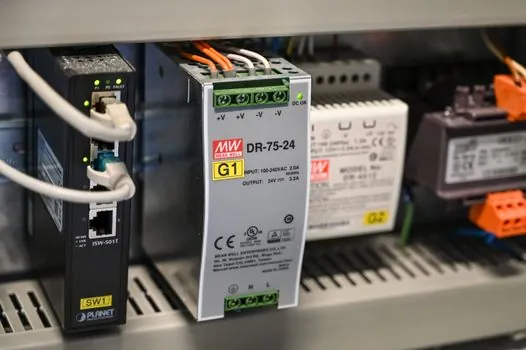
Procurement planning should begin before final design packages because manufacturer allocation, submittal review, approvals, manufacturing, factory testing, shipping and field acceptance sit between design and energization [S5]. For a data center, medium-voltage switchgear lies between available utility power and usable IT capacity, making delayed delivery a direct constraint on commissioning [S5].
A time relay or counter meter may appear in auxiliary control assemblies, but it does not remove the factory queue for the lineup. Switchboard, panelboard, busway and commodity circuit-breaker lead times are separate procurement lines and should not be substituted for an MV switchgear date [S4].
Order books show where the queue is heading
Manufacturer backlogs provide a forward indicator because a book-to-bill ratio above 1.0 means orders are exceeding shipments [S4]. Powell reported a 3.0 book-to-bill ratio and a $2.4 billion medium-voltage and low-voltage switchgear backlog as of August 3, 2026 [S4].
Powell reported a 3.0 book-to-bill ratio and $2.4 billion of MV/LV switchgear backlog as of August 3, 2026, with a book-to-bill above 1.0 indicating that orders were outpacing shipments [S4].
These figures cover different portfolios and reporting periods, so they are not direct substitutes for a factory quotation. They do show that queue pressure extends beyond one manufacturer or one medium-voltage class [S4]. For project-level decisions, the most useful procurement record remains the dated manufacturer slot, approved configuration and contractual delivery milestone.
Long-lead electrical equipment sets the energization path
Medium-voltage switchgear is not the only electrical constraint. Pad-mount transformers require 40–65 weeks, substation transformers from 65 to 110 weeks depending on rating, and generator step-up transformers 100–150+ weeks [S1][S2]. In 2026, 1.5 to 3 MW diesel generators have lead times of 50 to 78 weeks, while 500 to 1,500 kVA UPS systems require 30 to 48 weeks [S2].
A one-line comparison identifies the practical differences: 15kV metal-enclosed gear at 52–72 weeks is faster than 15kV/27kV metal-clad gear at 60–80 weeks, while 38kV switchgear at 78–104 weeks exceeds both [S2]. In 2026, pad-mount transformers have lead times of 40 to 65 weeks, and substation transformers require 75 to 110 weeks [S2].
That hierarchy argues for sequencing the power path rather than ordering equipment independently. Medium-voltage switchgear, transformers, generators and UPS systems must converge at a feasible commissioning sequence, so the project schedule should track interfaces as closely as individual delivery dates. More detail on the overall procurement exposure appears in Long-Lead Equipment List for a 100 MW Data Center.
Use dated factory slots, not market averages
Medium-voltage switchgear procurement in 2026 should use a 60–80 week schedule allowance for 15kV/27kV metal-clad projects and 78–104 weeks for 38kV equipment, subject to a firm manufacturer quotation [S2]. Shorter 44-week survey averages cover broader product populations and should not override a project-specific slot [S3][S4].
For data center schedules, the next controllable action is to lock the required voltage class, breaker arrangement, protection package and commissioning sequence, then obtain written factory dates. Track two signals: the approved slot reservation and the supplier’s backlog or book-to-bill ratio. A rising ratio above 1.0 is a queue-pressure warning, not proof that every project will receive the maximum quoted delivery time [S4].