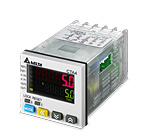
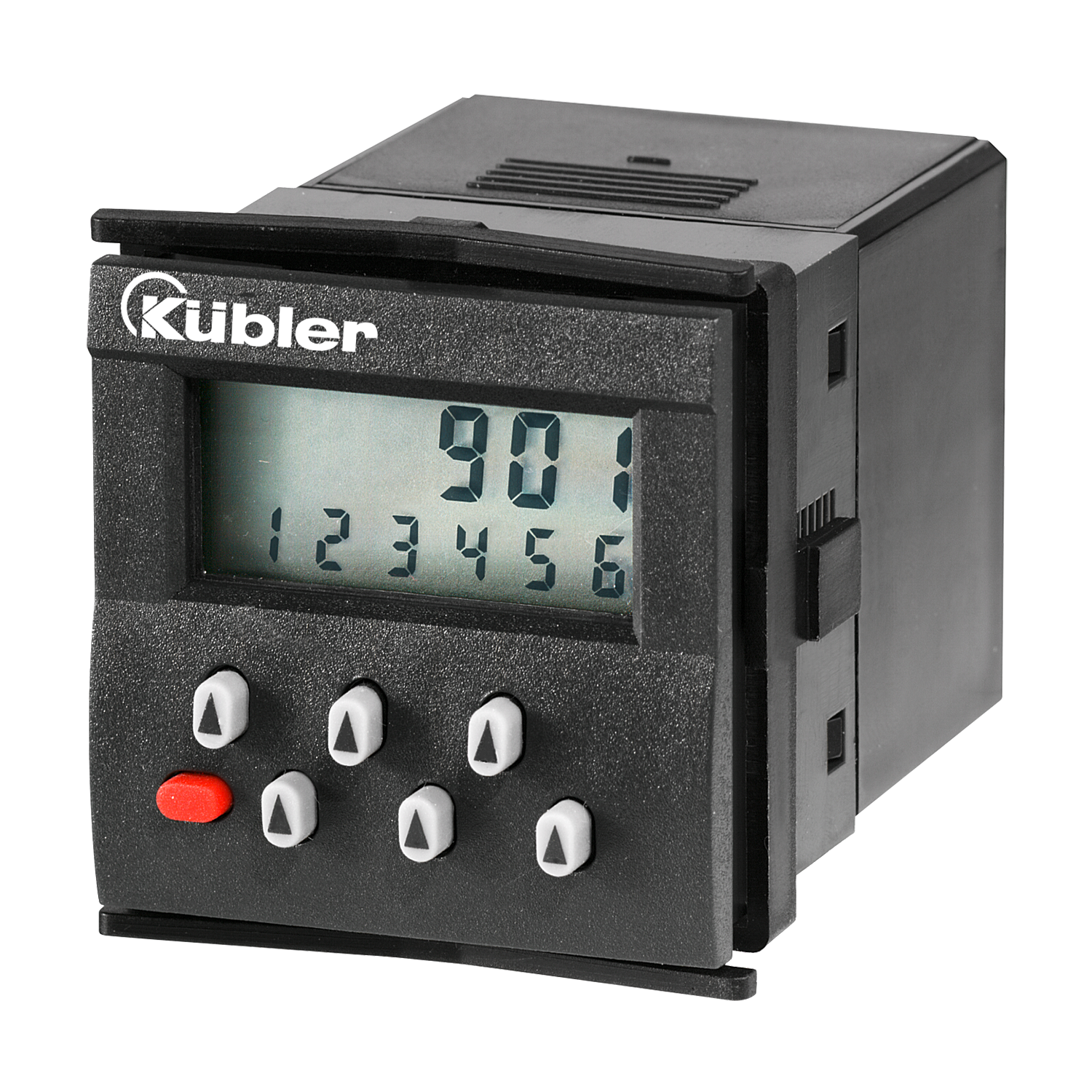
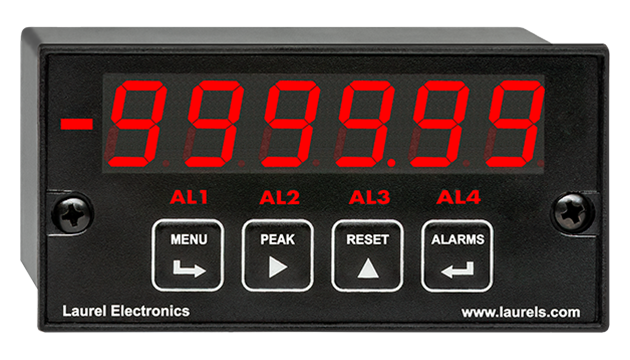
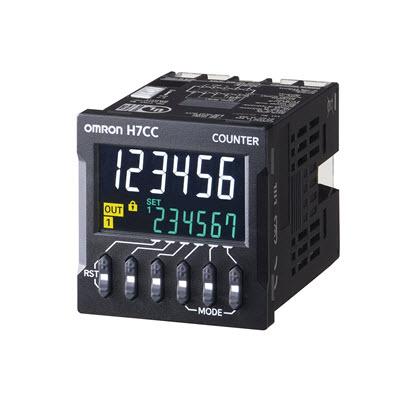
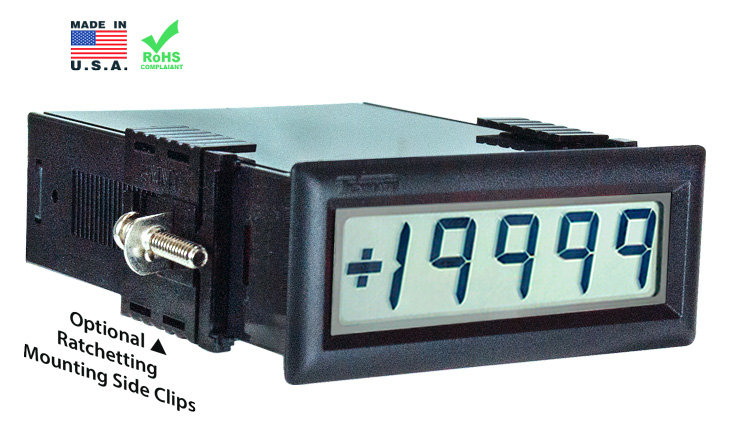
A counter is a control-panel instrument that registers and displays the number of discrete events applied to its input: pieces leaving a conveyor, revolutions of a shaft, strokes of a press, or pulses from a sensor. Industrial counters split into two families. Electromechanical counters drive a numeric drum through a coil or motor and hold the total mechanically with no power. Electronic counters use a digital display and add preset comparison outputs, rate and batch functions, scaling, and communication.
This guide treats panel-mount counting and totalizing instruments for machine control: the count modes they implement, the input signals they accept, the counting frequency they sustain, and the standards and form factors that govern installation. Where it helps, real series from Omron, Red Lion, and Hengstler anchor the numbers to verifiable datasheets.
Photo: ArnoldReinhold, CC BY-SA 3.0, via Wikimedia Commons
This guide is written for industrial purchasing engineers and design engineers selecting a counting or totalizing instrument for a control panel. It covers six chapters: what a counter is, electromechanical versus electronic types, count modes, input signals and electrical interfacing, the key specification parameters, and the selection decision sequence, followed by seven selection FAQs. Form factor and safety references follow DIN 43700 panel-cutout dimensions and the IEC 61010 series for measurement and control equipment; quadrature decoding follows standard x1, x2, and x4 encoder conventions.
Chapter 1 / 06
What is a Counter
A counter is a discrete-event measurement instrument: it increments (or decrements) a stored number each time a defined event occurs on its input, then displays that number. The event is whatever closes a contact or switches a sensor, a part breaking a photoelectric beam, a cam closing a limit switch, a tooth passing a proximity sensor, or an edge from an encoder. Unlike a continuous process variable such as pressure or temperature, the quantity a counter measures is inherently digital, so the counter does not need an analog-to-digital converter; it needs a clean edge-detection front end and a stable register that does not lose its value.
Functionally, a counter sits between three other control-panel categories and is easy to confuse with them. A timer measures elapsed time rather than events. A tachometer or rate meter divides counts by a time window to display speed (revolutions per minute, pieces per minute), and many modern counters include a rate-meter mode. A frequency meter is essentially a rate meter optimized for high-frequency electrical signals. The defining job of a counter is to maintain a running total of events and, in most industrial units, to act on that total through a preset output.
Structurally, an industrial counter has four blocks: (1) the input conditioning stage, which sets voltage thresholds, debounce filtering, and NPN or PNP polarity; (2) the count register, electronic (volatile RAM backed by non-volatile EEPROM or a lithium cell) or mechanical (a geared numeric drum); (3) the comparison and output stage, which compares the register against one or more preset values and drives relay or transistor outputs; and (4) the display, a mechanical drum, an LED, or an LCD. Reset and inhibit inputs let a machine controller clear or freeze the count without operator intervention.
The lineage of counting instruments is long. Mechanical revolution counters and odometers date to the nineteenth century, and motor-driven and ratchet electromechanical counters dominated industrial counting through the mid-twentieth century, valued because they keep their total with no power. The electronic counter arrived with digital logic: solid-state preset counters replaced relay-and-cam logic on packaging and converting machines, and the panel-mount LED or LCD counter became a standard control-panel component. Today a single electronic multifunction unit such as the Omron H7CX or Hengstler tico 731 can be configured as counter, tachometer, or timer, collapsing several legacy part numbers into one ordering code.
In application scale, counters span an enormous dynamic range. A mechanical stroke counter on a press may log a few events per second across years of service. A high-speed electronic counter reading a 20 kHz encoder line, as the Red Lion CUB5 supports, registers twenty thousand pulses every second. Because no single device covers both ends well, selection is fundamentally about matching the counting frequency, the count mode, and the output type to the specific machine cycle, which the remaining chapters develop step by step.
Chapter 2 / 06
Electromechanical and Electronic Types
The first branch in counter selection is electromechanical versus electronic. Electromechanical counters advance a physical numeric drum, either by a solenoid coil pulse (impulse counters) or by a synchronous motor (used mainly in time totalizers). Their defining strength is non-volatile retention by mechanics: the displayed total survives complete and indefinite power loss with no battery, and cannot be reset remotely or by a software glitch, which makes them tamper-evident for utility, rental, and warranty totals. Their weaknesses are a low maximum counting rate, typically on the order of 10 to 25 Hz set by moving mass, mechanical wear over millions of cycles, and the absence of preset outputs or communication.
Electronic counters store the count digitally and display it on LED or LCD. They divide further by power architecture. Externally powered units run on 24 VDC or 100 to 240 VAC and offer the full feature set: presets, dual channels, rate and batch modes, scaling, and outputs. Self-powered units, such as the Omron H7EC, contain a long-life lithium cell and an LCD, counting at up to about 1 kcps and retaining the total in memory for about seven years on the cell with no wiring beyond the count signal, which makes them direct retrofits for mechanical totalizers. The table below contrasts the families on the metrics that drive selection.
Attribute
Electromechanical
Self-powered electronic
Externally powered electronic
Display
Numeric drum
LCD
LED or LCD
Max counting rate
10 to 25 Hz
~1 kcps
5 to 20 kHz
Power required
None (coil pulse)
Internal lithium cell
24 VDC or 100 to 240 VAC
Retention on power loss
Mechanical, indefinite
~7 years (cell)
EEPROM, non-volatile
Preset control output
Rare
No
Relay and transistor
Remote reset / inhibit
No
Limited
Yes
Typical use
Stroke and utility totals
Retrofit totalizer
Machine batch control
Within electronic counters, a second classification is by digit count and resolution. Common displays are 4-digit, 6-digit, and 8-digit. The Hengstler tico 731 is offered as an 8-digit LCD or a 6-digit LED; the Red Lion CUB5 is an 8-digit miniature unit. More digits give a larger maximum count before rollover and finer totals, but cost and panel space rise. For a batch counter that resets every few thousand pieces, four digits suffice; for a lifetime totalizer that must run for years without rolling over, eight digits are prudent.
A practical decision rule: if the value must persist through power outages without a battery and the rate is low, choose electromechanical or a self-powered LCD; if you need preset outputs, dual-channel arithmetic, or kHz counting, choose an externally powered electronic counter. Many machines use both, a self-powered lifetime totalizer for maintenance records alongside an externally powered preset counter that controls the production cycle.
Chapter 3 / 06
Count Modes and Functions
Counters differ less in hardware than in the count modes their firmware implements. Choosing the right mode is the core of applying a counter correctly, because the same physical unit behaves very differently as a totalizer, a preset controller, or a batch counter. The four foundational behaviors are totalizing, presetting, rate measurement, and batching, with directional and arithmetic variations layered on top.
Totalizing is the simplest mode: the counter adds each input pulse to a running total and displays the cumulative value since the last reset, with no control output. Totalizers report production volume, machine cycles, or flow-meter pulses for record keeping. A scaling factor (prescale) can convert raw pulses into engineering units, for example multiplying flow-meter pulses by a K-factor so the display reads liters instead of pulses.
Preset mode adds one or more comparison setpoints. When the count reaches a preset value the counter switches a relay or transistor output, which can stop a machine, advance an index, or signal a PLC. Preset counters frequently count down from the setpoint to zero so the display shows pieces remaining; the Omron H7CX, for example, returns the present value to the set value at the end of a decrement cycle in single-stage and two-stage variants. Two-stage presets give an early warning at preset 1 and a final stop at preset 2, useful for slow-down-then-stop sequencing.
Rate (tachometer) mode measures the input pulse frequency over a time window and displays it as a rate: pieces per minute, cycles per hour, or revolutions per minute. Many multifunction units, including the Red Lion CUB5, can show rate and total simultaneously, one on the main display and one on demand, so a single instrument both totalizes throughput and shows live line speed.
Batch mode is preset counting with automatic recycling: the counter counts pieces up to a target, fires an output to end the batch, resets, and begins the next batch, while a second register often totals the number of completed batches. This is the standard mode for packaging, filling, and cut-to-length machines. The table below summarizes the four modes and the directional and arithmetic options that extend them.
Mode
What it does
Control output
Typical application
Totalizer
Accumulates running total
None
Production and flow records
Preset
Compares count to setpoint(s)
Relay / transistor at preset
Stop-at-count, indexing
Rate / tachometer
Pulses per unit time
Optional rate alarm
Line speed, rpm
Batch
Preset plus auto-reset and recycle
End-of-batch output
Packaging, cut-to-length
Up / down (1-input)
Direction set by control line
As configured
Net inventory in/out
Quadrature (2-input)
Direction from A/B phase, x1 to x4
As configured
Encoder position counting
Dual-input electronic counters extend these modes with arithmetic and directional logic. Two inputs A and B can be used for up/down counting (one input adds, the other subtracts), for anti-coincidence counting (ignoring simultaneous edges), or for quadrature decoding from an encoder. Higher-end panel counters also offer arithmetic between channels such as A+B, A-B, A×B, and A/B, letting a single instrument compute net or differential counts without an external PLC. Confirm which modes a candidate supports against your sequence of operations before ordering, because mode availability, not raw counting speed, is the most common cause of a counter being unfit for a job.
Chapter 4 / 06
Input Signals and Electrical Interface
A counter is only as reliable as its input wiring. The input stage must be matched to the source device, the source must be matched to the counter polarity, and the filter must be matched to the pulse rate. Getting any of the three wrong produces either missed counts or phantom counts, both of which silently corrupt the total. Industrial counters accept several distinct input classes, and a good multifunction unit lets you select among them in firmware.
No-voltage (dry contact) inputs come from relays, limit switches, reed switches, and pushbuttons. The counter supplies its own sensing voltage and detects the contact closing to common. Because mechanical contacts bounce, these inputs must run through a debounce filter, commonly a 30 Hz mode that rejects pulses shorter than roughly 15 ms, so each closure registers once. The Omron H7CX provides exactly this selectable 30 Hz versus 5 kHz input.
Voltage and solid-state inputs come from PNP or NPN three-wire DC proximity and photoelectric sensors, PLC outputs, and logic gates. Here polarity matters: an NPN (sinking) sensor pulls the line to 0 V when active, while a PNP (sourcing) sensor pushes it to the positive rail. The counter input must be configured to match, and many counters offer a switchable NPN/PNP selection. Magnetic pickups produce a low-level AC signal, sometimes only tens of millivolts at low speed, and need an input with sufficient sensitivity. High-voltage versions, such as the Hengstler tico 731 high-voltage option, accept pulses from 12 to 250 V AC or DC directly.
Quadrature encoder inputs use two channels, A and B, 90 degrees out of phase. The counter reads the phase order to determine direction and applies x1, x2, or x4 decoding to multiply resolution: x1 counts one edge per cycle, x2 counts both edges of one channel, and x4 counts both edges of both channels, so a 2,500 pulse-per-revolution encoder yields 10,000 counts per revolution in x4. Choose the decoding factor for the resolution you need and confirm the counter accepts the encoder output level (commonly push-pull, open-collector, or line-driver). The table below maps common source devices to the correct input configuration.
Source device
Input class
Filter / mode
Watch out for
Relay / limit / reed switch
No-voltage (dry)
30 Hz debounce
Contact bounce double-counts
NPN sensor (sinking)
Voltage, NPN
High-speed
Wrong polarity gives no count
PNP sensor (sourcing)
Voltage, PNP
High-speed
Wrong polarity gives no count
Magnetic pickup
Low-level AC
Sensitivity setting
Weak signal at low speed
Incremental encoder
Quadrature A/B
x1 / x2 / x4
Set decoding for resolution
High-voltage pulse 12 to 250 V
HV input option
High-speed
Confirm voltage rating
On the output side, externally powered counters drive control loads from the preset comparison. Relay (contact) outputs handle higher currents, for example the Omron H7CX relay rated 3 A at 250 VAC or 30 VDC resistive, with a minimum applied load of 10 mA at 5 VDC so the contacts stay reliable. Transistor outputs (NPN open collector, rated 100 mA at 30 VDC with about 1.5 V residual on the H7CX) switch faster and last longer for high-cycle signaling into a PLC. Match the output type to the load: a relay to switch a motor contactor or solenoid, a transistor to signal a controller input.
Chapter 5 / 06
Key Specification Parameters
A counter datasheet lists many lines, but only a handful drive the selection decision. The parameters that matter are counting frequency, number of digits, input type and polarity, count modes, output rating, power supply, panel size, environmental rating, and retention. Each is explained below so a spec sheet can be read at a glance.
Counting frequency (counting speed) is the maximum input pulse rate the counter registers without loss, in Hz or counts per second. It must exceed the worst-case event rate, which equals target or contact events per second at maximum machine speed. Representative figures from datasheets: the Omron H7EC self-powered counter handles about 1 kcps; the Hengstler tico 731 reaches 7.5 kHz; the Omron H7CX is selectable at 30 Hz or 5 kHz; the Red Lion CUB5 accepts up to 20 kHz. For mechanical-contact sources the relevant figure is the slow filtered mode, not the headline kHz number.
Digit count sets the maximum total before rollover and the resolution of the display. Typical electronic units are 4, 6, or 8 digits. Choose enough digits that a lifetime total or a worst-case batch never rolls over unexpectedly; an 8-digit unit counts to 99,999,999 before wrapping.
Input type and polarity must match the source, as detailed in Chapter 4: no-voltage versus voltage, NPN versus PNP, single-input up/down versus quadrature. Count modes (totalize, preset, rate, batch, arithmetic) must include the behavior your sequence requires. These two qualitative specifications, not raw speed, are the most frequent cause of a wrong purchase.
Output rating applies to preset counters. Relay outputs are specified by switching current and voltage (for example 3 A at 250 VAC) and by minimum load; transistor outputs by sink current and voltage (for example 100 mA at 30 VDC) and residual voltage. Pick relay for power loads, transistor for fast, high-cycle signaling.
Power supply for externally powered counters is commonly 24 VDC, 100 to 240 VAC, or a wide-range universal input. Self-powered counters need no supply but rely on an internal lithium cell with a finite life, about seven years minimum on the Omron H7EC. Panel size follows DIN 43700: 48x48, 48x24, 24x48, 72x72, and 96x48 or 96x96 mm bezels with matching cutouts, plus miniature 1/32 DIN formats. Size is effectively irreversible once the panel is machined, so fix it first.
Environmental rating and standards govern where the counter can be installed. The front-panel ingress protection rating (commonly IP65 or NEMA 4X on the bezel, as on the Red Lion CUB5) determines washdown and dust suitability; operating temperature ranges such as the CUB5 minus 35 to plus 75 degrees Celsius bound the ambient. As built-in measurement and control equipment, panel counters are designed to the relevant requirements of the IEC 61010 series and typically carry CE and UL or cUL marks. The table below collects representative figures from current manufacturer datasheets for quick comparison; always confirm against the exact ordering code.
To turn the preceding chapters into a specific order code, follow the decision sequence below. Most selection mistakes are not a single wrong number but a decision made at the wrong level, for example fixing on a fast model before confirming the count mode it must run. These eight steps double as a fixed RFQ template.
Function and count mode: Decide first whether you need a pure totalizer, a preset controller, a rate or tachometer display, or a batch counter, and whether direction (up/down) or quadrature counting is required. Mode availability governs everything downstream.
Counting frequency: Compute the worst-case pulse rate at maximum machine speed (targets or contacts per second) and choose a counter whose rated counting frequency comfortably exceeds it. For mechanical-contact sources, confirm a debounce or 30 Hz input mode exists.
Input signal and polarity: Match the input to the source: no-voltage for dry contacts, NPN or PNP for solid-state sensors, low-level AC for magnetic pickups, quadrature A/B for encoders. A switchable NPN/PNP input adds flexibility.
Digits and scaling: Pick enough digits that the lifetime or batch total never rolls over, and confirm prescale or K-factor scaling if the display must read engineering units rather than raw pulses.
Output type and rating: For preset counters, choose relay outputs (rated by current and voltage, for example 3 A at 250 VAC) for power loads, and transistor outputs (for example 100 mA at 30 VDC) for fast, high-cycle signaling into a PLC. Decide single-stage or two-stage presets.
Power supply: Match available control voltage, 24 VDC, 100 to 240 VAC, or wide-range universal, or choose a self-powered unit where no supply is run to the panel position.
Panel size and protection: Fix the DIN 43700 cutout (48x48, 24x48, 72x72, 96x96 mm, or miniature) before machining the panel, and choose the front ingress rating (IP65 or NEMA 4X for washdown and dust) and operating temperature range to suit the environment.
Standards and retention: Confirm the IEC 61010 design basis and the required CE, UL, or cUL marks for the installation, and confirm how the count is retained on power loss (mechanical drum, lithium cell, or non-volatile EEPROM).
One dimension that is easy to overlook at the purchasing stage but decisive over a machine's life is serviceability and standardization: whether the counter is a multifunction unit that can be reconfigured rather than replaced when requirements change, whether spare parts and a compatible replacement remain available, and whether the lithium cell in a self-powered unit can be sourced years later. Choosing a widely stocked multifunction series such as the Omron H7CX, the Hengstler tico 731, or the Red Lion CUB5 reduces the number of distinct spares a maintenance store must carry and shortens repair response time after five to ten years of production. Verify the exact ordering code, output configuration, and certification marks against the current manufacturer datasheet before placing the order.
FAQ
What is the difference between a totalizer, a preset counter, and a batch counter?
A totalizer simply accumulates the running total of input pulses and displays the cumulative value since the last reset, without any control output. A preset counter adds one or more comparison setpoints: when the count reaches the preset value, it switches a relay or transistor output that can start, stop, or signal a machine, and many preset counters count down from the setpoint to zero. A batch counter is a preset counter applied to production batches: it counts pieces up to a target, fires an output, then resets to start the next batch. In short, all three count the same pulses, but totalizers report, preset counters control, and batch counters control plus auto-recycle.
What does the counting frequency or counting speed specification mean?
Counting frequency is the maximum input pulse rate the counter can register without missing counts, given in Hz or counts per second (cps). Electromechanical counters are limited to roughly 10 to 25 Hz by their moving parts. Electronic counters span a wide band: self-powered LCD totalizers such as the Omron H7EC handle about 1 kcps, the Hengstler tico 731 reaches 7.5 kHz, the Omron H7CX is selectable at 30 Hz or 5 kHz, and the Red Lion CUB5 accepts up to 20 kHz. The chosen frequency must exceed your worst-case pulse rate, which equals contact or target events per second; for low-speed mechanical contacts a 30 Hz setting with built-in contact-bounce debounce is correct, while a high-resolution encoder needs the kHz range.
What is the difference between an NPN and a PNP sensor input?
NPN (sinking) and PNP (sourcing) describe how a three-wire DC sensor switches its output. An NPN sensor pulls the signal line down to 0 V (common ground) when active, so the counter input sees a falling edge to common. A PNP sensor pushes the signal line up to the positive supply when active, so the counter input sees a rising edge to plus V. Most industrial counters such as the Omron H7CX provide a switchable NPN/PNP input or a no-voltage (dry contact) versus voltage input selection. Wiring an NPN sensor to a PNP-configured input gives no counts, so confirm the sensor type before commissioning. NPN dominates in Asia, PNP in Europe.
What DIN panel cutout sizes do counters use?
Industrial panel counters follow DIN 43700 bezel and cutout standards. The most common front sizes are 48x48 mm (1/16 DIN, cutout 45x45 mm), 48x24 mm and 24x48 mm narrow formats, 72x72 mm, and 96x48 mm or 96x96 mm (1/8 and 1/4 DIN). The Hengstler tico 731 uses a 24x48 mm body, the Omron H7CX uses 48x48 mm, and miniature units like the Red Lion CUB5 fit a 1/32 DIN style cutout. Pick the size first because it fixes the cutout you machine into the panel door; replacing a counter with a different DIN size later means recutting or fitting an adapter plate.
Why is contact debounce and input filtering important for low-speed counting?
A mechanical contact, relay, limit switch, or reed switch does not close cleanly: the contacts bounce open and closed for one to several milliseconds before settling, and a raw high-speed counter would register each bounce as an extra count. To prevent over-counting, electronic counters include a selectable input filter, often a 30 Hz mode that ignores pulses shorter than about 15 ms. Set the counter to the slow or contact mode whenever the source is a mechanical contact. Conversely, when counting fast electronic pulses from a proximity sensor or encoder, leave the filter at the high-speed setting, otherwise the filter itself will drop real counts.
How do quadrature encoder inputs and x1, x2, x4 decoding affect the count?
An incremental encoder outputs two channels, A and B, that are 90 degrees out of phase (quadrature). A counter with a quadrature input uses the phase relationship to detect direction and to multiply resolution. In x1 mode the counter registers one edge per cycle, in x2 mode it counts the rising and falling edge of one channel, and in x4 mode it counts both edges of both channels, giving four counts per encoder line. A 2,500 pulse-per-revolution encoder therefore yields 10,000 counts per revolution in x4 mode. Choose x4 for the finest position resolution and bidirectional counting; choose x1 for simple totalizing where direction does not matter.
Which manufacturers and series are common for industrial counters?
Mainstream panel and preset counter series include Omron (H7CX multifunction preset counter, H7EC self-powered totalizer, H7CC), Red Lion (CUB5 miniature dual counter or rate meter, and the Legacy and PAX panel meter families), Hengstler (tico 731 multifunctional counter, plus electromechanical drum counters), Trumeter, Eaton (Durant and E5 series), Baumer, Kubler, and Veeder-Root for mechanical totalizers. For selection, match the count modes, the counting frequency, the DIN size, and the output rating to your machine; for example the Omron H7CX offers a 3 A at 250 VAC relay output and an NPN open-collector transistor output rated 100 mA at 30 VDC. Verify the exact ordering code on the manufacturer datasheet before purchase.
Counter Manufacturers
Source-backed product routes. Open a company dossier for procurement scope and cited evidence.