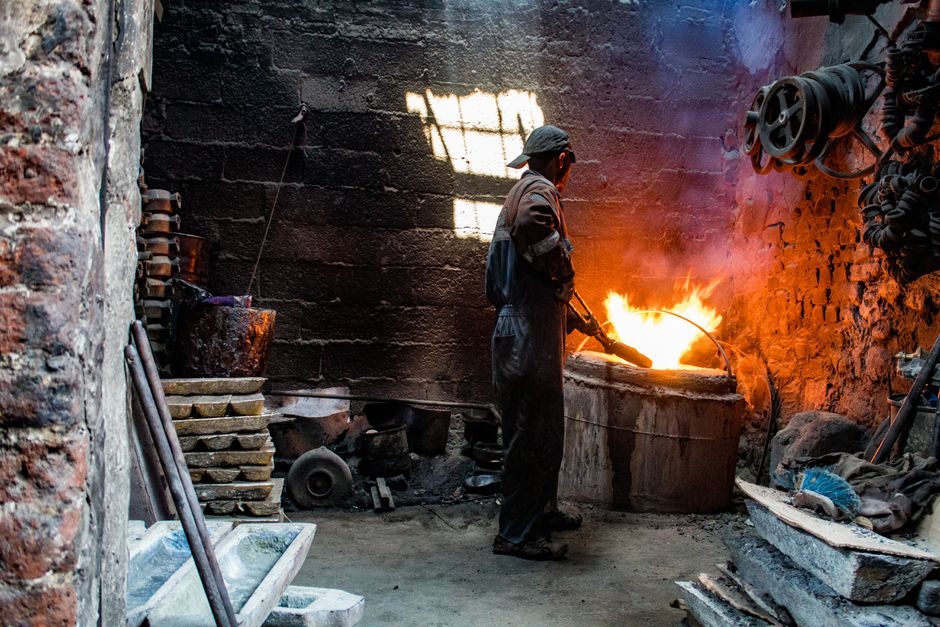
Five furnace families dominate 2026 industrial melt shops — induction, crucible, gas-fired aluminum, cupola and holding — and the selection is decided by the alloy, lot size, melt rate and melt-loss tolerance, not by marketing claims [S2].
The buying decision is fundamentally a cost-per-ton equation: rated capacity (kg/h), installed kW or Nm³/h, specific energy (kWh/t or Nm³/t), refractory campaign life (heats or weeks) and recovery yield together determine true ownership cost. A 1-ton coreless induction furnace holding 1450–1550 °C for steel is a different asset from a 500 kg gas-fired aluminum melting furnace holding 720–760 °C, even though both are called "melting furnaces" on a vendor list.
Alloy and Melt-Temperature Window: the First Filter
Pouring and refractory selection for an iron-smelting furnace and foundry ladle is keyed on a longer service life, simpler construction and easier maintenance, and the same logic cascades upstream into furnace class choice [S1].
Each alloy family collapses onto a tight liquidus range that immediately disqualifies certain furnace types. Ferrous melts (cast iron 1150–1300 °C, carbon steel 1490–1530 °C, stainless 1450–1510 °C) sit squarely inside the crucible furnace and induction envelope. Aluminum alloys (660–760 °C) demand a different refractory and tighter flue-gas management, which is why gas-fired aluminum melting furnaces use silicon-carbide or fused-cast AZS linings rather than the alumina-magnesia spinel used in iron service. Copper (1083–1220 °C) and brass (900–1040 °C) are middle-band: induction coreless is most common, but channel or push-up crucible units remain specified for foundries running mixed alloy batches. Zinc and lead (420–660 °C) are outside the high-temperature crucible business and are typically handled in low-mass cast-iron pot furnaces or resistance-heated baths.
Energy Source and Specific Energy: kWh/t vs Nm³/t
SCR-parallel intermediate-frequency melting furnaces and aluminum-shell steel-melting furnaces are now grouped as a "new energy-saving series" on Chinese OEM line cards, signalling that energy per ton is the headline procurement metric, not nameplate kW [S2].
Energy source fixes furnace geometry. Medium-frequency coreless induction (250–2000 Hz, typical 500–1000 Hz) is the workhorse for steel and iron foundries in the 0.5–20 t class, with published specific energy around 500–600 kWh/t for steel and 550–650 kWh/t for ductile iron, depending on charge preheat, scrap quality and power density. Channel induction holds 75–85 % electrical efficiency at steady state and is the right answer for high-utilization holding furnace duty, not for cold-start melting. Cupola melting furnaces running on coke plus auxiliary gas deliver 7–10 % coke-on-charge and are still the lowest specific-energy route for high-tonnage ductile iron where metallurgical coke is affordable and emissions permits allow.
Capacity, Tap Mass and Production Window
Vacuum induction melting furnaces ship as a discrete OEM category distinct from atmospheric industrial melting furnaces and aluminum melting furnaces, which means the buying process itself is split by capacity band [S3].
Lot size dictates furnace class. Jobbing iron and steel foundries running 200–800 kg batches typically pair a 0.5–1 t coreless induction furnace with a 1–3 t channel holding unit for pour-rate smoothing. High-mix low-volume specialty steel and superalloy producers move up to vacuum induction melting (VIM) furnaces, usually 50 kg–3 t, with controlled-atmosphere or vacuum capability for nitrogen- and hydrogen-sensitive grades. Aluminum foundries split into three discrete cells: small die-casting shops (200–600 kg gas crucible or stack melter), mid-volume permanent-mold operations (1–5 t gas or electric melting furnace plus 2–10 t holding), and integrated casthouses (20–80 t reverberatory or twin-chamber melter feeding a production line). Cupola plants run continuous-feed campaigns of 5–50 t/h and are economically irrational below roughly 5 t/h.
Refractory Campaign and Maintenance Access
Longer service life, convenient construction and easy maintenance is the working definition of a good refractory choice for an iron-smelting furnace or foundry ladle, and that criterion should be applied to the furnace as a whole when comparing vendor proposals [S1].
Refractory is a hidden 15–25 % of furnace lifecycle cost. Alumina-magnesia spinel linings in coreless steel furnaces typically run 200–400 heats before a re-lining patch, and 1500–3000 heats to full tear-out. Ductile-iron coreless units running at higher superheat and longer hold times compress that to 800–1500 heats. Aluminum-stack crucibles (SiC or clay-graphite) are replaced per shift in some high-throughput die-cast cells, whereas monolithic castables in a reverberatory aluminum melter can deliver 2–5 years between major repairs. The selection rule: pick the lining class the maintenance team can actually patch, not the one with the best lab data sheet. A furnace that can be hot-patched in 8 hours beats one that needs a 5-day cool-down to re-line.
Selection Criteria Matrix: Five Furnace Types Side by Side
SCR-parallel intermediate-frequency and aluminum-shell steel-melting furnaces are the 2026 mainstream for ferrous; vacuum induction remains a specialty category; and industrial melting furnaces plus aluminum melting furnaces remain a parallel aluminum-focused segment [S2][S3].
The five families line up against four decision criteria as follows. (1) Alloy: induction covers ferrous + nickel + copper; crucible covers aluminum + zinc + lead; gas aluminum melters cover aluminum only; cupola covers cast iron only; VIM covers superalloys and aerospace-grade nickel/cobalt. (2) Capacity: 50 kg–20 t induction; 50 kg–5 t crucible; 0.3–80 t gas aluminum; 5–50 t/h cupola; 50 kg–3 t VIM. (3) Specific energy: 500–650 kWh/t induction steel; 55–75 Nm³/t gas aluminum; 7–10 % coke cupola. (4) Typical user: steel/iron jobbing foundry, die-cast aluminum shop, integrated casthouse, large iron foundry, superalloy/aerospace melter. The wrong match is a small aluminum die-cast shop buying a VIM, or a 60 t/h iron plant buying a 1 t coreless — both are real spec errors seen in 2025–2026 procurement files.
Who It Is For — and Who It Is Not For
Spec-based selection against a documented alloy, tonnage and energy budget is now table stakes for 2026 buying, and the OEM market has hardened around it [S2][S3].
The right buyer for an induction melting system is a ferrous or copper-alloy foundry with 8–24 h daily utilization, stable scrap supply and access to grid power above roughly 800 kWh/t rated. It is the wrong tool for a 200 kg/h aluminum die-cast cell — that cell wants a gas crucible or stack melter, not a 500 kW solid-state inverter sitting idle 60 % of the day. The right buyer for a cupola is a ductile-iron pipe or automotive casting plant running 5000+ t/month with permits and a metallurgical-coke contract; a jobbing shop running 600 t/month will never recoup the capital. The right buyer for a holding furnace is a foundry that already has a melter upstream and needs pour-rate buffering; buying a holding furnace as a stand-alone "starter asset" is a common 2025–2026 spec error driven by lower nameplate price.
Standards, Sourcing and Trackable 2026 Signals

Vacuum induction melting furnaces and industrial melting furnaces are listed as separate procurement categories on Chinese supplier portals as of mid-2026, confirming that buyers and OEMs are keeping the categories discrete rather than converging them [S3].
For 2026 procurement, the auditable signals are: (a) verify the rated kW or Nm³/h and the specific-energy figure on the OEM data sheet, not the marketing brochure; (b) require the refractory class, lining thickness and campaign-life guarantee in writing; (c) match the furnace class to the dominant alloy and tap mass; and (d) for ferrous shops weighing induction versus cupola, also see the cost frame for the upstream charge-handling equipment covered in the skid steer loader selection criteria and skid steer loader 2026 price guide when sizing charge buckets. For shops where melt stock flows directly into cast cells, the aluminum die casting machine 2026 cost guide is the natural downstream spec neighbour. The next trackable node is the Q4 2026 release of new energy-saving series intermediate-frequency electric furnace ratings from Chinese OEMs [S2].