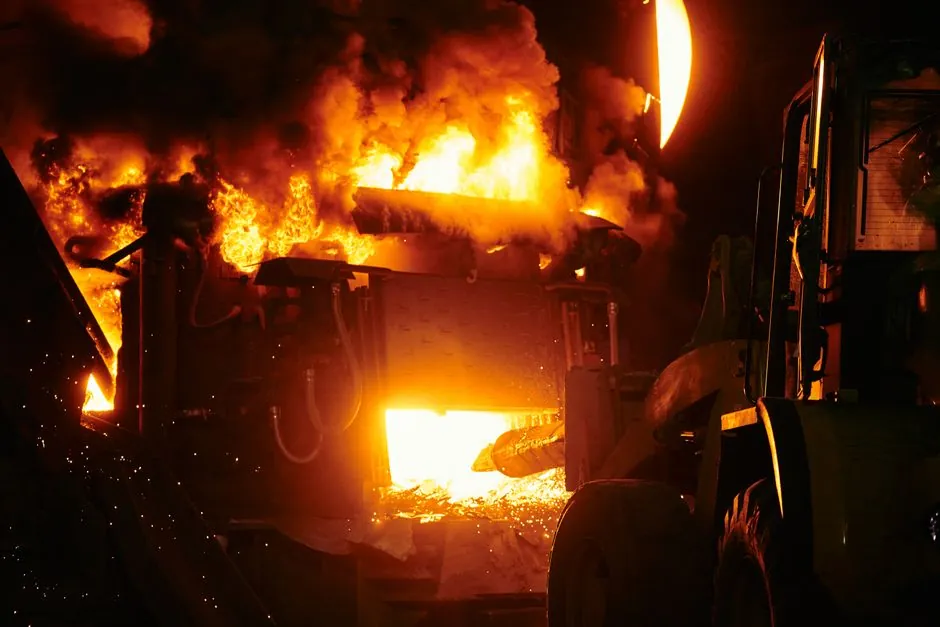
Iron-dominant agricultural machinery (plough bodies, gearbox housings, drawbar hitches, tillage discs) typically requires gray or ductile iron in the 1300–1450°C pour range, while wear parts (rotor blades, chopper hammers) often shift to high-chrome white iron or Mn-steel above 1500°C, which is the first spec gate when picking between induction furnace, cupola furnace, and crucible-class electric units [S1].
Batch size drives the next decision: small job shops pouring 50–200 kg per heat handle alloy swaps with a tilting crucible furnace, mid-volume lines at 500–2000 kg per heat typically pair a medium-frequency induction furnace with a holding furnace, and high-tonnage grey-iron plants keep a hot-blast cupola furnace as the primary melt source [S1][S3].
Alloy, Melt Mass, and Batch Rhythm
Agricultural castings split into three alloy families, and each one pushes the furnace choice in a different direction. Gray and ductile iron for structural housings melt in the 1250–1450°C band and tolerate either cupola or induction melt; high-chrome white iron and Mn-steel wear parts push past 1500°C and rule out standard graphite-crucible electric units, which are typically rated for metals below 1100°C continuous (with a 1150°C short-term ceiling) per the Eagle digital gold-melter spec sheet [S2]. Magnesium-alloy implement components, increasingly used for lightweight housings, are normally processed in dedicated gas-aluminum-melting-furnace-style sealed units or vacuum/atmosphere-controlled crucible furnaces with SF₆ cover gas, not in open induction baths [S1].
Capacity per heat is the second hard gate. A 10 kg magnesium laboratory furnace is a R&D unit, not a production asset [S1]; a 1–2 kg electric gold/silver melter with a graphite crucible and 1100°C continuous rating [S2] is similarly a bench tool, not an agricultural-line primary melter. Production-scale agricultural castings start in the 100–500 kg crucible class and scale up to 5 t coreless induction furnace furnaces with 750–1500 kW medium-frequency power supplies for grey-iron gearbox and axle-housing pours [S3].
Comparing the Main Furnace Classes
For a magnesium-specific agricultural part (e.g. a Mg-alloy gearbox cover), the supplier benchmark is a dedicated magnesium melting/dosing furnace with sealed crucible and cover-gas train, not a generic melting furnace, and these are quoted at roughly US$1,000 per set on Chinese B2B catalogs in 2026 listings, MOQ 1 piece or 1 set [S1]. A typical 1 kg/2 kg digital electric gold/silver melter with 1100°C continuous rating, digital PID control, and MS-body construction is a comparably-priced bench reference point, but it is built for jewelry-scale loads, not for casting iron tractor parts [S2].
Energy, Power, and Throughput Numbers
Coreless induction furnace units specified for agricultural iron foundries in current Alibaba/Made-in-China listings cover 0.1–5 t per heat with 100–3000 kW medium-frequency power, 1–10 t/h melt rate, and 380 V / 50 Hz or 415 V / 60 Hz mains, with energy consumption commonly quoted at 550–620 kWh per ton of liquid iron [S3]. A 750 kW, 1 t medium-frequency unit typically ramps a cold charge to 1450°C in 55–70 minutes, holds temperature within ±15°C under PID control, and pairs naturally with a 500–800 kW channel-type holding furnace on the pour line for continuous molding [S3].
Cupola furnaces in the agricultural machinery segment (mostly India and China small foundries) are typically 400–800 mm internal diameter, 3–6 t/h cold-blast iron output, with coke ratio 1:7 to 1:9 (coke:iron) and 1800–2000°C tuyere zone temperature; modern hot-blast cupolas add a 600–800°C blast preheater and a wet scrubber, and they win on cost per ton but lose on flexibility if the melt must move to ductile iron or steel [S3]. Crucible furnaces (lift-out or tilting) for farm-machinery job shops are usually 100–500 kg capacity, 60–150 kW electric or 30–80 m³/h natural gas, and are still specified where batch changeover exceeds 4–6 alloy shifts per day, or for short-run specialty parts [S1].
Selection Criteria, Use Cases, and Sourcing
Decision rule of thumb for agricultural machinery buyers: if the dominant product is gray/ductile iron in batches above 2 t and the line runs 8+ h/day, specify a medium-frequency induction furnace with a holding furnace; if the line is high-tonnage grey iron and the local coke price is below roughly 80% of equivalent electricity cost, stay with a cupola furnace; if the work is small-batch alloy swaps, repair castings, or magnesium-alloy lightweight parts, a tilting crucible furnace or a sealed magnesium dosing furnace is the right tool [S1][S2][S3].
Current 2026 sourcing signals: Chinese B2B catalogs list induction melting furnaces, crucible furnaces, and magnesium alloy dosing furnaces in the US$1,000–10,000 per set range with MOQ 1 piece, lead times quoted at 15–45 days ex-works Baoji/Shijiazhuang [S1][S3]. Indian small-foundry catalogs list 1 kg and 2 kg electric gold/silver melters with 1100°C continuous rating (1150°C short-term), digital temperature control, MS body, and a graphite-crucible + tongs + stirring-rod accessory kit, again for jewelry scale and not for iron castings, but a useful reference for what a modern small electric crucible furnace package looks like at the entry level [S2]. The melting furnace category page covers the full generic landscape for buyers comparing cross-category options.
Limitations, Failure Modes, and Standards
Each furnace class has a known failure pattern that a spec sheet should address. Induction furnaces suffer coil-grounding faults and water-leak incidents when cooling water conductivity drifts above 5 µS/cm; cupolas suffer tuyere blockage and stack-emission excursions when coke moisture exceeds 6%; crucible furnaces suffer thermal-shock cracking if charging cold, wet returns above roughly 20% of charge weight; holding furnaces suffer skull buildup and lid-hinge fatigue after roughly 5,000 heating cycles [S3]. A practical engineering gate is to require refractory lining warranty terms of at least 6 months or 1,000 heats, whichever comes first, and a documented water-quality spec on any induction-class unit [S3].
Standardization note: agricultural machinery iron castings are typically purchased against ISO 1083 for ductile iron grades (e.g. EN-GJS-400-15 for gearbox housings, EN-GJS-600-3 for wear-loaded hubs) and ISO 185 for grey iron (Grade 200–300 for non-critical housings); safety of the furnace itself is typically covered by IEC 60519-1 and IEC 60519-2 for electric heating installations, with CE/EMC conformance for the European market. Operators should request the supplier's test report and refractory data sheet before issuing a PO, and verify that the rated melt mass matches the heaviest single heat in the production schedule, not just the average.
Closing signal: a verifiable next move is to compare induction and cupola per-ton melt cost against the 2026 local industrial electricity and coke tariffs, then confirm that any short-listed crucible furnace or magnesium dosing furnace carries a current 12-month refractory warranty and a documented SF₆ or SO₂ cover-gas system for Mg-alloy work [S1]. For related cast-component sourcing, the Nickel Alloy Selection for Automotive Manufacturing: 2026 Grade Map page covers wear-resistant grades that often overlap with white-iron agricultural wear parts, and the Zinc Die Casting Machine Selection for Rail Components page covers shot-weight and tonnage math that translates to agricultural die-cast gearbox housings.