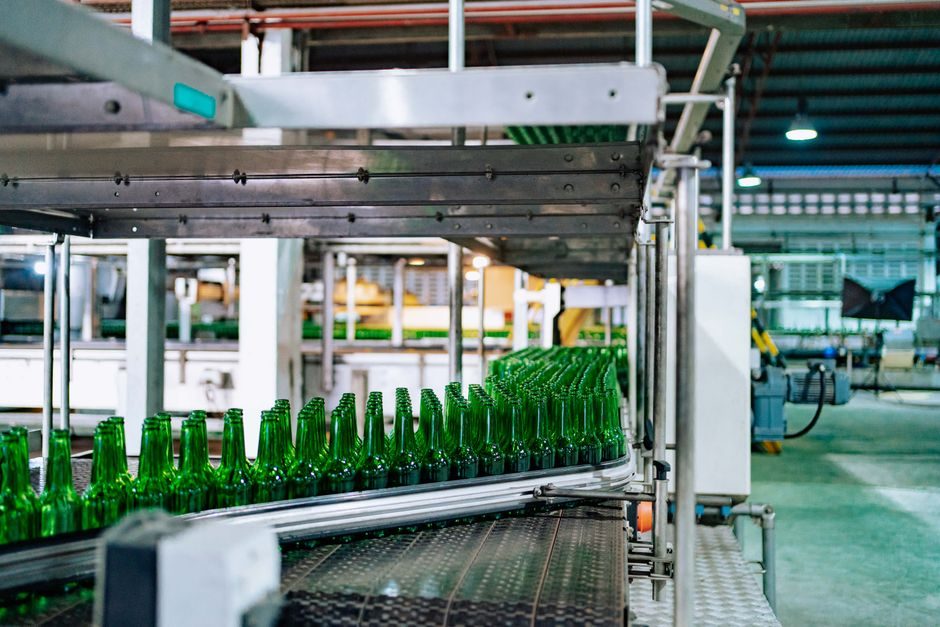
Selecting a mesh belt conveyor in 2026 is a five-gate engineering decision, not a catalogue browse: belt material chemistry, continuous-temperature window, product load per square metre, mesh opening geometry, and the drive-and-speed envelope each cut the candidate list by roughly half, and only a handful of builds satisfy all five at once.
Recent supplier data confirms the operating envelope for the most common belt class: PTFE-coated fibreglass mesh is rated for continuous service from -140 °C to +260 °C, with a short-term peak resistance of 360 °C [S1]. Stainless-steel balanced-weave and spiral mesh belts from Chinese wire-mesh manufacturers cover the heavier-duty range typical of food, glass and heat-treatment lines [S2][S3].
Belt material class and temperature window
PTFE-coated fibreglass open-mesh belts are the default pick for drying, shrinking, and textile-finishing lines where the surface must release sticky product and survive oven exposure, with a published continuous range of -140 °C to +260 °C and short peaks to 360 °C [S1]. Where the chemistry of the product rules out PTFE (e.g. certain food-contact greases at sustained >200 °C), stainless-steel wire-mesh belts — typically SS304 for general food/dairy and SS316 for corrosive wash-down — are the alternative, supplied as balanced weave, flat wire, or spiral-link construction by dedicated mesh-belt factories [S2][S3].
For ambient or sub-100 °C packaging and light-duty lines, non-metallic belts such as polyester and PVC mesh remain in production, and current factory catalogues still segment PTFE, PVC, felt, and fusing-machine belts as distinct product lines [S5]. The selection gate is chemistry first, temperature second: a 200 °C oven line that processes oily food will fail a polyester belt but run cleanly on SS304 balanced weave with a wiped-down return run.
Load per square metre, mesh opening, and product behaviour
Mesh opening and wire diameter jointly set the load capacity, the airflow through the belt, and whether the product will sit on the surface or drop through. PTFE open-mesh belts are sold in standard grid counts (commonly 1×1 mm to 10×10 mm) where finer mesh raises contact area and product support but cuts airflow — a direct trade for drying efficiency versus carry-through of small parts [S1].
For washing, coating, or freezing lines where the belt must drain or let air rise through the product, mesh opening is the dominant gate, ahead of frame width. For blanching or pasteurising tunnels on food lines, SS316 with a 6–8 mesh count is the typical default because the open area is large enough for water and steam to reach the product [S3]. The same manufacturer portfolios also offer spiral-link mesh belts for cooling spirals, where the belt must track a tight radius and the wire pitch becomes the controlling variable [S3].
Frame, drive, and speed envelope

The mechanical envelope is set by three numbers: belt width, linear speed, and drive power. Light-duty PTFE lines typically run 0.5–6 m/min; heavy-duty SS spiral or rod-reinforced belts for freezers, bakeries, and glass lines run 2–25 m/min with drive drums sized to the tension rating. Cross-referencing a belt conveyor layout against a steel mesh datasheet is the only reliable way to size the drum and the tensioner together; mismatches here are the most common cause of premature belt stretch or edge tracking failure. [S1]
Tensioning hardware is itself a selection gate: a fixed-length screw take-up suits short, low-speed lines, while a gravity or pneumatic belt tensioner is the correct call on long dryer tunnels where thermal expansion across 30+ m is non-trivial. For variable-speed lines running a flat-belt or V-belt drive, the sheave ratio and motor frame size have to be locked in parallel with the belt width — change the belt material, and the required torque band shifts again.
Decision comparison: PTFE mesh vs SS304/SS316 mesh vs polyester mesh
Stacking the three mainstream belt chemistries against four decision criteria gives a clear cut: PTFE mesh wins on temperature (-140 °C to +260 °C continuous, 360 °C peak) and release properties, SS304/SS316 balanced weave wins on mechanical load and chemical/corrosion resistance at the cost of belt mass, and polyester mesh wins on unit cost and food-contact flexibility up to ~100 °C [S1][S2][S3][S5]. A useful working rule is: PTFE when the oven exceeds 180 °C or product sticks; SS316 when the line is wet, washed down, or carries hot oil; polyester when the line is ambient and the budget is tight.
Two side-by-side choices that often confuse buyers: a PTFE belt with a Kevlar or fibreglass reinforcement is not equivalent to an SS belt at 200 °C — PTFE will out-perform on release, SS on puncture and load. And a ribbed-belt drive should not be specified for a precision dryer line that requires slip-free synchronisation; a synchronous or gear-motor drive is the correct hardware, and the drive choice is independent of the mesh material.
Where mesh belt conveyors are NOT the right answer
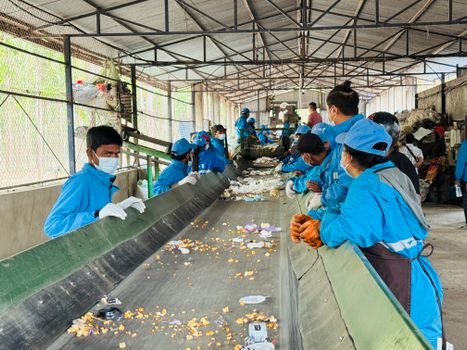
Mesh belts are wrong for three common scenarios: high-impact loading of lump rock or scrap (use a chain conveyor or apron feeder instead), sanitary lines that demand a fully sealed, crevice-free surface (use a flat stainless or modular plastic belt), and long inclined runs above 15° carrying packaged product (use a roller conveyor with cleats or a cleated modular belt). Pushing a mesh belt into any of these three roles typically shows up as belt stretch, edge wear, or contamination carry-over within the first quarter of service. [S2]
Two further constraints are easy to miss: spiral mesh belts have a minimum product size to track the radius cleanly — small parts migrate outward at speed and jam the spiral — and PTFE open mesh has poor resistance to mechanical cuts from sharp tooling, so a metal-detect or blade station upstream of the belt is good engineering practice. Where these constraints rule the belt out, the adjacent chain conveyor selection guide covers the alternative architecture.
Standards, traceability, and 2026 sourcing signals
There is no single ISO or EN standard that governs a complete mesh-belt conveyor assembly; the relevant references are material- and component-level. Stainless belt wire is commonly ordered to AISI 304/316 chemistry; food-contact belts are typically specified against FDA 21 CFR and EU 1935/2004 compliance, with factory documentation available on request from established manufacturers [S2][S3]. Drive and guarding components fall under ISO 13849 and EN 60204-1 for the conveyor as a machine, applied by the system integrator rather than the belt supplier.
Two 2026 sourcing signals to track: the consolidation of PTFE and PVC mesh belt production around a small set of Chinese factories that publish multi-language catalogues covering both belt families on a single domain [S5], and the steady broadening of wire-mesh-belt factory product lines into spiral-link and rod-reinforced formats for freezer and bakery applications [S3]. Together they mean a 2026 RFQ can usually be quoted from two or three suppliers with verifiable production photos and material certificates, rather than the long email chains of five years ago. When the spec drives the belt weight past ~25 kg/m², ask the supplier for a finite-element or test data sheet on the spiral pitch — it is the single most predictive document for service life.
For related coverage, see Chain Conveyor vs Vibrating Conveyor: Which One Actually Fits Your Line.