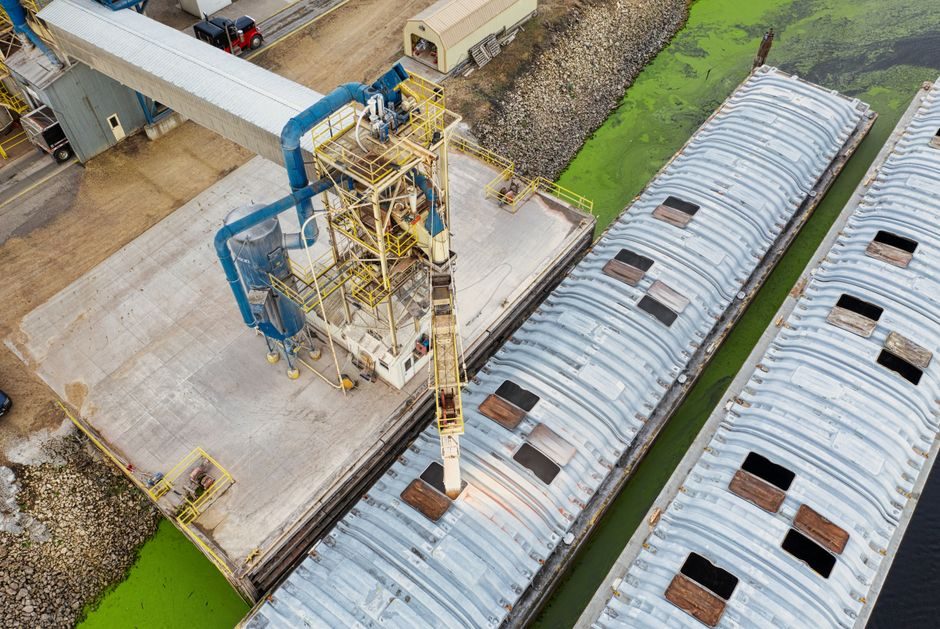
Chain conveyors are built around a roller chain or silent chain pulling pallets, drums, tires and bodies through assembly, accumulation and transfer — Daifuku Webb's power-and-free overhead range reaches 10,000 kg maximum load with individual load stop/start [S1].
Vibrating conveyors move bulk — ores, sand, food granules, foundry sand — on a trough shaken by an eccentric or electromagnetic drive; the product never leaves the pan, so abrasive or hot material (often 150–400 °C in foundry duty) rides on a static surface while only the pan moves. The decision is not "which is better" but "unit load or bulk, hot or ambient, accumulation or steady flow."
Core Mechanism and Energy Path
A chain conveyor transmits force through a tensioned chain loop — conveyor chain meshes with sprockets at the drive and tail, dragging flights, attachments or carrier saddles along a track. PIBRA's two-track modular line lists electric, manual, central and automatic drive options in a single product code, all feeding the same chain conveyor frame [S2].
A vibrating conveyor stores energy in a spring-mass system and releases it as a controlled oscillation. The trough is mounted on leaf springs or coil springs; an eccentric or linear vibrator drives it at a tuned frequency, typically 50–60 Hz for mechanical units and 5–50 Hz for electromagnetic feeders. Material is propelled in a series of micro-throws; the trough itself does the work, so there is no wear surface in contact with the product other than the pan.
What Each One Is For — and What It Is Not For
Chain conveyors are the right answer when the load is discrete: a pallet of parts, a 500 kg workpiece fixture on a Maschinenbau Kitz SRF-P 2010 accumulating line running 30,000 mm/min, a vehicle body, a tyre, a drum of fluid [S3]. They accumulate, transfer, lift to overhead, and merge into painting or assembly cells. They are the wrong answer for free-flowing bulk: fine ore will fall through chain gaps, sticky cake will foul sprockets, and a 1 km trough of vibrating pan is far cheaper to maintain than a sealed cable drag chain running the same duty.
Vibrating conveyors are the right answer for hot, abrasive, or fragile bulk: foundry sand returning to a shakeout, clinker cooler discharge, food-grade sugar or salt where sanitary washdown matters, or glass cullet where metal-to-metal contact would shatter the product. They are the wrong answer when you need a stoppable unit load, when the line must accumulate under power, or when the product has any structural rigidity — a vibrating pan will not carry a 500 kg engine block from station to station.
Selection Criteria, Side by Side
Five gates decide fit. (1) Load form: discrete unit load → chain; free-flowing bulk → vibrating. (2) Temperature: chain components are usually limited to roughly 200 °C at the chain itself (the product can be hotter if shielded), while vibrating troughs handle 400–600 °C castings or hot clinker on refractory-lined pans. (3) Accumulation: chain conveyors stop individual carriers on power-and-free tracks at full line speed [S1]; vibrating conveyors only accumulate by building a deeper bed on the pan, which changes residence time and throughput. (4) Maintenance envelope: chain drives are accessible, lubrication-points visible, links replaceable; vibrating drives are sealed but springs and bearings wear, and pan cracks are a recurring repair. (5) Sanitation: vibrating troughs lift off and wash down in minutes, which is why food, dairy and pharma bulk lines almost always pick them over enclosed drag systems.
Daifuku Webb's stated 10,000 kg ceiling is at the top of the chain-conveyor envelope; most floor-mounted assembly lines sit between 500 kg (Maschinenbau Kitz SRF-P 2010) and 3,000 kg, and overhead power-and-free systems handle the heavy tail [S1][S3]. PIBRA's two-track modular frame accepts pallet, packaging, container, wood, concrete, drum, automobile, tyre, glass, long-product and wheel carriers on a common chassis [S2] — a flexibility envelope that vibrating equipment cannot match because vibrating equipment does not carry discrete carriers at all.
Operating Limits, Failure Modes, and Real Numbers
Chain conveyors fail predictably: chain stretch past 3% over a 1 m span is a re-tension signal; sprocket tooth wear shows as hook engagement; flight wear changes the pickup geometry. Maximum speeds for accumulation conveyors are usually 0.5 m/s, with 30,000 mm/min (0.5 m/s) being a typical upper figure for a roller-chain accumulation line [S3]. Overhead power-and-free runs faster on the main loop but slows at workstations. Chain elongation beyond the take-up travel is the most common reason a chain conveyor suddenly stops; the take-up cannot absorb the next thermal or load cycle.
Vibrating conveyors fail in springs, bearings and pan welds. A cracked coil spring changes the natural frequency; the trough begins to rock, noise rises, and the drive motor pulls more current. Pan weld failures show as casting leaks in foundry duty or as product leakage in sanitary lines. Stroke length (typically 5–25 mm peak-to-peak) and frequency must stay in the designed range; doubling the stroke "to push more material" is the single most common field mistake and ends in anchor-bolt failures.
Where Lines Use Both Together
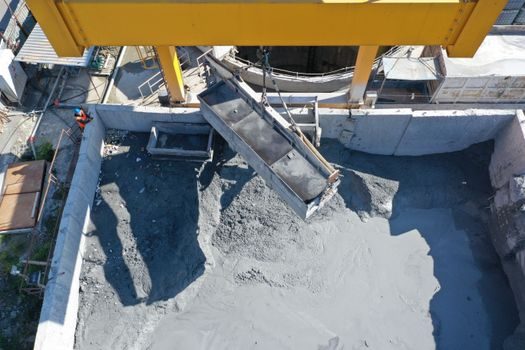
Foundries, cement plants and mineral processing routinely run a vibrating conveyor under a crusher or cooler and feed a chain conveyor downstream for palletising or transfer. In a paint shop, the overhead power-and-free chain carries bodies through pre-treatment, oven and topcoat [S1], and the sludge or overspray byproduct exits on a vibrating pan. In a bottling plant, glass moves on a chain conveyor through inspection and the broken cullet drops onto a vibrating trough to be conveyed back to the recycling bin. The two technologies are complements, not competitors, on most well-engineered lines.
For buyers mapping a new line, the belt conveyor buying guide 2026 covers the third major option when the load is neither discrete nor hot, and the screw conveyor selection criteria article covers enclosed bulk transfer where dust containment is the driver. If the constraint is a heavy-lift hoist or crane feeding the chain conveyor, the single girder crane vs storage rack breakdown clarifies how upstream handling affects carrier design.
Cost, Lead Time, and Sourcing Signals
Chain conveyor lead time tracks the longest sub-assembly: power-and-free track in 8–14 weeks for a 200 m overhead loop, 4–8 weeks for a floor-mounted accumulating line. PIBRA-style modular two-track frames ship faster because the carrier and track are catalogued [S2]. Vibrating equipment lead time is dominated by the pan: stainless or refractory-lined troughs push 10–16 weeks, and electromagnetic drives are still on allocation for some European brands.
The two verifiable signals to track over the next quarter are: (1) OEM disclosure of new sanitary vibrating pan certifications for food and pharma — useful for buyers replacing drag conveyors to meet washdown rules; (2) overhead chain conveyor requalification projects tied to EV battery and solar-panel assembly growth, where power-and-free accumulation is being repurposed from automotive paint shops into cleanroom-adjacent lines [S1]. Either signal moves a procurement decision forward more reliably than a price quote.