
Urban infrastructure sites — parking lots between buildings, subdivision grading, road widening inside built-up corridors — resolve to a small set of repeatable dozer picks: 13–20 t mid-size hydrostatic crawlers with a Power Angle Tilt (PAT) blade for general grading, and 30 t+ crawler dozers when haul-road cuts and large-volume fill moves are on the critical path [S3]. The reasoning is mechanical, not marketing: hydrostatic drive replaces the torque converter + powershift with a closed-loop hydraulic circuit, so the operator can reverse and turn under load without clutching, which is exactly the cycle that dominates confined urban work.
Urban projects also have to coexist with adjacent structures, buried utilities, and municipal noise/emissions rules, which pushes the spec away from the largest mining-class dozers and toward machines sized to the smallest productive load. A related working spec map for bulldozer selection for demolition reaches a similar conclusion from the opposite end of the site — demolition favours guarded cabs and 360° visibility over raw blade force — and the same logic governs picking a dozer for a city block.
Why a mid-size hydrostatic crawler keeps winning urban tenders
Mid-size hydrostatic crawlers in the 13–20 t operating-weight class deliver enough drawbar pull to push compacted urban fill yet stay under the width and axle-load envelopes that road-base contractors and municipalities prefer, per the scenario-based selection logic in the 2026 JumboBee dozer guide [S3]. The same source maps urban parking-lot grading explicitly to a "mid-size Crawler Dozer with Hydrostatic Drive (for example, Deere 700 or Caterpillar D5) with a Power Angle Tilt Blade" because the operator must angle the blade to windrow material to the side and pivot in tight circles between buildings [S3].
For pipeline and right-of-way work that also runs through urban corridors, hydrostatic drive gives the same controllability edge that pays off in narrow easement cuts, and the dedicated bulldozer spec map for pipeline right-of-way construction walks through the undercarriage and ripper choices that sit underneath that drivetrain call. The crossover is real: a pipeline crew working inside a city street is doing urban grading with extra depth control, and the same mid-size hydrostatic platform is the typical answer.
Crawler vs wheel dozer vs mini dozer on a city site
The three drivetrain/chassis families compare on four criteria that matter on a city site, and the table below is the short-list a fleet manager or estimator should keep on the truck:
· Crawler dozer (track): best for soft, uneven, or abrasive subgrade; slow ground speed but highest tractive effort per ton; ground pressure commonly in the 0.4–0.7 bar band for a 15–20 t machine with standard track shoes [S3].<br/>· Wheel dozer (tyre): up to ~3× the ground speed of a crawler on hard surfaces, which makes it the right pick for spreading fill on a finished roadbase or working a quarry haul road; ground pressure higher, so it cuts up soft urban subgrade and is generally ruled out on muddy city lots [S3].<br/>· Mini dozer: under ~6 t operating weight, narrow track gauge, and a small PAT or six-way blade — the precision choice for finish grading, sidewalk sub-base prep, and backyard utility trenches where a full-size dozer cannot enter [S3].
The 3:1 speed ratio between wheel and crawler machines is the headline number from the JumboBee 2026 guide [S3], and the practical reading is that contractors who own one wheel dozer and one mid-size crawler can cover most urban grading and road-maintenance contracts without buying a third platform. Selecting among these three should be done before brand short-listing, because the chassis family constrains tyre/undercarriage budgets, transport width, and the available blade and ripper options more than the engine badge does.
Blade, ripper, and undercarriage choices on the urban spec
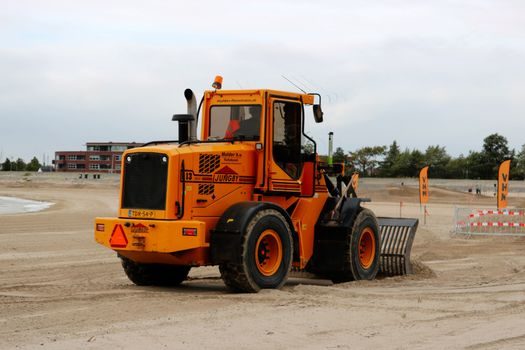
Blade geometry is the second decision after chassis family. A straight (S) blade is the cheapest and pushes the largest volume per pass on a long, straight windrow — highway cuts, subdivision pads. A universal (U) blade adds large wings that roll material ahead of the cutting edge, increasing capacity on lighter materials but at the cost of higher rolling resistance. A Power Angle Tilt (PAT, also called six-way) blade tilts and angles in addition to lift, which is what makes it the urban default: the operator can windrow to the side, cut a slope, and back-drag a finish surface without repositioning the machine [S3].
Single-shank and multi-shank rippers live at the back of most crawler dozers and break up hardpan, frost, or lightly shot rock before the blade reaches it. For urban work the ripper is more often used to fracture a cement-stabilised base or a thin asphalt layer than to break true rock, so a parallelogram ripper with a single tooth is the common config on mid-size machines [S3]. Undercarriage choices — sealed-and-lubricated track (SALT) vs standard, and shoe width from ~460 mm to ~610 mm — are set by the ground-pressure target: wider shoes drop psi for soft subgrade, narrower shoes fit tighter urban corridors and reduce transport-weight charges. The general machine mass range for the class sits at 13–20 t, with engine output typically 110–160 hp for the mid-size tier [S3].
Hybrid and electric drivetrains for low-emission urban zones
Hybrid bulldozers pair a combustion engine with electric drive motors and an energy store (battery bank or supercapacitor) that captures energy under deceleration and load swings, with the electric motor carrying the transient peaks. The 2026 Mico Equipment bulldozer guide flags hybrid units as a fit for "urban development projects with controlled ecological footprints," where noise caps, night-shift rules, and Tier 4 Final / Stage V emission zones all push the spec toward electrified drivetrains [S4].
The practical trade-off is capital cost vs operating-cost recovery. Hybrid drive trims fuel burn on a load-and-carry cycle but only pays back the premium where machine hours are high, fuel cost is high, and the site is genuinely noise- or emission-sensitive — a school expansion, a hospital campus, a night shift inside a noise-restricted district. Pure battery-electric dozers exist in the small and mid-size class for indoor demolition, greenhouse pad work, and tunnel work, but for open-air urban grading the hybrid diesel-electric platform is currently the lowest-risk specification [S4].
Total cost of ownership and the 100-tonne outlier
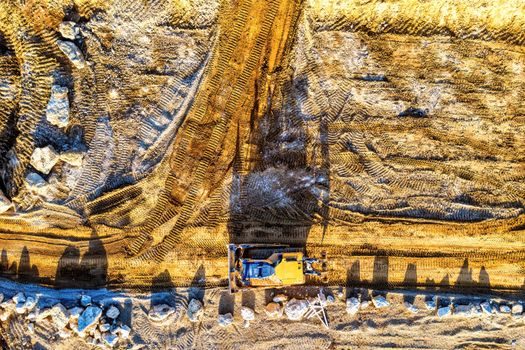
Total cost of ownership on a dozer is dominated by fuel, undercarriage wear, and scheduled service over a 10,000–15,000 h life, not by acquisition price. The Hengwang spec guide puts the relevant machine-weight window for the bulk of grading, land-clearing, and infrastructure work in the 14–30 t class, with single-machine purchase prices ranging from roughly USD 80,000 for a small utility dozer to well over USD 500,000 for a 30-tonne-plus unit [S5]. The same source reminds buyers that rippers — "claw-like device" at the rear of the dozer — "break up hard ground or rock," which is the capability that pushes a 30 t dozer onto an urban site in the first place, even when the daily grading volume does not strictly require the size [S5].
For projects that genuinely need 100-tonne-class machines — large open-pit cuts, heavy mining, major port earthworks — the SinoRealMachinery 2026 buyer's guide positions machines like the SR980LC at the top of the size envelope, with operating weights near 100 t and engine outputs well above 500 hp [S6]. For urban infrastructure that ceiling is almost never the right answer; the 100 t class is over-sized for a city block, over-width for standard lowboy transport in many jurisdictions, and over-budget for the marginal productivity it adds on a 2 m cut. The economic question is whether the site's hourly production target can be met with two mid-size machines at lower mobilisation cost, or whether a single large machine reduces the head-count on site enough to justify the freight premium [S6].
Project-management and ecological context for urban dozer work
Urban infrastructure dozer selection does not happen in isolation from how the project is procured and how the disturbed ground is restored. The Springer 2013 study on non-business urban infrastructure construction finds that "the economic loss, time delay, low efficiency of investment caused by the improper selection of project management frequently occurred" when owners fail to align the management mode to the characteristics of the project — which translates in the field to the wrong-sized fleet being mobilised and the wrong machine class being deployed for the subgrade being worked [S1].
Ecological design of the same urban footprint is governed by the EU Habitats Directive 92/43/EEC, which lists 231 habitat types (71 priority) and underpins the requirement that disturbed ground on urban green-infrastructure projects be re-vegetated with species assemblages appropriate to the microhabitat, not generic turf [S2]. In practice this means the dozer on a park, greenway, or urban-forest project is a temporary tool that has to leave a finish surface the planting crew can actually work with, which is one of the reasons finish-grade mini dozers sit alongside mid-size hydrostatic units on urban framework contracts.
Track these signals over the next planning cycle: municipal Stage V / Tier 4 Final enforcement dates in your jurisdiction, hybrid dozer model availability in the 15–20 t class, and contractor prequalification criteria that score undercarriage technology and emissions tier alongside hourly rate. For deeper coverage of the demolition-side trade-offs, the bulldozer selection for demolition working spec map is the natural read-along.
Detailed specification references: bulldozer, pressure transmitter, and flow meter.