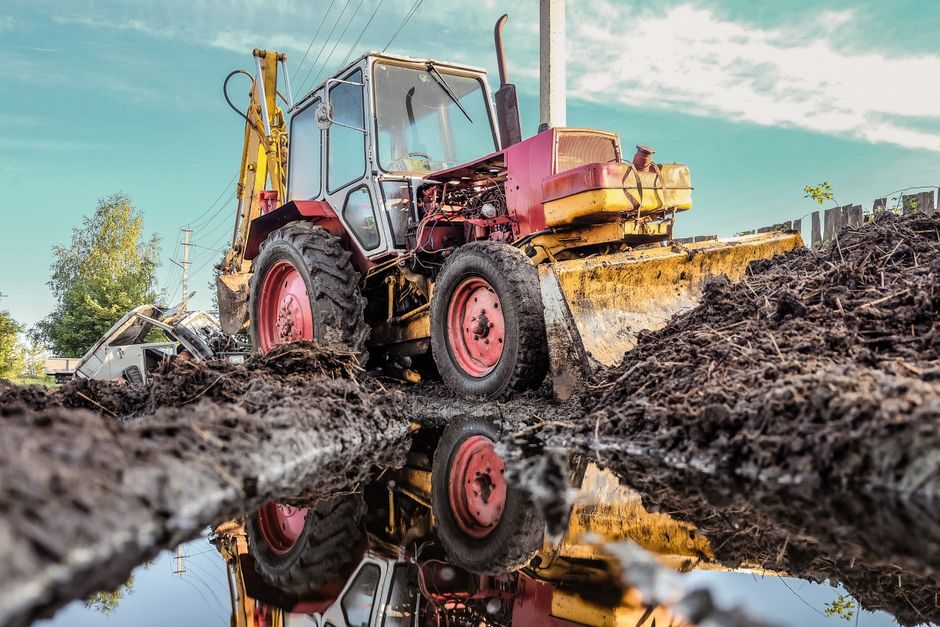
On European gas-trunk spreads, pipeline construction dozer packages cluster around the 20-30 tonne operating-weight class with hydrostatic drive, semi-U or full-U blade and bolt-on rear ripper, sized to keep pace with 100-200 m/day lay rate on 500-1400 mm dia lines [S1].
Typical reference projects, including the 75 km of 1200 mm Wijngaarden-Westerschelde and 106 km of 1400 mm Gazelle gas pipeline, demand 3-5 dozers per spread for right-of-way (ROW) clearing, trench excavator push, padding and backfill support, plus a dedicated swamp or low-ground-pressure (LGP) unit for wet crossings and sideboom assist [S1].
Operating Weight Class and Engine Power Tiers
Crawler dozers for pipeline work split into three tiers: small (D5/D6 class, 13-20 t, ~110-160 hp) for 300-500 mm distribution and tie-in work; medium (D7/D8 class, 20-35 t, ~180-260 hp) for 500-1200 mm trunk lines; and large (D9/D10 class, 40-70 t, ~370-600 hp) for 1200-1400 mm trunk and station-yard grading on cohesive or rocky soils [S1].
Engine tier typically follows emissions stage requirements rather than raw horsepower: Tier 4 Final / Stage V units are now standard for European spreads, and contractors such as A.I.B. GmbH operate across DE, AT, FR, BE, NL, DK, RO and FI with welding and shutdown crews on projects typically governed by ISO 9001:2015 quality systems [S2].
Blade Type Selection by Soil and ROW Task
For pipeline ROW specifically, the dominant spec is semi-U because it handles both grading on the ditch line and pushing the excavator spoil back during backfill, eliminating a second machine on the spread. Coal-seam or rock spreads may require a D8/D9 with single-shank parallelogram ripper, hydraulic tilt, and optional root rake for ROW clearing ahead of the trench.
Undercarriage and Ground Pressure for Cross-Country ROW
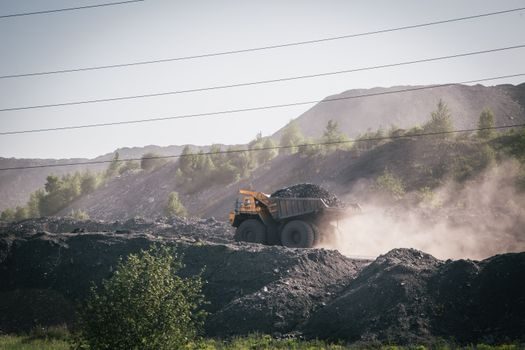
Standard track (STD) undercarriage ground pressure of 55-65 kPa works on dry, drained farmland; LGP (low ground pressure) versions drop that to 28-40 kPa via wider track shoes (760-915 mm) and longer track frames, required for marsh, peat, snow and reclamation-area work common in NL and DK spreads [S1].
Undercarriage protection spec should include full-length track-frame guards, positive track-pin seals, and rock-guards/strut guards when running abrasive fills. Sealed-and-lubricated (SALT) chains extend bushing life 2-3x versus standard dry-pin chains on rocky ROW, a measurable saving when a dozer logs 3,000-4,000 hr on a single 100 km spread.
Drivetrain, Hydraulics and Operator Cab Spec
Hydrostatic drive has effectively replaced torque-converter + powershift on new pipeline dozers because it provides infinite speed control from 0-10 km/h forward/reverse without clutching, critical for fine grading next to an open trench and for power-turning under load.
Cab spec for pipelay should include ROPS/FOPS, sealed HVAC with positive-pressure dust filtration (cat dust rating MERV equivalent), sound levels under 75 dBA at the operator station, and rear-view camera plus side-view mirrors. EU operators expect integrated 2D/3D machine-control GNSS mounting brackets even if slope-assist alone is bought initially, because most spreads retro-fit Trimble or Topcon grade control within the first 500 hr.
Sideboom, Ripper and Trench-Shield Coordination
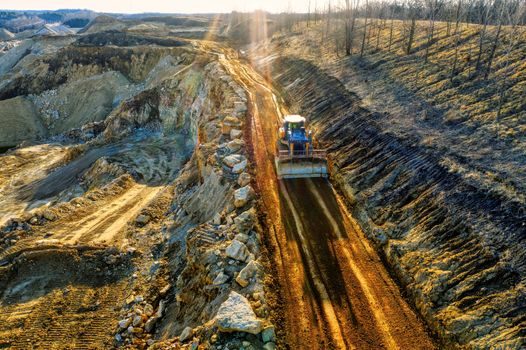
A pipeline spread rarely buys a dozer as a stand-alone machine: it is paired with a dedicated sideboom (typically 40-90 t class pipelayer) for lowering in, and with a hydraulic excavator for trenching. Dozer push on the excavator during hard digging is the most common justification for the medium D7/D8 class on 800-1200 mm spreads [S1].
Single-shank parallelogram ripper, with ripper-beam raise/lower and pitch hydraulics, is specified on 60-70 % of European trunk-line dozers because root and weathered-rock removal on the ditch line is a daily task; multi-shank (3-tooth) rippers are reserved for agricultural ROW with shallow root mats. Trench-shield handling rarely involves the dozer directly but does require a dozer on standby for emergency backfill and shield extraction.
Inspection, Serviceability and Cost-of-Ownership Signals
For European pipeline contracts running 18-36 months, fleet managers weight daily service points (10-minute ground-level fluid checks), centralised lubrication banks, and modular final-drive removal, because a dozer offline on a spread costs 800-1,200 EUR/day in lost production. Service intervals of 500 hr on engine oil and 2,000 hr on hydraulic oil, with no-tool daily greasing, are now baseline [S2].
For bulldozer fleet planning on multi-spread contractors, this is the single most defensible procurement argument in 2026.
Limits, Failure Modes and What Bulldozers Do Not Cover
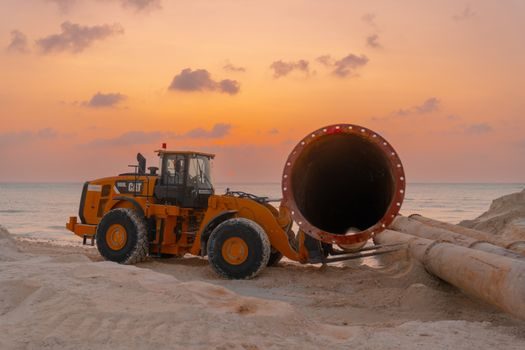
Bulldozers are not a substitute for excavator trenching, sideboom lowering-in, or compaction on the backfill lift; specifying a dozer to dig hard ground beyond 0.6-0.8 m depth burns fuel and tracks without productivity. They also cannot deliver smooth-grade finish on final lift: a motor grader or compactor must follow the dozer on the ROW for the visible surface profile [S1].
Common failure modes on pipeline ROW include track-shoe wear from abrasive sand (replace at 50 % shoe-plate thickness), final-drive seal failure from water ingress on swamp crossings, and radiator core blockage from cottonwood or willow seed in spring ROW clearing. Inspect radiator cores at 250 hr intervals during high-debris months. For more on the broader earthmoving selection logic and how crawler dozers compare against wheel dozers on adjacent mining and landfill duties, the mining dozer spec map for 2026 and landfill bulldozer selection guide lay out the wheel-vs-track trade-off, while the stainless steel grade map covers the blade and ripper material options that resist abrasive wear in rocky ROW.
Track the EU Stage VI emissions deadline for non-road mobile machinery between 37-75 kW as a 2026 watch-item for small D5/D6 class re-powering; meanwhile, hydrostatic-drive market share on new pipelay orders and the Tier 4 Final residual at 3-year auction are the two signals that will move spec in the next 12 months.
Detailed specification references: bulldozer, pipeline pump, and pressure transmitter.