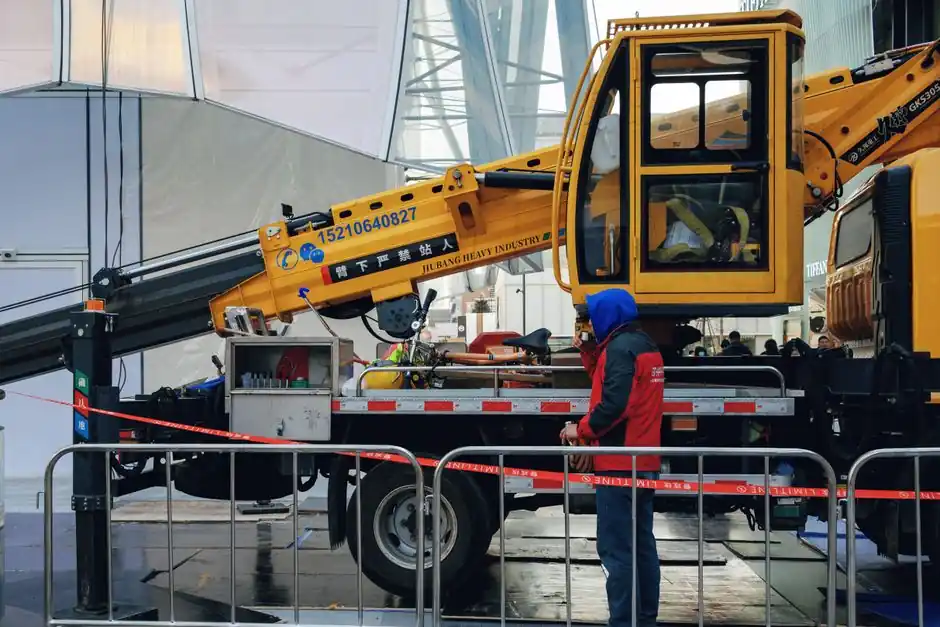
Mining-grade aerial work trucks are built on severe-duty chassis with booms spanning 23 ft to 200 ft, platform widths up to 192 inches, and self-leveling rotating platforms rated for dust, moisture, and continuous vibration [S1].
Selection pivots on five decision axes: working height required, boom architecture (telescopic vs. articulating vs. knuckle/telescopic), chassis class, on-board utilities (welder, air, hydraulic, 110 V leads at the basket), and the duty cycle the unit will see in pit or plant service [S1][S2].
What "Mining" Actually Changes on an Aerial Work Truck
OSHA-mandated fall protection has pushed aerial work platforms (AWPs) into roles once held by ladders and scaffolding, including mining, where standard utility bucket trucks are not rugged enough for production environments [S2]. Mining-specific upfits address four wear mechanisms: respirable dust ingress, sustained vibration from haul-road travel, impact from fly rock and bench faces, and continuous duty cycles that would burn through a light-commercial boom in a single shift [S1].
A typical mining upfit packages a severe-duty chassis (e.g., Western Star), a heavy-duty rotating platform up to 192 inches wide, an insulated or material-handling boom, and turret- or basket-mounted jibs and winches for crane-style tasks [S1]. Common in-service configurations also include on-platform utilities (welder leads, compressed air, hydraulic circuits, 110 V receptacles) so the operator can run a tool without descending, which directly cuts cycle time on maintenance work [S1].
Boom Architecture: Telescopic, Articulating, and Knuckle/Telescopic
Bucket-truck OEMs offer three primary boom architectures, each with a distinct reach profile: telescopic ("stick" or "squirt" booms) for maximum horizontal reach, articulating booms for up-and-over access, and knuckle/telescopic combinations for high-elevation side reach with reduced tail swing [S2]. Telescopic units like the Elliott H110F and the Elliott E-Line series (E160) are favored where straight-line outreach dominates, while the Terex LT40 and Versalift VST-7500-E108 illustrate the articulating-telescopic class that limits truck repositioning on congested bench work [S2].
Within articulating designs, overcenter booms let the bucket travel past the truck's centerline, a geometry that pays off in forestry, utility, and construction jobs with restricted set-up areas [S2]. For pit-wall scaling, ANFO loading, and highwall lighting or instrumentation work, a telescopic insulated boom (e.g., 70 ft to 110 ft class) is the common fit because it combines vertical reach with the horizontal standoff needed to keep the truck off the blast zone [S1]. Bucket-truck OEMs Terex, Versalift, and Altec are the three names most cited for global fleet procurement in this segment [S2].
Working Height, Reach, and the Mining Task Map
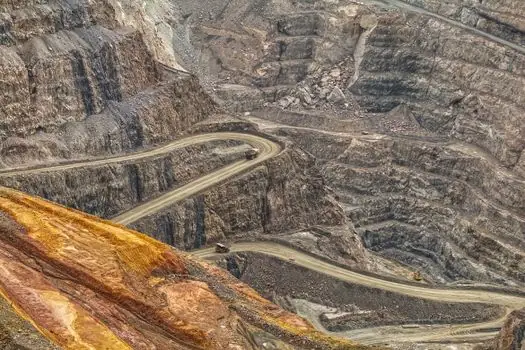
Working height should be matched to the highest routine access task, not the worst-case one-time job, because each step up the boom-length ladder adds cost, chassis mass, and counterweight requirements [S4]. Mining tasks typically cluster into four height bands, each with a different optimal boom class: 23-50 ft for ANFO delivery, scaling, and shotcrete nozzle work; 50-70 ft for haul-truck light clusters, crusher liners, and conveyor head pulleys; 70-110 ft for highwall instrumentation, primary crusher structures, and stockpile lighting; and 110-200 ft for transmission/distribution work crossing the mine lease, where the unit behaves more like a utility line truck than a pit vehicle [S1].
Horizontal outreach, not just vertical height, drives the real productivity number. Telescopic booms deliver the longest straight-line reach, which is the deciding spec when the truck must set up on a haul road and reach over a berm to a bench face; articulating booms win where the work sits behind an obstruction the boom must fold around [S2][S4]. The knuckle/telescopic configuration is the compromise spec, trading a small amount of straight reach for far less tail swing on the offside, which matters when the truck is working next to a live crusher or a high-traffic haul road [S2].
Load Class, Platform Size, and On-Board Utilities
Aerial platform trucks are commonly segmented into three load classes, and the right class depends on whether the basket is carrying one worker with tools, two workers with materials, or heavy fixtures like a motor or a section of pipe [S4]. A standard light-duty basket (under ~250 kg) handles inspections and single-worker tool work; medium-duty (250-500 kg) covers two-person crews with welders and gas bottles; heavy-duty platforms above 500 kg, often with the 192-inch rotating deck, are used for material handling, ANFO delivery, and component replacement on crushers and conveyors [S1][S4].
Self-leveling rotating platforms are a defining mining option because they let the operator rotate the load without slewing the whole truck, a critical feature when the truck is pinned against a bench wall with no room to maneuver [S1]. On-board utilities (welder leads, compressed-air couplings, hydraulic circuits, and 110 V power at the basket) are not accessories, they are the reason the unit replaces scaffolding in the first place [S1][S3]. Mining-grade builds also add turret-mounted winches for crane-style lifts, basket-mounted jibs to position a load past the basket rail, and material-handling jibs for ANFO delivery systems (e.g., Elliott G50 Minereach) [S1].
Chassis, Drivetrain, and Pit-Site Mobility
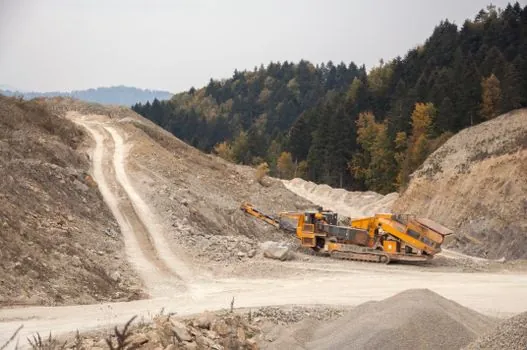
The boom is only half the spec; the chassis decides whether the truck actually reaches the work face. Mining upfits are typically mounted on severe-duty flatbed chassis (Western Star is a common choice for 110 ft-class booms) with reinforced subframes, additional outriggers, and suspension rated for haul-road speeds on unpaved surfaces [S1]. Wheelbase, axle configuration, and gross vehicle weight rating (GVWR) must be checked against the boom's stowed and deployed moment loads, because an overcenter load on soft pit-floor material can lift a drive axle if the chassis is undersized [S1][S2].
For fleet managers comparing mining-spec aerial work trucks against other access equipment, the relevant trade is truck-mounted boom vs. self-propelled boom on a dedicated carrier: truck-mounted units win on road mobility and rapid deployment between pits, while self-propelled units win on rough-terrain maneuverability at a single fixed face [S4]. Buyers should also weigh how the unit integrates with the existing mining dump truck fleet (see mining dump truck selection guidance and mining haul truck class and TCO maps), because parts commonality and dealer footprint drive lifecycle cost as much as the boom spec does [S8]. For broader context on how aerial work trucks fit into the heavy-equipment lineup, see the aerial work truck encyclopedia entry and the aerial work platform overview.
Standards, Safety, and Sourcing Constraints
Aerial work platforms used in mining service must meet the same ANSI A92.20 design, ANSI A92.22 training, and OSHA 29 CFR 1910.269 / 1926.453 fall-protection requirements that govern utility and construction AWPs, plus any MSHA requirements that apply when the unit is operating in a regulated mine site [S2][S3]. Insulated booms (e.g., Elliott I70 at 70 ft) are specified for work near energized overhead lines crossing a mine lease, while non-insulated material-handling booms are restricted to de-energized or non-electrical tasks [S1].
Not every option listed by an upfitter is available on every brand or model: Aspen's published mining menu, for example, explicitly states that boom lengths from 23 ft to 200 ft, 192-inch platforms, and turret winches are not uniformly populated across the Elliott and Armlift lines they carry [S1]. Sourcing lead time and dealer support density should be checked before locking the spec, because a 110 ft boom on a severe-duty chassis is a long-lead build and downtime in a remote pit is expensive. As one industry guide puts it, "a better platform match can improve jobsite safety, boost working efficiency, and support long-term fleet reliability" [S4], a sentence that captures the entire selection case in one line.
Trackable signals to watch through Q4 2026 include OEM announcements on hybrid-electric severe-duty chassis (which would change the mine-site fuel-cost math), any MSHA guidance update on insulated aerial devices in surface coal, and the next round of bucket-truck market sizing data following the 2027 projection of $1.5 billion global valuation [S2].
For component-level specifications, see mining dump truck.