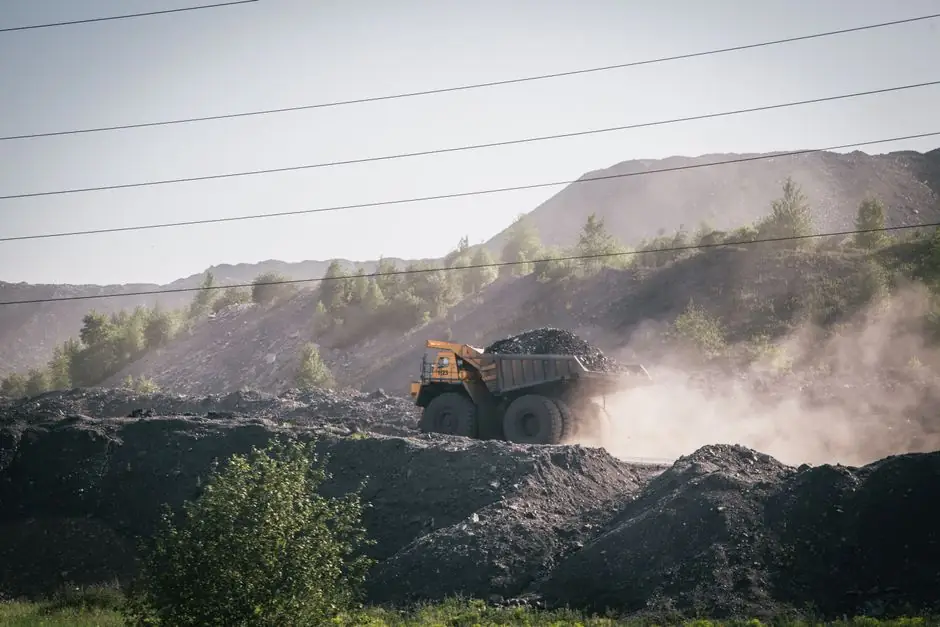
Farm managers who try to repurpose ultra-class off-highway mining dump trucks above 300 t payload [S3] quickly run into ground-pressure and road-width problems that rule the configuration out for cultivated fields.
Articulated dump trucks (ADTs) and small standard dump trucks sized 1.5-16 cubic yards cover most agricultural tasks from fertilizer haul to harvest movement [S2][S4], and selection hinges on four criteria: nominal payload, body volume in cubic yards, ground clearance, and turning radius. This article lines those criteria against the four main dump-truck classes so an ag buyer can avoid the over-spec trap and still get year-round reliability.
Why ultra-class rigid mining dump trucks do not transfer to the field
Rigid-frame off-highway mining trucks are built for controlled haul roads in open pits and large quarries, with massive off-road tires, a non-articulated chassis, and ultra-class payload capability above 300 t [S3]. Their tare weight concentrates axle load high enough to rut soft topsoil, and their 6 m+ width typically exceeds farm-track lane limits, which is why the four-class taxonomy on [S3] keeps them in a separate open-pit bucket from anything used on cultivated land.
For a working baseline, [S5] reports that haulage absorbs up to 70% of open-pit operating cost, and that transport cost climbs 20-30% per 100 m of additional pit depth. Translating that economics to agriculture: a heavier truck on a soft field is paying the same depth penalty on every load, which is a direct cost increase with no production offset.
Articulated vs standard dump trucks: which suits farm haul
Articulated dump trucks with a pivot joint between cab and trailer are widely specified for large construction sites, infrastructure projects, earthmoving operations, and medium-scale mining, and the same pivot geometry gives them the slope and soft-ground performance that muddy field entrances demand [S3].
Standard on-road dump trucks in the 10-16 cubic yard range remain the most common agricultural hauler for fertilizer, crop, and bulk-aggregate moves [S2][S7], while small modified pickups near 1.5 cubic yards cover orchard and livestock-farm duties. Side-dump and roll-off variants earn their place in tight spaces where rear unloading is not feasible, including mixed agriculture and mining support yards [S4].
Decision criteria: payload, body volume, ground pressure, maneuverability
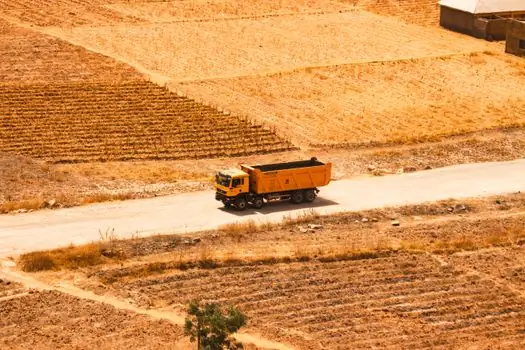
Selection across the four dump-truck classes is driven by four engineering criteria. Nominal payload sets the per-load economics; standard rear-tippers cover 10-16 cubic yards (roughly 7.6-12.1 cubic meters after unit conversion 1 m^3 = 1.308 yd^3 per [S2]) while ultra-class rigid haulers go to 300+ t. Body volume dictates trip count: a 16 yd^3 standard truck at field density moves roughly 20 t per cycle versus 300+ t on a single rigid-truck cycle. Ground pressure rules out ultra-class on tilled soil because tire footprint does not scale with chassis mass. Maneuverability, captured by turning radius and overall length, separates ADTs and standard dump trucks from rigid off-highway units in narrow farm lanes.
The same selection logic, applied to landfill and tunnel work, lines up along a similar set of constraints, as mapped in dump-truck-selection-for-landfill-operations-spec-map-and-operating-fit-criteria and tunnel-dump-truck-selection-class-geometry-and-haul-cycle-match. For ag use the FUCOM multi-criteria framework from [S5] is overkill in its full form, but the four-group split (technical, technological, environmental, economic) is a clean way to score candidates on a scoring sheet.
Class-by-class comparison for farm and farm-adjacent work
Standard rear-tippers (1.5-16 yd^3) are the default for fertilizer, grain, and bulk-aggregate haul on public-road-linked farms, with the lowest acquisition cost and the broadest service network [S2][S7]. Articulated dump trucks (typically 25-45 t payload class) extend that envelope to soft-ground fields, muddy access tracks, and slope work, trading higher unit cost for traction and lower ground pressure via multi-axle steering [S3]. Side-dump and roll-off variants win where rear ejection is blocked by a wall, bank, or conveyor, and they show up in mixed agriculture-mining sites handling ore, overburden, and feed-stock in the same yard [S4].
Rigid off-highway mining trucks in the 100-300+ t class are economic only on engineered haul roads with continuous high-load cycles [S3]; using one part-time on a farm wastes both fuel and capital. Underground dump trucks are a separate low-profile geometry problem outside the ag envelope and are not considered here.
Use cases that do and do not justify a mining-class truck on a farm
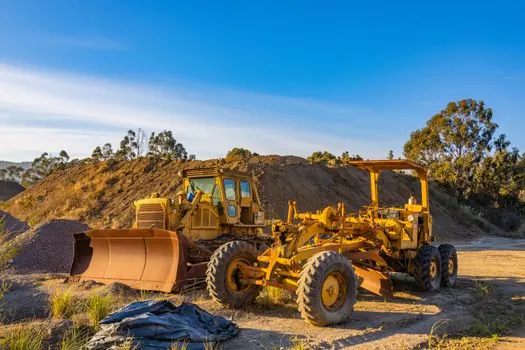
Farms and farm cooperatives that operate their own quarry, borrow pit, or aggregate operation can justify a mid-size articulated or standard rigid-frame truck in the 30-60 t class, because the unit handles both on-road aggregate haul and in-field earthworks [S3][S7]. A row-crop operation with a 2,000-acre grain or produce footprint is best served by 10-16 yd^3 standard rear-tippers for crop and fertilizer movement, supplemented by a single 25-40 t ADT for landforming and drain work [S2][S4].
Orchards, vineyards, and livestock operations rarely need more than a small modified-chassis dump truck near 1.5 yd^3 plus a tractor-trailer combination; specifying anything larger increases tire-soil compaction without lifting throughput. The same dump-truck type range shows up in the broader equipment encyclopedia and on the mining dump truck reference, but the operating envelope is very different from the ag side.
Standards, sourcing, and what to verify at the dealer
No ag-specific mandatory standard governs dump-truck selection, but buyers should confirm three engineering points: the manufacturer's published payload and body-volume rating in the operator manual (units are often cubic meters, requiring conversion 1 m^3 = 1.308 yd^3 per [S2]), tire load rating matched to soft-ground operations, and brake and lighting compliance for any on-road movement between fields. Manufacturer published load capacity tables (e.g., SANY SYZ448C-9S(R) at 48 m^3, equivalent to about 63.3 yd^3 per [S2]) are the right reference for the actual hauled volume, not the body geometric volume alone.
Selection studies for open-pit fleets consistently flag that transportation cost dominates 50-70% of total operating cost depending on depth and haul distance [S5], so any ag buyer who oversizes into mining-class equipment is paying a mining-class fuel and maintenance bill for a fraction of the cycles. For crews already running mixed fleets, the concrete and material-handling side of the equipment line is covered separately in concrete-mixer-truck-selection-for-demolition-projects-spec-map, which uses a similar criteria-scoring approach for a different truck class.
Trackable signals to watch: dealer-reported ADT lead times in the 25-45 t class, manufacturer updates to body-volume ratings in cubic yards for North American ag spec sheets, and any revision to tire-load-rating tables for soft-soil operations. The encyclopedia entries on dump trucks and mining dump trucks will carry the next spec refresh once the 2027 model-year data lands.
Detailed specification references: reach truck.