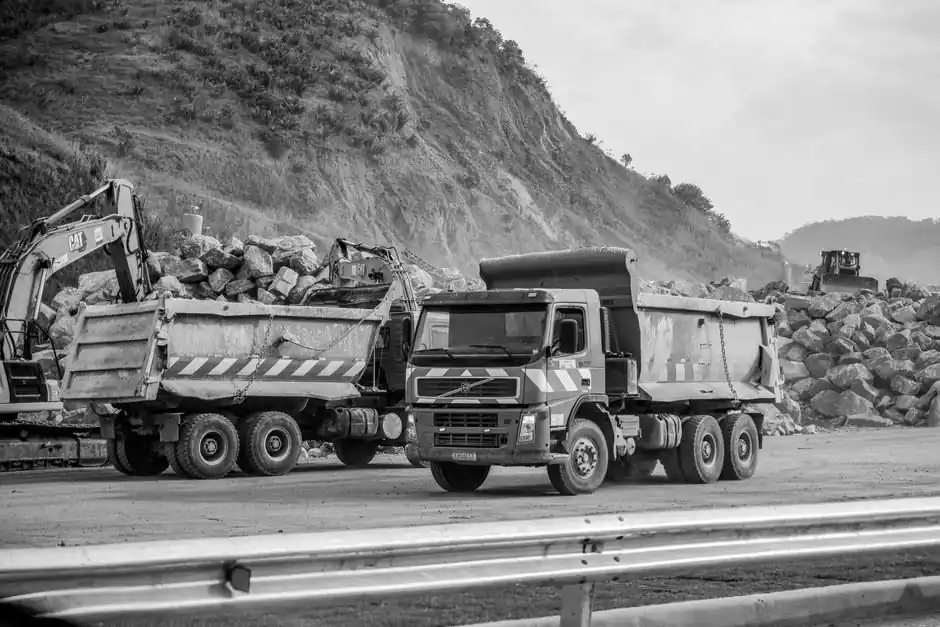
Landfills run a hybrid of waste streams, cover soil, and often leachate-saturated cells, so the truck spec that works at a hard-rock open pit rarely transfers cleanly. The first decision is chassis type: rigid haulers in the 90-400+ t payload class with engines above 1,500 hp dominate long-haul, well-maintained mine roads, but they demand stable, drained haul surfaces and tolerate soft, wet cover poorly [S1][S3].
Articulated dump trucks (ADTs) in the 30-45 t class carry permanent all-wheel drive, oscillating articulation, and suspension tuned for soft, inconsistent terrain, which is closer to the daily reality of a working cell [S3]. For most municipal and industrial landfill operators, the practical envelope sits between these two, and selection comes down to haul distance, ground bearing capacity, and waste density rather than marketing payload claims.
Chassis decision: rigid hauler vs ADT vs electric drive
Rigid mining dump trucks use a fixed frame, payload classes from 90 t up to 400+ t, and engines above 1,500 hp, giving them the lowest cost-per-ton on long, well-maintained haul roads with high cycle counts [S1]. Their limitation at a landfill is sensitivity to soft, wet, or contaminated ground: thick mud and standing water force downtime because the chassis and tire loadings assume a prepared surface [S3].
ADTs accept lower payloads but trade them for permanent AWD, articulated steering, and suspension travel that keeps all wheels on the ground across ruts, cover-soil transitions, and 30% grades, which is why they remain the default for short-haul, soft-ground work [S3]. Electric-drive mining trucks (battery and trolley-assist variants) are now offered by major OEMs, with zero on-site exhaust and lower energy cost per ton, though battery pack mass penalizes payload on every cycle and capital cost remains roughly 2-3x a comparable diesel rigid [S1]. For a closed landfill cell with cap work, the electric case is real; for a mixed-waste active face, diesel ADT still wins on availability.
Payload, engine, and body sizing for waste streams
Payload class is governed by MSW bulk density, not headline rating. Municipal solid waste in a loose cell runs 350-500 kg/m³, while cover soil and C&D debris push 1,200-1,800 kg/m³, so a 40 t rated ADT will gross out on volume long before weight on most waste days [S1][S5]. A 30-45 t ADT with a struck body of 19-24 m³ is the common match for MSW; for cover soil and daily cover, stepping up to a 45 t class or adding a tailgate for controlled dumping avoids spillage on the run to the working face [S5].
Engine class should track haul profile, not peak payload. For landfill ramps of 8-12% grade at 1-3 km, 350-500 hp is the working band for 30-45 t ADTs, with a retarder (engine brake or hydraulic) sized to hold rated gross weight down the descent without fading the service brakes [S3]. Hydraulic tailgates and controlled-dump bodies are standard on most modern ADTs, which matters at a landfill where uncontrolled unloading spreads litter and compactor traffic follows [S1][S5].
Ground, tires, and total cost of ownership
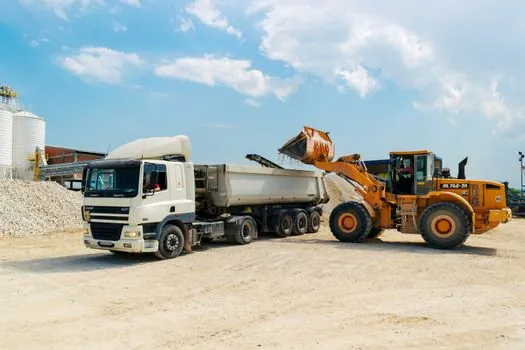
The hidden cost on a landfill is the haul road. Rigid haulers require stable, well-drained, meticulously maintained roads; building and maintaining that surface is a major capital line and a continuing operating expense, which is why the rigid TCO equation only works at high annual tonnage and long cycles [S3]. ADTs tolerate poor surfaces, but tire wear on a contaminated, sharp-debris site is the single largest variable cost: specify cut-resistant radial earthmoving tires, expect 2,000-4,000 hour life depending on cover material, and budget a tire-management line that is often 15-25% of scheduled maintenance.
For deeper decisions, a 2024 multi-criteria study of open-pit dump-truck selection ranked technical, technological, environmental, economic, and organizational criteria using the FUCOM method, and flagged that haulage can reach 70% of total open-pit operating cost, with cost rising 20-30% for every 100 m of additional depth [S4]. The same logic applies to a vertical landfill cell: every metre of lift adds cycle time and fuel, so right-sizing payload to the cell geometry matters more than chasing the largest truck the gate can fit.
Standards, safety, and site-specific constraints
Landfill trucks operate under the same off-road vehicle safety regime as mining equipment, with ROPS/FOPS cabs, fire suppression, and slope-rated braking expected as standard rather than optional. Operator visibility, reverse alarms, 360° camera systems, and body-up indicators are baseline on modern ADTs and rigid haulers from major OEMs, because tip-over and sideslip on contaminated ground are the dominant incident categories [S1][S3].
Check local rules on leachate containment: any truck working in or near a cell must be specified with drip pans, hydraulic leak kits, and a body design that minimises residual liquid discharge on the haul road, which directly drives selection of sealed hydraulic systems and stainless or hard-lined tipper floors on machines dedicated to wet waste [S5]. Engine emissions tiering (US EPA Tier 4 Final, EU Stage V) is the other non-negotiable line for most new deliveries in 2026, and it interacts with the electric-drive decision because battery machines sidestep the emissions compliance burden entirely.
Use-case match: which truck for which landfill
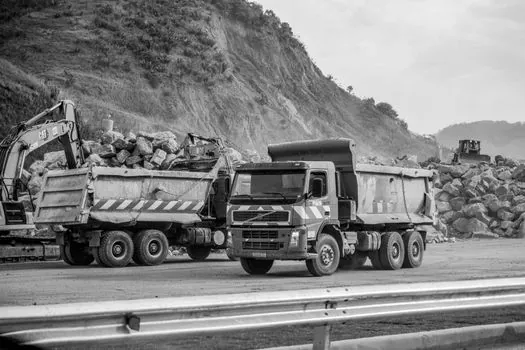
Active MSW face, 0.5-2 km haul, soft and wet ground: 30-45 t ADT with 19-24 m³ body, 350-500 hp, retarder, and hydraulic tailgate. This is the default for most municipal sites and the lowest-risk spec [S3][S5].
Closed cell with cap and cover-soil haul, 2-5 km on a prepared access road: 45-60 t ADT or, if tonnage and road quality justify it, a 90-100 t rigid hauler. The rigid wins on cost-per-ton only when the road is engineered and drainage is reliable [S1][S3].
Greenfield regional landfill, high annual throughput, 3+ km internal haul on engineered roads: 100-150 t rigid hauler, with ADT support for cell-edge and slope work. Capital is high, but per-ton cost is the lowest of the three options on the main haul [S1][S4].
Urban or odour-sensitive sites with zero-exhaust mandates: electric-drive mining truck (battery or trolley) where OEM support and charging infrastructure exist; otherwise a Stage V / Tier 4 Final ADT [S1].
Decision criteria in one view
Comparing the three main options against the four landfill-relevant criteria: a 40 t ADT scores high on soft-ground mobility and capital cost, medium on cycle speed, and low on cost-per-ton at long haul distances. A 100 t rigid hauler scores high on cost-per-ton and cycle speed, but low on soft-ground mobility and capital cost. An electric-drive mining truck scores high on emissions and operating energy cost, medium on soft-ground mobility (battery mass varies by OEM), and low on capital cost and on payload net of battery weight. Use this as the starting matrix, then weight each row against your site's haul distance, road quality, tonnage, and regulatory environment [S1][S3][S4].
Limits and failure modes to spec against
The most common selection mistake at a landfill is buying a rigid hauler for a soft, short-haul site, then bleeding money on haul-road maintenance, tire wear, and weather-related downtime [S3]. The opposite mistake, buying a 25 t ADT for a 5 km engineered haul, leaves cost-per-ton on the table versus a 100 t rigid. Either extreme is a sign the multi-criteria framework, technical, technological, environmental, economic, and organizational, was not applied up front [S4].
Other failure modes worth naming: underspec'd retarders on loaded descents (brake fade, fire risk), wrong body steel for acidic leachate exposure (floor perforation within 18-36 months), and tire selection that ignores sharp C&D debris in the waste stream. Each of these is a known, named failure category in off-road haulage, and each is addressable in the spec before purchase, not after [S1][S3][S5].
For adjacent equipment decisions, the same site-selection logic applies to a skid steer loader for landfill work, and to cover-soil placement where a dynamic compactor for demolition fills is sometimes mis-applied. The truck is the right starting point because haulage drives the cost stack.
Track two signals over the next planning cycle: OEM announcements on electric-drive mining-truck payload parity with diesel rigid haulers, and any tightening of off-road engine emissions rules that shifts the TCO math toward battery machines. Either one will reset the chassis decision above within 24-36 months, while ADT-versus-rigid selection on ground conditions is unlikely to change.
For component-level specifications, see mining dump truck, dump truck, and reach truck.