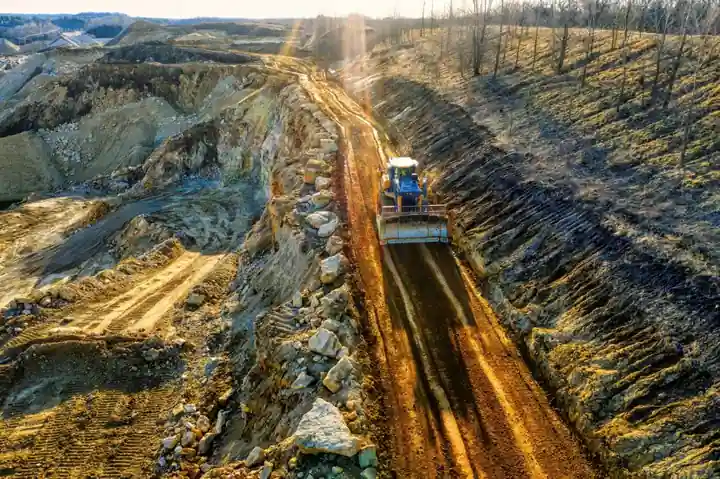
Mining-spec bulldozers are typically selected in the 320 HP and above class for overburden stripping, ripping, and haul road maintenance, where drawbar pull, low ground pressure, and reinforced undercarriage life dominate the decision over brochure horsepower [S4].
Across open-pit, quarry, and stockpile roles the machine is judged by traction efficiency, structural strength, hydraulic response, cooling capacity, and field service access; these working-condition checks, not catalog numbers, decide whether a dozer survives a 24/7 mining duty cycle [S1].
Mining Roles a Crawler Dozer Must Cover
Overburden support, ripping, slot dozing, bench/berm upkeep, and haul road maintenance are the five recurring production roles for a mining dozer, and each role maps to a different traction, weight, and blade priority [S3].
Short-haul earthmoving under 100 m with a Universal (U) blade is consistently cheaper than mobilizing an excavator-truck fleet for the same load, which is why stripping, stockpile feeding, and bench cleansing stay on the dozer rather than the shovel [S5].
Slot dozing in defined lanes keeps material on the blade longer, reduces spillage loss on short to medium push distances, and limits traffic conflicts on busy benches, a containment technique that consistently improves pass consistency over open-bench pushing [S3].
Drawbar Pull, Weight, and Ground Pressure
Drawbar pull under a loaded blade, not peak engine power, is the metric that decides whether a dozer can move blasted rock, weathered overburden, or sticky clay in a single pass [S1].
Soft ground and wet overburden invert the usual size logic: low ground pressure from wider tracks and balanced weight beats raw blade volume, and an oversized machine that loses mobility becomes a fuel-burn problem instead of a productivity asset [S2].
For a deeper comparison of how tracked machines compare to other heavy equipment used on the same mine site, the bulldozer reference page lays out the typical operating weight, ground pressure, and drawbar-pull ranges for production crawler classes.
Blade Selection: S, U, Semi-U, and Angle
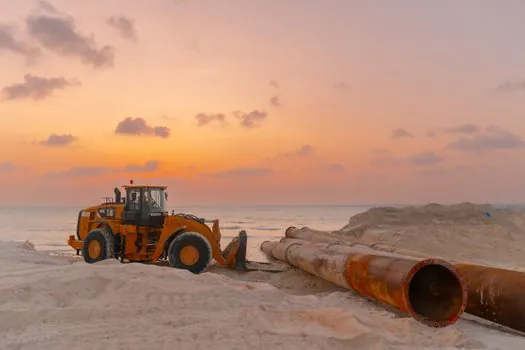
Straight (S) blades fit stripping and grading on hard, compacted soil; Universal (U) blades carry the largest volume for stockpiling and long pushes of loose, low-density material; Semi-U (SU) blades split the difference for general mining on mixed rock and dirt; angle blades handle soft to medium soil road side-casting [S4].
U-blade wings move materially more volume than a standard straight blade, which is the reason high-capacity stockpile management in coal and ore yards stays on U-blade configured crawlers rather than smaller S-blade units [S4][S5].
Material rolling, blade penetration, and uphill push response should be verified on the actual pit floor, because a blade that looks correct on paper can fail to load on wet, compacted, or sharply fractured ground [S1].
Ripping: Single-Shank vs Multi-Shank
Single-shank rippers give deep penetration into tough limestone, shale, and weathered ore horizons, while multi-shank rippers are chosen for fragmentation across wider passes where breaking pattern matters more than depth [S3][S4].
Ripping pre-conditions compacted ground so the next blade pass or loader cycle can move material at a lower wheel-slip and fuel cost, which is why most mining-spec crawlers leave the factory with a rear ripper as standard [S4][S5].
Modern mining dozers increasingly use automated ripping logic that trims engine RPM and track speed to prevent track slip, a control change that materially extends undercarriage life, normally the single most expensive maintenance line on a tracked machine [S5].
Crawler vs Wheel Dozer Trade-Off
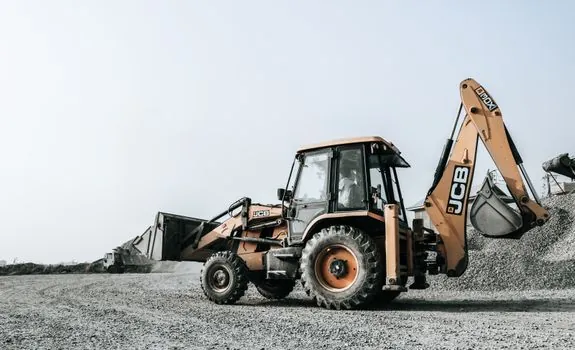
Crawler dozers win on steep grades, soft ground, heavy ripping, and pioneering bulk pushes because of low ground pressure and high tractive effort, while wheel dozers win on cleanup around shovels, haul road light maintenance, and high mobility between sites because they self-travel without a lowboy [S5].
Undercarriage wear (bushings, links, sprockets) is the dominant maintenance cost on a tracked mining dozer, while tire life and drivetrain heat are the equivalent cost centers on a wheel dozer; the choice is effectively a bet on which cost line the site can manage better [S5].
Undercarriage, Cooling, and Field Service
For quarry and pit work, roller sealing, track link quality, sprocket durability, and resistance to abrasive contamination decide undercarriage life, and belly guards plus final-drive sealing decide whether dust and grit kill the drive in the first 5,000 hours [S1].
Transmission cooling during long push cycles and predictable hydraulic response for fine grading are the two non-structural checks that determine whether a dozer can sustain production dozing on a haul road or only short intermittent pushes [S1].
Local parts access and field service response time are now as decisive as published specifications, because buyers increasingly source heavy machinery, components, and spares across regions rather than from a single domestic OEM [S2].
Operating Limits and Failure Modes to Plan For
Structural fatigue from impact loading when a blade contacts boulders or compacted blasted material is the most common structural failure mode in quarry face support, which is why blade arm welding quality, stress distribution, and reinforced frames are checked at the FAT stage, not after commissioning [S1].
Track slip on wet, dry, and compacted surfaces wastes fuel, raises undercarriage wear, and reduces net production rate; mismatched shoe type versus pit floor condition is the simplest root cause and the easiest to correct before a machine is deployed [S1][S2].
Operators compensate for a poorly matched dozer with repeated passes, and downstream equipment (loaders, haul trucks, drills) waits longer for prepared ground, a chain reaction that shows up as rising cost-per-ton before it shows up in the maintenance log [S2].
Sourcing and Specification Discipline
Buyers comparing mining dozers across brands and regions are advised to score each candidate on the same five-item checklist: material type, push distance, ripping requirement, grade and traction, and blade goal, before any brand or model shortlist is built [S3].
For buyers building a broader equipment-and-instrument spec pack around a new mine or quarry expansion, the measuring-instrument procurement spec-first approach lays out a parallel spec-first discipline that maps cleanly onto dozer, truck, and support-equipment selection.
Trackable signals for the next 90 days: OEM announcements of automated ripping and slip-control retrofits for in-service 320 HP+ fleets, and any published updates to MSHA-aligned haul-road and safety-berm geometry guidance that affect dozer-pass frequency on working benches [S4][S5].
For component-level specifications, see mining dump truck, and pressure transmitter.