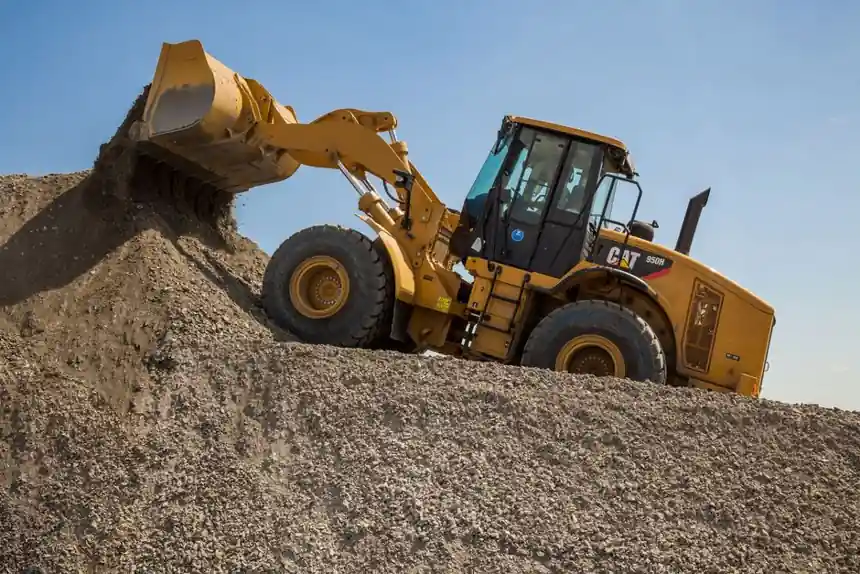
Landfill-spec wheel loaders span operating weights of 13,100 to 31,000 kg and bucket volumes of 2.6 to 5.6 m³ across the heavy-duty waste-handling class, with factory guarding, solid tyres, and reversible cooling fans now standard [S2].
Selection is driven less by raw engine horsepower and more by structural protection, debris-tolerant cooling, and bucket geometry suited to high-tipping into transfer trailers and side-loaded containers, which is why dedicated waste-spec models from CASE, Hyundai, and similar OEMs have diverged sharply from general-purpose construction configurations [S2][S3][S4].
Operating Weight, Bucket Volume, and Static Tipping Load
Heavy-duty waste-class loaders weigh 13,100 to 31,000 kg, with bucket volumes from 2.6 to 5.6 m³, placing them firmly above the compact segment (Bobcat L65 to L95 at 9,944 to 11,993 lb) and well into the production-loader class used at municipal solid waste sites [S1][S2]. For reference, the CASE 721G waste-management model posts an operating weight of 36,011 lb and a static tipping load of 27,092 to 32,380 lb, with bucket capacity from 2.6 to 5.5 cu yd [S1].
Static tipping load matters more than rated engine horsepower in landfill service because the load is rarely uniform: a bucket half-full of dense demolition debris, soaked organic matter, or a single bulky item will exceed the rated payload before the machine reaches the truck. The 721G's ~30,000 lb tipping-load envelope, paired with 195 hp, is closer to the working envelope most municipal sites size for [S1][S4].
Factory Waste-Spec Guarding: What Actually Changes
The CASE 821G Waste Specification package, which arrived factory-built in Australia in September 2025, includes heavy-duty solid tyres, a reinforced underbelly, a full guarding package over critical components, a mid-mounted cooling stack (replacing the traditional stacked-radiator layout), and a factory-fitted auto greasing system [S3]. The mid-mount cooling relocation is a deliberate change: stacked radiators trap lint, plastic film, and fibre waste against the fan, while a mid-mounted layout expels debris more effectively and reduces overheating risk in dusty conditions [S3].
Hyundai's HL970, deployed in two-shift, 2,000 h/year service at the Cröbern landfill near Leipzig, runs on rock tyres and uses a reversible fan as standard, which the site logistics manager flagged as "absolutely essential" for dust-laden air and continuous operation [S2]. A sealed, filtered cabin with positive-pressure ventilation is a parallel protection layer; at WEV's site, every loader and skid steer in the waste-handling fleet is fitted with a Seca cabin air filtration system to keep operators functional through long shifts [S2].
Selection Criteria vs Application Fit
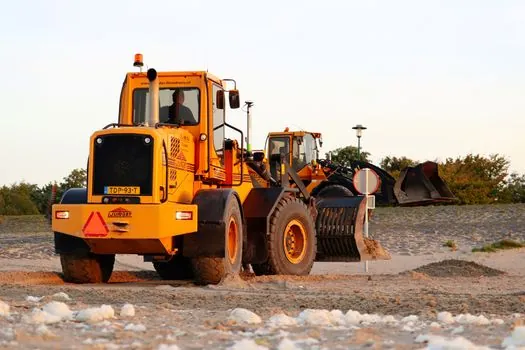
For daily cover, working-face shaping, and transfer-station loading, a 13,000 to 25,000 kg class loader with a 2.6 to 4.0 m³ general-purpose bucket is usually sufficient, while for high-tipping into 4.5 m sidewalls or walking-floor trailers, a 20,000 to 31,000 kg machine with a 4.5 m³ high-tip bucket is the right call [S2][S5]. Compact loaders under 12,000 lb (Bobcat L65 to L95) are explicitly "better equipped for smaller projects and light materials" and are not the right tool for landfill face work [S1].
Waste-spec loaders are NOT a replacement for dedicated landfill compactors, even though they spread and push waste into thin layers ahead of compaction [S5]. They are a support machine, with their value measured in working-face uptime, transfer-station throughput, and the absence of unscheduled radiator cleanings, not in compaction density itself.
Cooling, Filtration, and Uptime: The Hidden Specs
Reversible fan direction and mid-mount cooling stacks are now the defining uptime features, and they appear across the heavy-duty waste-class regardless of OEM [S2][S3]. Auto greasing, factory-fitted on the 821G Waste Handler, extends pivot-pin and bearing life and removes a daily pre-start task that crews routinely skip under shift pressure [S3].
At a working landfill the loader runs hot, dusty, and continuous, with ambient spikes near compost biofilters and routine exposure to hydrogen sulphide and ammonia plumes. A standard construction-spec cooling package will not survive this duty cycle without daily manual cleaning, which is why waste-spec guarding has converged on sealed electrical connectors, debris-resistant air intakes, and positive-pressure cab filtration as a baseline rather than an option [S2][S3][S4].
Spec Comparison: Compact vs General-Purpose vs Heavy Waste-Class
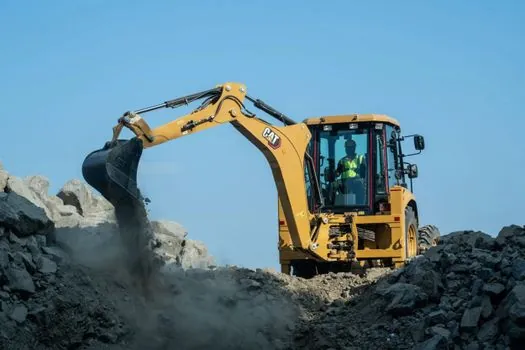
Compact wheel loaders (Bobcat L65, L85, L95; CASE 21F to 321F) sit at 9,944 to 13,633 lb, 0.78 to 1.7 cu yd buckets, 55 to 74 hp, and 5,236 to 10,301 lb static tipping load, which is appropriate for landscaping, light aggregates, and small site cleanup but under-spec for any working face [S1]. General-purpose loaders (CASE 521G, 621G) climb to 24,203 to 28,159 lb with 142 to 172 hp and 1.77 to 4.5 cu yd buckets, which fits transfer stations and small landfill cells with light contamination [S1].
Heavy waste-class (CASE 721G, 821G; Hyundai HL970, 770-9A) sits at 28,000 to 68,000 lb, 2.6 to 5.6 m³ (3.4 to 7.3 cu yd) bucket options, 195 to 300+ hp, and tipping loads above 27,000 lb, which is the operating envelope for municipal solid waste, commercial landfill cells, and material recovery facility feed [S1][S2]. The right size is the smallest machine in this class that still meets the site's peak daily tonnage and the highest trailer sidewall in the rotation.
Sourcing and Standards Anchors
OEM waste-spec data sheets from CASE and Hyundai, plus aggregator listings such as Ritchie Specs, are the primary public sources for current operating-weight, bucket, and guarding specifications [S1][S2][S3][S4][S6]. Field reports from operating landfills (Cröbern in Germany, Northeast Cartage in Pennsylvania) supply the duty-cycle and uptime data that brochures omit, including the WEV 2,000 h/year benchmark and the 25 to 40 gal/week diesel delta reported on the CASE 721G [S2][S4].
There is no single ISO or SAE standard that defines "waste-spec" guarding; each OEM bundles its own factory package, and the useful cross-vendor comparison is component-by-component: solid-tyre compound, fan reversibility, guarding coverage map, auto-greasing, and cab filtration class. The wheel loader reference page tracks the broader machine taxonomy that surrounds this waste-class subset, including the skid steer loader class that often pairs with it on confined working faces.
Trackable signals to watch over the next two quarters: OEM rollouts of additional factory-fitted waste-spec SKUs (CASE added the 821G in 2025, and competitors typically follow within 12 to 18 months), updates to mid-mount cooling adoption across mid-size loader lines, and any new auto-greasing or telematics integration that lands on the standard waste-handler build sheet rather than as a dealer-installed option. For procurement teams cross-referencing adjacent categories such as backhoe loader buy specs, the same guarding-versus-base-price trade-off applies and is worth weighing against the heavier waste-class wheel loader.
See also our earlier report, Optical Glass Selection for Electronics: A Spec-First Map.