Plant buyers in mid-2026 sort concrete batching plants by output class first, not by price: the 45-60 m³/h HZS60 tier (JS1000 mixer, 130 kW total power, 4.1 m discharge) and the 60-75 m³/h HZS75 tier (JS1500, 165 kW, 80 mm max aggregate) remain the workhorses of mid-volume producers [S7]. For high-volume fixed sites, the HZS180 tier pushes 150-180 m³/h through a JS3000 twin-shaft mixer at 3 m³ per cycle, sitting at the upper edge of the catalog range published in June 2026 [S7].
Specifiers should treat capacity, mixer type, and discharge geometry as a locked triplet — change one and the other two typically force a redesign. For a primer on the equipment class itself, see the concrete batching plant encyclopedia entry, which frames output, aggregate handling, and admixture dosing as the three primary sub-systems inside every plant.
Capacity and Mixer Pairing: The 45 / 60-75 / 150-180 m³/h Tiers
The HZS60 class delivers a rated 45-60 m³/h through a JS1000 twin-shaft compulsory mixer with 1 m³ input batch volume, a 4.1 m discharge height, and 3 aggregate bin types — the standard small-plant envelope for residential and low-rise commercial work [S7]. Step up to the HZS75 and output rises to 60-75 m³/h, mixer capacity moves to JS1500 (0.75 m³/min mixing capacity), max aggregate climbs to 80 mm, and aggregate bin count extends to 3-4 types, with total power rising to 165 kW from the HZS60's 130 kW [S7]. The HZS180 doubles down again: 150-180 m³/h, JS3000 mixer, 3 m³ per cycle, 200 t/h aggregate belt delivery, and the same 4.1 m discharge height as the smaller units — meaning the same truck geometry accepts all three tiers, but the supporting silos and conveyors do not [S7].
For a one-class-down cross-check, the PROMAX C100-TWN L compact stationary plant is rated at 100 m³/h (3,531 ft³/h) and is sold specifically on a plug-and-play, low-transport-cost positioning that targets the gap between the HZS75 and HZS180 [S1]. That 100 m³/h slot is exactly where the Chinese catalog thins out — there is no native HZS100 in the HZS60/75/180 ladder, so the C100-TWN L fills a real procurement gap for mid-tier contractors [S1][S7].
Mobility vs Stationary: When the Wheels Earn Their Cost
Mobile plants (Haomei, Yueshou, HAMAC) and stationary plants (PROMAX, CONMACH, Concrete Batching Systems W2 wet batch) solve different logistics problems, and the choice is rarely financial. Mobile plants from the Henan manufacturing base are typically sold with 1 set minimum order, T/T payment terms, and shipping container optimization for cross-border delivery to markets including Malaysia, Saudi Arabia, India, Indonesia, Russia, and Kazakhstan [S2][S3]. The trade-off is structural: mobile plants sacrifice the deep aggregate bins, the long conveyor runs, and the high silo counts of a fixed HZS-class installation in exchange for redeployment speed.
Stationary plants assume a 2-5 year site tenure and amortize a heavier foundation, larger cement silos, and higher total connected load. The W2 wet batching plant from Concrete Batching Systems (UK) is sold as a turnkey installation with backup service — a different procurement model than a Chinese mobile unit shipped FOB [S6]. Buyers running 3 or more sequential sites in 24 months typically net positive on mobile; buyers building a single ready-mix yard for 5+ years always net positive on stationary. The mobility gate is therefore a project-portfolio question, not a unit-price question.
Aggregate, Discharge and Power: The Mechanical Spec Triangle
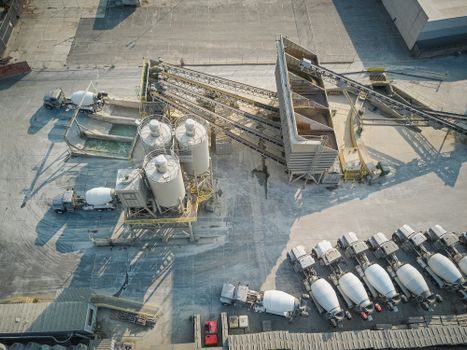
Three numbers govern whether a plant physically fits a site: maximum aggregate size, discharge height, and total connected power. The HZS60/HZS75/HZS180 family all use a 4.1 m discharge height, which is the industry-standard truck-chargetarget that lets a standard 6×4 transit mixer pull under the discharge chute without a raised ramp [S7]. Max aggregate size of 80 mm on the HZS75 (and presumably the HZS60) restricts the mix to standard crushed-stone or gravel mixes; sites requiring 100-150 mm aggregate for mass-concrete dams need a different plant class entirely [S7].
On used-equipment side, REMCON Associates lists a 2018 Erie MG-12CP station with a 1100 kW twin generator package — that 5-10x power class is a different category, typically a central-mix plant serving a quarry or a major ready-mix fleet, not a contractor yard [S9]. The CONMACH product line spans quarry and concrete, so its batching plant datasheets share the same heavy-frame and high-power engineering base as its crushers [S4].
Plant Type Matrix: Stationary, Mobile, Compact and Wet-Batch Compared
A side-by-side comparison clarifies the 2026 procurement decision. Against four decision criteria — output ceiling, redeployment time, foundation requirement, and power supply — the four common plant archetypes line up as follows: [S1]
Stationary HZS-class (HZS60/75/180): output 45-180 m³/h, redeployment weeks-to-months (it is not designed to move), full foundation and silo farm required, 130-200 kW grid connection [S7]. Compact stationary (PROMAX C100-TWN L): output 100 m³/h, redeployable in days with plug-and-play packaging, lighter foundation, grid power at the mid-tier [S1]. Mobile (Haomei/Yueshou/HAMAC): output spans the 45-120 m³/h range depending on chassis, redeployable in 24-72 hours, no permanent foundation, self-contained diesel-electric option [S2][S3][S8]. Wet-batch (W2 by Concrete Batching Systems): output sized to the W2 module, designed for wet-process mix designs where water is dosed into the mixer rather than at the truck, turnkey installed with backup [S6]. The decision axis is therefore: how often does the plant move, and how wet is your mix design? Those two answers eliminate 3 of the 4 archetypes immediately.
Selection Criteria Process: From Output Gate to Vendor Shortlist
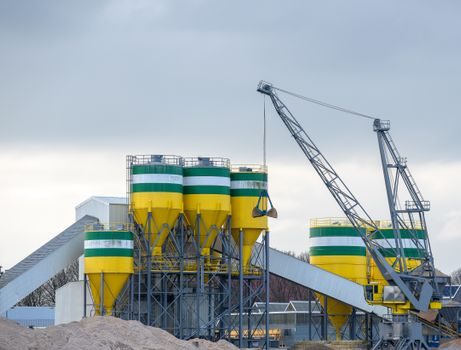
The Bona Concrete Plant selection write-up, dated June 2026, lays out the standard Chinese-catalog method: fix the output class first, then the mixer model, then aggregate size, then power — and only then compare brand and price [S5]. That sequencing matches what the spec sheets enforce: the HZS60 cannot become an HZS180 by changing a component, because the mixer, belt conveyor (200 t/h on the HZS180 vs lower on smaller units), and total power all scale together [S7]. Skipping the output gate and starting with price is the single most common buying mistake in this category, because it forces the specifier to over-size the plant to meet future demand and then absorbs the capital cost differential for years [S5].
The decision-matrix discipline (criteria on the top axis, plant options on the left axis, weighted scoring across each row, sum and rank) applies directly here and is the same method used in industrial procurement generally; weighting capacity at 30%, mixer durability at 20%, aggregate flexibility at 15%, power and discharge at 15% combined, and after-sales / parts at 20% is a defensible starting structure [S10]. Buyers who run that matrix on the HZS60 vs HZS75 vs HZS180 vs C100-TWN L shortlist typically converge on a single model within a working day, because the catalog data is tight and the decision criteria are mechanical rather than aesthetic [S1][S5][S7][S10].
Brand and Vendor Landscape: Turkey, UK, China, US
The June 2026 vendor map splits cleanly by region. Turkey is represented by PROMAX (compact stationary, plug-and-play positioning) and CONMACH (heavy stationary, quarry-cross DNA) [S1][S4]. The UK contributes Concrete Batching Systems with the W2 wet-batch turnkey model and a 32-year service posture [S6]. China dominates the catalog depth: Haomei, Yueshou, HAMAC, Bona, and the HZS-class OEMs all publish overlapping model lines, with Henan (Zhengzhou) as the manufacturing cluster hub [S2][S3][S5][S7][S8]. The US side, represented by REMCON Associates, focuses on used and refurbished equipment plus consulting — the 2018 Erie MG-12CP and 1100 kW twin generator inventory indicates a different buyer segment (quarry operators and large ready-mix fleets) than the greenfield Chinese catalog [S9].
For buyers, the regional split matters for three reasons: lead time (China FOB vs Turkey/UK ex-works), parts availability (UK/Turkey have stronger EU-Middle East channels, China has stronger Africa-Asia-Russia channels), and certification (EU plants carry CE/EN documentation by default; Chinese plants may require buyer-side CE marking assistance). Yueshou's 1-set minimum order with T/T payment terms is representative of the Chinese export model — flexible MOQ, but the buyer carries the destination-side compliance work [S2].
Common Failure Modes and Engineering Constraints
Three spec traps catch first-time buyers in 2026. First, mixer-model vs output mismatch: a JS1000 mixer in an HZS60 frame cannot be pushed to 75 m³/h without accelerated liner wear and aggregate jams — the HZS75 ships with a JS1500 for a reason [S7]. Second, aggregate size underspec: a site feeding 100 mm rock into an HZS75 (rated 80 mm max) will see regular mixer-blade failures, typically within the first 500-1000 mixer-hours. Third, power-supply gating: 165 kW on the HZS75 and 200 kW on the HZS180 both require a dedicated transformer tap on most brownfield sites, and ordering the plant before the electrical upgrade is a classic 60-90 day delay vector [S7].
Admixture handling is a fourth, less obvious gate: serious ready-mix operations dose concrete admixtures at the mixer or the truck, and the plant must reserve a dedicated dosing line with a flow meter and a calibration port. Plants sold without that line force field-retrofit, which is the single most common commissioning overrun. For sites that also pour slabs requiring crack control, concrete fiber dosing (steel or macro-synthetic) needs a separate fiber-feed conveyor and an aggregate bin re-balance, neither of which is standard on the HZS60/75 catalog line [S7].
How a Concrete Batching Plant Links to the Pumping Chain
Output class on the plant must match the placement chain downstream. A 45-60 m³/h HZS60 cannot feed a truck-mounted concrete pump sized for 90+ m³/h placement; conversely, an HZS180 over-feeds a 50 m³/h boom pump and creates truck-queue congestion. The standard rule of thumb in current buying guides is to size the plant to 1.1-1.3x the peak placement rate to absorb truck-cycle variability, which means an HZS75 typically pairs with a 50-65 m³/h boom pump and an HZS180 with a 120-150 m³/h pump fleet [S7]. Buyers who spec both ends of the chain together — plant and pump — eliminate the truck-queue bottleneck that is the most common cause of placement-rate underperformance on mid-rise commercial sites. A direct spec comparison between plant output and pump reach is laid out in the plant-vs-pump 2026 buyer cut, which is the natural follow-on read after this selection walkthrough.
Track, in the next 90 days, two signals: (1) whether Chinese HZS-class OEMs publish an HZS100 or HZS120 model to close the 75-180 m³/h catalog gap that the PROMAX C100-TWN L currently exploits, and (2) whether the 80 mm max-aggregate ceiling on the HZS75 gets raised in a 2026 model-year refresh — both moves would shift the mid-tier selection calculus documented above [S1][S7].