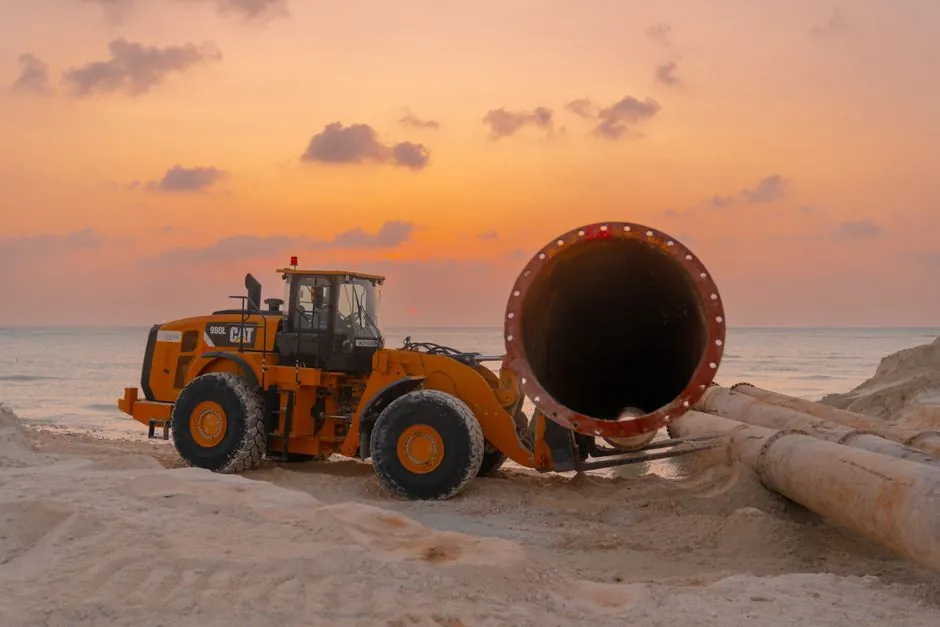
Truck-mounted concrete pumps sized for pipeline right-of-way work fall into three practical bands: 24-32 m boom / 80-120 m³/h for shallow trench backfill and valve-chamber slabs, 36-42 m / 120-160 m³/h for mid-rise pump stations and elevated pipe racks, and 47-70 m / 160-200+ m³/h for high-rise process structures and bridge crossings where the chassis cannot park adjacent to the form [S2].
Pipeline spreads are governed by horizontal reach along the trench, vertical lift to elevated crossings, and the maximum aggregate the pump can pass without plugging the line; a 36 m boom remains the most common all-rounder, while a 70 m³/h trailer pump placed on a tight cycle can outperform a 160 m³/h truck fighting a 4-section Z-fold inside a 7 m lane [S2][S8].
Boom Reach Bands and the Pours They Actually Cover
Boom reach is the single most decision-driving spec on a truck-mounted concrete pump, and on pipeline work it splits into three practical bands [S2]. A 24-32 m unit handles villa-scale ground rafts, small valve-chamber slabs, and shallow utility trench backfill where the truck can set up within a short hose run of the pour. The 36-42 m class reaches 10 floors of vertical lift and is the most common all-rounder for mid-rise pumping stations and elevated pipe-rack pours. The 47-70 m class is reserved for high-rise process structures and bridge crossings where obstructions physically prevent the truck from parking next to the form, with 47-52 m typically covering 15-16 floors of vertical reach [S2].
Wheel-type and crawler-type boom pumps fill the lower-reach gap on rough terrain: wheel units run 18-38 m reach at up to 89 m³/h, while crawler units run 8-25 m reach at up to 50 m³/h and are the standard pick for soft ground and slope work where a 30+ ton truck chassis would sink [S5].
Output, Pressure, and Pump-Drive Topology
Output on truck-mounted boom pumps runs 90-200+ yd³/hr, roughly 2-3x what a trailer-mounted line pump delivers (40-90 m³/hr), so boom pumps win on continuous pipeline pours where a transit mixer feeds the hopper without pause [S2][S4]. Twin hydraulic pistons alternate inside the wet hopper: one cylinder draws wet concrete from the hopper while the other pushes it into the delivery line, and an S-valve (S-tube) transfer tube switches the discharging cylinder between the two pipeline ports each stroke, governed by ASME B30.27 for material placement systems [S2].
System pressure is the second decision driver. Trailer pumps sit at 8-14 MPa with 150-300 m horizontal reach, while boom pumps run 10-18 MPa; the SCHWING SP 7000 and SP 9000 twin-cylinder all-hydraulic open-loop architecture is built for sustained >100 m³/h duty, using controlled differential-cylinder acceleration to keep pipeline surge low and let the unit run harsher mixes via the high-pressure switching circuit [S4][S8]. For pours above 100 m³/h sustained, the higher-output class is mandatory, not optional [S8].
Pipeline vs Boom: Decision Matrix for Pipeline Jobs
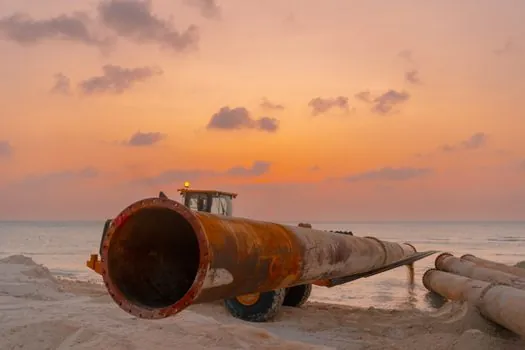
For a horizontal pipeline spread (trench backfill, culvert surround, utility ducts), a trailer-mounted line pump with up to 1,500 ft horizontal reach and 300+ ft vertical reach is often the lower-cost answer, especially on remote or restricted-access right-of-way where a 30+ ton boom truck cannot safely set outriggers [S2][S3]. Where the pour includes both a long horizontal run and a vertical lift to a pipe rack or tank top, a boom truck with pipeline extension along the boom is the standard configuration, with a 28-32 m unit covering residential and light-commercial pump stations and a 36-40 m unit opening mid-rise commercial work [S2].
The trade lines up cleanly against four criteria: reach, output, crew, and mobilization cost.
Comparison of boom vs trailer line pump on pipeline spreads [S2][S3][S4][S8]:
- Horizontal reach: Boom pump 24-70 m, trailer line pump up to 1,500 ft (~450 m).
- Output: Boom pump 80-200+ m³/h, trailer line pump 30-90 m³/h.
- Crew: Boom pump 1-2 operators, trailer line pump 2-4 crew for hose handling.
- Site access: Boom pump needs full outrigger spread, trailer pump fits restricted-access right-of-way.
Crew size is part of the trade: a boom pump runs with 1-2 operators, a line pump needs 2-4 crew for hose handling, which matters on remote pipeline spreads where labour mobilization is a real line item [S2].
Mix Design Rules That Keep the Line Flowing
The generally accepted rule for pumpable mix is that the internal pipeline diameter must be at least 1.5x the maximum nominal coarse aggregate size; below that ratio, the stone bridges at bends and the line plugs [S2]. A 100 mm (4 in) delivery pipe is the de-facto standard for most truck-mounted units, accepting pebble aggregate up to 50 mm or gravel up to 40 mm, and concrete slump is held in the 80-230 mm working window for pumpable mixes [S7].
For long-distance pumping, a dual-layer bend pipe at the hinge elbows is the standard fix for the wear problem that ends most boom-pump pipelines prematurely, replacing single-wall elbows that wear through and burst under the abrasive slurry load [S2]. Slump is the other lever: too stiff and the line stalls, too wet and the mix segregates. Adding water at the jobsite to ease pumping is a common failure mode, it reduces strength, increases shrinkage, and breaks the approved mix design; the correct route is a pump-friendly design from the ready-mix producer using approved admixtures [S3].
Pump Size and Output Selection by Project Class
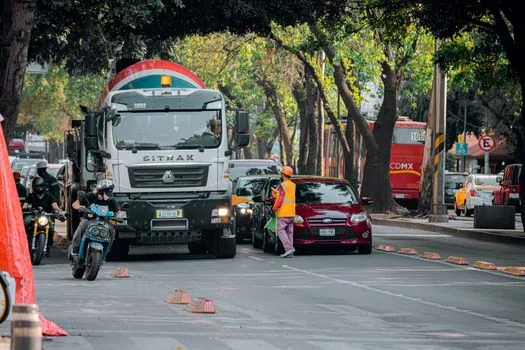
Pump size is set by required output, line distance, concrete mix, and daily pour volume, not by the largest unit available [S3]. For small-scale residential and confined-space work, a compact trailer pump at 30-40 m³/h is the standard pick; for high-rise or large infrastructure, a 47-75 m boom pump at 80-180 m³/h is required to handle both vertical lift and continuous placement [S4]. Theoretical output and required mixer-truck count can be cross-checked with N = (Q1/V) × (L/S + Tt), where Q1 is pump output in m³/h, V is mixer capacity, S is mixer speed, L is roundtrip distance, and Tt is onsite duration in hours [S4].
Trailer pumps with similar output classes still differ in power source, hydraulic brand, control mode, and wear-part arrangement; projects needing a balanced output-and-pressure combination often evaluate the HBT80S1813-110 against pipeline distance, concrete grade, and expected daily pour volume [S9]. For pipeline work specifically, a concrete pump truck with a 33 m vertical / 28.9 m horizontal reach at 31.5 MPa oil pressure and 120 m³/h rated output is a typical mid-band configuration, paired with 40 mm max aggregate handling [S5][S7].
Operational, Maintenance, and Safety Constraints
Daily hydraulic checks, monthly pipeline inspections, and annual structural-integrity assessments are the standard maintenance cadence for truck-mounted concrete pumps in continuous service [S4]. Modern units ship with overload protection, emergency stops, and anti-collision interlocks, but those controls do not replace pipeline wear monitoring, which is the leading in-service failure mode on long pipeline spreads [S2][S4].
Site constraints that change the unit selection, not just the spec: outrigger spread requirements, ground bearing pressure for the 30+ ton chassis, and pipeline route planning that minimises 90-degree elbows and steep vertical risers all act as hard limits on what the spec sheet alone can promise [S2][S3]. For work where a truck-mounted crane or a concrete mixer truck is also mobilised, the concrete pump's footprint and the crane's swing radius must be planned together, since the boom outriggers and the crane outriggers cannot share the same pad on a confined pipeline spread. Piping between the hopper and the pour point, where the line pump's 1,500 ft horizontal / 300+ ft vertical reach genuinely outperforms a boom, is also where a pipeline pump running as a stationary booster can be inserted to extend range on long horizontal spreads [S2].
The signal to track next: chassis electrification of truck-mounted boom pumps, with battery-powered models entering the same 80-180 m³/h class as diesel chassis, and IoT-enabled predictive maintenance that flags pipeline wear before a burst [S4]. On pipeline work specifically, watch for boom pumps shipping with factory-fitted dual-layer bend elbows as standard rather than as an aftermarket retrofit, since dual-layer elbows are the single most effective fix for the abrasive-wear failure mode on long right-of-way pours [S2].
Background reading: Fire Alarm Control Panel Selection for Chemical Plants: Spec Map 2026.