Shield selection for urban sewer, rail, and utility tunnels in 2026 is dictated by four hard constraints: ground type, finished internal diameter, minimum curve radius at launch, and available shaft footprint, with the final shortlist typically drawn from EPB, slurry, or double-shield variants in the 3-12 m diameter band [S2][S3].
The bottleneck is no longer machine availability but fit: a 200 m long double-shield TBM cannot be integrally assembled inside a 40 m × 40 m shaft, and karst corridors rule out open-face methods, so contractors now specify split-assembly, EPB with mode-switching, or small-diameter pipe jacking as default procurement lines [S2][S4].
Ground conditions drive the first pass: EPB vs slurry vs double-shield
Earth-pressure-balance (EPB) shields dominate mixed-face urban ground where the face pressure must be supported by conditioned spoil, and they are the default for clay-over-rock profiles such as Austin Chalk with clayey overburden [S4].
Slurry shields (see shield machine) take over in high-permeability sands and gravels below the water table, where the bentonite suspension actively balances pore pressure rather than relying on spoil paste pressure. For long hydraulic tunnels in harder rock, the double-shield configuration (see shield machine) is the standard mechanized option and was demonstrated in the Meishan headrace tunnel under a 500 m limiting curve radius in August 2026 [S2].
Diameter, curve radius, and shaft footprint: the three numerical filters
Urban gravity sewers cluster around 1.5-3.0 m finished ID and are routinely built by 78 in. (1.98 m) segmental tunnel, with the San Antonio W9 project installing 22,000 linear ft of 48 in. FRPM pipe, of which roughly half the alignment runs through 78 in. tunnel [S4].
Metro and road tunnels step up to the 6-12 m band, where the limiting factor becomes the launching curve. A 500 m radius forces split-body launching with pre-deflection of the curved guide bench, directional arrangement of the reaction frame, and micro-correction with low thrust and short advance strokes, the exact sequence used at Meishan in March 2026 to reach a peak daily advance of 23.39 m and a monthly advance of 444 m [S2].
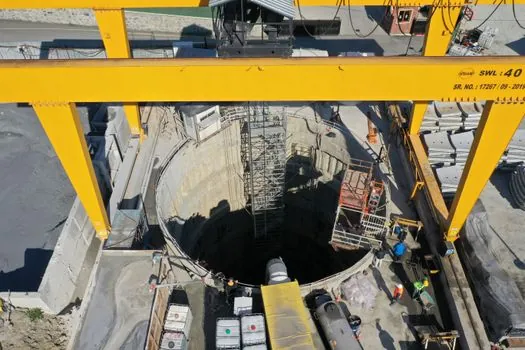
Shaft footprint is the third filter. A 40 m × 40 m portal cannot accept an integral 200 m TBM, so the procurement specification must explicitly call for out-of-tunnel, split-body stepwise assembly with integral launching, otherwise schedule risk moves from contractor to client [S2].
Tail void, grout, and face support: process control that defines the spec
Tail-grout performance, not cutterhead torque, is the dominant variable for surface settlement over active utilities. A 2026 multi-state optimization study by Taiyuan University of Technology separates fresh-grout workability (water-binder ratio, bentonite-solid ratio, fluidity, bleeding) from hardened behaviour (compressed deformation, 3-day and 28-day UCS) and tests under 100, 300, and 300 kPa confining pressures in sand, silt, and clay cells, which gives specifiers a defensible four-axis performance envelope instead of a single strength number [S3].
Face support in EPB mode depends on conditioned spoil pressure, foam injection, and polymer additive rate, and operators have moved to interpretable models for parameter setting because volume loss to compensation mismatch is the leading driver of post-construction settlement in dense urban ground [S3].
For comparison, a procurement decision typically lines up as follows (criteria in this order: ground fit, min. curve radius, min. shaft footprint, urban grout/settlement control): EPB wins on clay-silt mixed ground at 200-300 m curves with small shafts, slurry wins on high-permeability sands below water table, double-shield wins on long rock drives where a 500 m curve is the tightest radius, and the in-place shield machine selection matrix is the operative reference for tender stage evaluation.
Confined sites, karst corridors, and small-radius launches
On the San Antonio W9 alignment, seven karst features in the Austin Chalk formation constrained the allowable excavation methods to hand-mining, digger shields, rotary TBMs, and hooded shields, since open-face methods had to be screened against both the Edwards Aquifer recharge zone and endangered invertebrate habitat [S4].
This is now a common procurement constraint: environmentally sensitive corridors are passed to bidders as a list of permissible methods plus a geotechnical baseline report, and the geotechnical baseline report becomes the contractual reference when an unmapped karst is encountered at the face [S4].
For related work on smaller-diameter and microtunnelling procurement, see the spec map for shield machine selection for landfill utility and liner work, and for larger utility crossings and port/terminal work the companion piece on shield machine spec maps for port and terminal utility crossings covers the higher-diameter rock-mode case.
Sensor and control stack: attitude, advance rate, and settlement feedback

Single-scene attitude control models lose generalisation across mixed urban geology, so 2026 procurement specifications increasingly require multi-source sensor fusion with hybrid machine-learning control on shield attitude, as demonstrated in the August 2026 Advances in Engineering Information paper on cross-geology shield attitude control [S1].
Concretely, the spec layer now asks for real-time advance-rate, thrust, chamber pressure, grout pressure, and segment pose feedback, with explainability on the parameter set so that engineers can defend the operating window at progress meetings rather than rely on a black-box recommendation [S1][S3].
For alignment geometry on tight urban curves, the total station spec map for tunnel construction covers the survey instrument side, which is the upstream of attitude control.
Standards, baseline reports, and contractual risk
Geotechnical baseline reports (GBR) are now standard on urban tunnel tenders, since they fix a contractual definition of "anticipated ground" against which differing site condition claims are measured; the W9 project prepared a GBR after two geotechnical investigation campaigns and built subsurface profiles into the bid documents [S4].
For segmental lining, allowable-joint and segmental-ring tolerance is set against the relevant ASTM/ACI concrete or FRPM product standard and the project's own GBR, not against a generic shield machine class. Where endangered species or aquifer rules apply, those constraints are written into the list of permissible excavation methods and the environmental constraints, then passed through to the shield specification as exclusion clauses [S4].
When NOT to use a full-face shield in urban infrastructure

Open-cut should be preferred where trench depth is less than 6 m and the corridor is free of utilities and mature vegetation, since the W9 alignment sits in a 100-year floodplain with mature trees and concrete trails and uses cut-and-cover for the shallower sections, leaving the 78 in. tunnel only for the deeper half [S4].
Hand-mining and digger shields remain appropriate for short, variable, or karst-ridden drives where a full-face slurry or EPB cannot be justified, and for diameter bands below about 1.5 m, a microtunnelling pipe-jack system with a remote-controlled cutterhead is the lower-risk procurement choice.
Trackable signals for the next procurement cycle: (1) tender documents increasingly binding the contractor to a stated tail-grout performance envelope rather than a mix design, following the 2026 multi-state optimization framework [S3]; (2) GBR-driven contract models becoming the default on karst corridors, with the W9 contract as the published reference [S4].
Spec-level background on the components involved: face shield, and coding machine.