Rigid-frame haul trucks dominate open-pit fleets, with the BelAZ 75710 at 496 short tons and the Caterpillar 797F at 401 short tons anchoring the ultra-class payload band [S5]. Capacity now spans from 40 short tons at the small end to roughly 500 short tons at the top, a 12.5x range covered by four structural classes [S5].
Class boundaries and design constraints are well documented: most haul trucks are too large for public roads, run off-road-only tires, and carry no axle suspension to survive continuous high-load cycles [S5]. A dump truck used in a mine is therefore not a scaled-up version of a road dump truck but a separate machine family governed by payload tonnage and haul-road geometry.
Four Structural Classes: Rigid, Articulated, Underground, On-Highway
Industrial and mining operators classify dump trucks into four structural categories: rigid, articulated, underground, and on-road, each matched to a defined operating envelope [S2]. Rigid trucks run a single non-articulated frame with the cab and dump body on one chassis, designed for open-pit mines and large quarries with reinforced frames, massive off-road tires, and heavy-duty rear tipping bodies capable of exceeding 300 tonnes payload in ultra-class configurations [S2].
Articulated dump trucks (ADTs) add a pivot joint between tractor and rear body, trading peak payload for traction and maneuverability on soft or uneven terrain [S2]. The most aggressive ADT envelope cited is a 35° incline operating limit, against which rigid trucks are not specified [S4]. Underground trucks are a narrower, low-profile category built to fit drift dimensions and ventilation constraints, while on-highway dump trucks (Classes 7 and 8, above 26,001 lbs GVWR) handle over-the-road aggregate and coal haulage on public infrastructure [S1].
GVWR Weight Classes 1-8 and Where Mining Trucks Sit
North American road-going dump trucks are stratified by Gross Vehicle Weight Rating into eight classes: light-duty Classes 1-3 cap at 14,000 lbs, medium-duty Classes 4-6 span 14,001-26,000 lbs, and heavy-duty Classes 7-8 cover 26,001 lbs and above [S1]. The lightest three classes serve utility and light goods work, Classes 4-6 cover box trucks and commercial vans, and Classes 7-8 host garbage trucks, city street sweepers, and small semi-trailers [S1].
Off-highway mining trucks deliberately exceed Class 8 road limits; the Caterpillar 797F at 400 tons payload sits roughly 57x above the Class 8 floor [S4]. This size gap is why haul trucks are barred from public roads, run off-road-only tires, and carry no axle suspension [S5]. For spec work, a mining dump truck selection should be decoupled from road-going GVWR classes and instead driven by payload tonnage, haul-road grade, and cycle time.
Payload Bands and Ultra-Class Reference Machines
The ultra-class threshold is 300 short tons and above, with current production models bracketing the 401-496 short ton band [S5]. Reference machines: BelAZ 75710 at 496 short tons on twin MTU 16V4000 diesels totaling 4,600 hp, XCMG XDE440 at 441 short tons on a single MTU 20V4000 at 4,000 hp, Caterpillar 798 AC at 410 short tons on the Cat C175-16 at 3,500 hp, and Caterpillar 797F at 401 short tons on the Cat C175-20 at 4,000 hp [S5]. Komatsu's 980E-5 sits at 369 metric tons, the smaller Liebherr T 284 leads the premium diesel tier, and the Caterpillar 775 anchors the lower end at 70 short tons for quarry and smaller-pit work [S4][S5].
Payload drives fuel burn directly. The Komatsu 930E-5 consumes 60-85 gallons of diesel per hour depending on load and grade, translating to over $6 million in annual fuel cost per truck at current prices, and rigid-frame trucks are 15-20% more fuel efficient than ADTs on well-maintained haul roads [S4]. A single 24-hour mining cycle on a rigid-frame truck can move more than 30,000 tons of material, the productivity envelope that makes the rigid frame the default for high-tonnage pits [S4].
Selection Criteria: Rigid vs Articulated vs Underground vs On-Highway
Rigid frame trucks suit open-pit mines with controlled, well-maintained haul roads, sustained high tonnage, and 20-year plus service life targets; they dominate the ultra-class segment above 300 short tons [S4][S5]. Articulated trucks are the correct call for steep grades up to 35°, soft or variable underfoot conditions, and pit operations below the 100-ton payload band where maneuverability outweighs peak payload [S4]. Underground trucks are mandatory when drift height, width, and ventilation constrain machine envelope. On-highway dump trucks in 6x4 or 8x4 axle configurations handle aggregate, sand, gravel, and coal on public roads, where payload is constrained by road-class regulation rather than tire or frame capacity [S1].
Total cost of ownership is the deciding factor above 100 tons. A new Liebherr T 284 lists at $5-6 million per unit, with annual maintenance above $1 million and tire costs near $300,000 per truck per year (six tires at roughly $50,000 each) [S4]. Autonomous hauling systems are now a serious TCO variable: Rio Tinto's fleet of over 300 driverless rigid-frame trucks has cut fuel use 15% and lifted operational efficiency 30%, materially shifting the per-ton cost curve for large operators [S4]. Electric drive and trolley-assist rigs are the next axis, with cited 40-50% fuel-cost reduction potential and 30-60 minute fast-charge windows on production-battery machines [S4].
Drive and Axle Configurations, and Construction-Variant Trucks
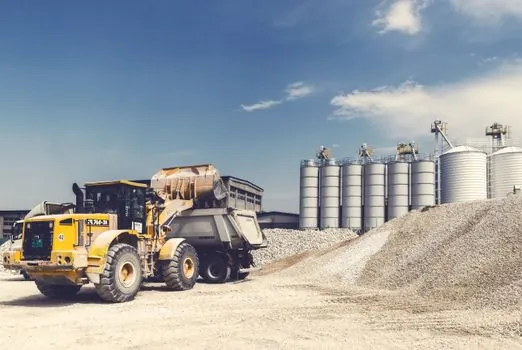
Within road-going and construction dump trucks, axle and drive layout is the primary differentiator: 4x2 single-axle for light, short-haul work, 6x4 dual-rear-axle for urban construction waste and sand haulage, and 8x4 three-axle for compliant heavy-duty and mine-adjacent long-distance haulage [S1]. Dumping mechanism is the secondary axis: rear-dump dominates the market, with side-dump used where cycle time and clearance favor lateral discharge [S1]. Construction and slag haulage typically runs 6x4 or 8x4 rear-axle configurations to handle uneven job-site surfaces, while agricultural and sanitary dump trucks form a separate sub-family for material-specific work [S1].
For broader fleet context, a construction machinery and equipment buyer should treat mining dump trucks, ADTs, and on-road dump trucks as three distinct procurement lines, not a single category with payload as the only variable. The structural class, the haul-road envelope, and the 20-year TCO math, including tires, fuel, autonomy, and overhaul cadence, must be specified independently before any vendor shortlist is built.
Trackable signals through the rest of 2026: production deliveries of the XCMG XDE440 (first model year 2022) into non-Chinese open-pit fleets, expanded autonomous-hauling rollouts beyond Rio Tinto's 300-truck baseline, and any OEM announcement of a payload step above the BelAZ 75710's 496-short-ton ceiling [S4][S5].
This topic is covered further in CMM Suppliers and Manufacturers: Selection Map for 2026 Procurement.