
A 140-220 hp, 12-14 ft moldboard motor grader with all-wheel drive, a forward-mounted front plow, and a wing plow is the standard configuration for municipal and highway snow removal in regions with annual snowfall above 60 in. Selecting below this bracket usually costs productivity per lane-mile; selecting well above it adds tire-chain wear, fuel burn, and bridge-load headaches without a matching throughput gain.
For dedicated winter duty the machine is essentially a motor grader re-tooled around three load cases: dry-push blading of packed snow, ice-edge cutting with carbide-tipped bits, and windrow control at intersection speeds. The selection problem is therefore not "which OEM" but which combination of operating weight, blade geometry, drive layout, and cab environment matches the average storm and the lane-miles your route absorbs per 12-hour shift.
Power, Weight, and Driveline Layout for Plow Duty
Engine output in the 160-220 hp bracket covers the 14 ft moldboard plus a 10-12 ft one-sided wing; below 150 hp the wing must be down-sized or the machine will stall in 8 in of wet, packed snow above 0°C.
Operating weight matters more than horsepower once you attach a front plow. A 35,000-45,000 lb GVW machine holds a 12 ft moldboard at a 0-2% cross-slope without wheel slip; under 30,000 lb the operator loses the side draft needed to peel compacted snow off asphalt and ends up riding the brakes, which is the fastest path to a frozen caliper in January. For routes with frequent bridge crossings, confirm the per-axle load against the posted limit before committing.
Moldboard Geometry, Cutting Edges, and Front Attachments
The 12-14 ft moldboard stays because it covers one full traffic lane plus 6-12 in of overlap in a single pass, which is the only way to keep pace with a 1-lane-mile-per-minute target during a 4 in/h storm. For ice-edge cutting, specify carbide-tipped cutting edges (typically 5/8 in thick, 6 in wide) rather than standard heat-treated steel: a carbide edge lasts 250-400 lane-miles of urban ice scraping versus 40-80 lane-miles for through-hardened carbon steel, at roughly 3-4x the unit cost [S3].
Front attachments are where most fleets mis-spec. A fixed-angle front plow in the 9-11 ft range handles 70% of residential and arterial work; a hydraulically-reversible front plow adds another 15-20% productivity on cul-de-sacs and dead-ends because the operator no longer has to back down the block to throw snow off the crown. Adding a one-sided wing extends the cut width to 22-26 ft on a single pass, which is mandatory on 4-lane arterials but is overkill on anything narrower than 30 ft of pavement.
Cab Environment: Visibility, Pressurization, and HVAC

For 12-hour winter shifts the cab must be ROPS/FOPS certified, low-noise (under 75 dBA at the operator station to meet common municipal procurement specs), and equipped with heated front, rear, and side glass plus a hot-air defrost capable of clearing 1/4 in of rime ice in under 20 minutes. Positive-pressure cab filtration is a worthwhile upgrade in any airshed with PM2.5 winter inversions, because it keeps the operator alert enough to actually use the moldboard tilt at speed. [S1]
Visibility is the single most under-rated spec. The ac motor drive on HVAC blowers, wiper arms, and heated mirror elements is rarely a separate spec line, but it determines whether the cab defrost actually works at idle when the engine is cold.
Hydraulics, Hydraulics, Hydraulics: The Wing-Plow Work Loop
A wing plow needs 30-45 gpm at 2,500-3,000 psi to hold its angle against a packed-snow windrow without drifting; the standard moldboard-only hydraulic package at 20-25 gpm will run out of oil before the wing even engages. Specify load-sensing, pressure-compensated hydraulics rather than open-center gear pumps: response time under load drops from 0.6-0.8 s to 0.2-0.3 s, which is the difference between a smooth pass and a gouge that requires a second machine to repair. [S1]
For fleets that already run hydraulic motor-driven fan and pump packages on summer attachments, confirm the cold-start fluid rating. ISO VG 32 hydraulic oil pours at -20°C; in jurisdictions where ambient drops below -30°C, ISO VG 15 or a synthetic PAO blend is mandatory, otherwise the wing-plow lift cylinder will shudder and stall within the first 30 minutes of a shift.
Selection Criteria Mapped to Route Type
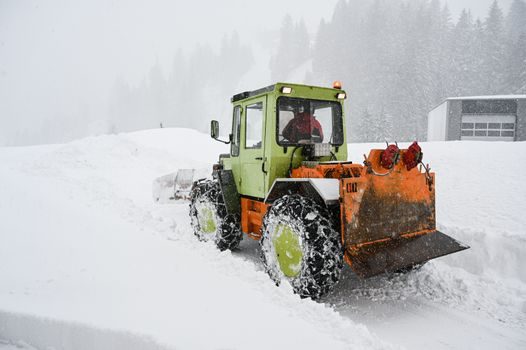
Three route profiles cover the majority of municipal snow duty, and each maps to a different spec block. An urban residential/cul-de-sac route with curb-tight geometry wants a 140-160 hp, 12 ft moldboard, reversible front plow, and AWD — this is the forestry motor grader selection philosophy inverted for tight, low-speed cuts rather than high-rip pioneering work. A primary arterial or state-route assignment wants 180-220 hp, 14 ft moldboard, fixed front plow, and a 10-12 ft one-sided wing. A 4-lane divided highway with full-shoulder running room wants the same 180-220 hp block but with a 12 ft reversible front plow, no wing, and the maximum GVW the local bridge ratings will accept. [S1]
The wrong choice usually shows up in operating cost, not in the spec sheet. A residential machine on an arterial will fall two lanes behind schedule; an arterial machine on a residential loop will tear up curbs and mailboxes. Match the machine to the lane-miles, not the other way around.
Who a Dedicated Snow Grader Is For, and Who Should Skip It
Buy a dedicated winter-spec motor grader if your fleet plows more than 30 lane-miles per 12-hour shift, averages more than 40 in of annual snowfall, and operates routes that include at least one arterial or state-route segment. Skip it if your annual snow work is under 80 hours and your summer workload is heavy grading or road reconstruction — in that case a standard tandem-drive grader with a quick-change front plow bracket is the lower-total-cost option. [S1]
Fleets that handle only parking lots and cul-de-sacs are usually better served by a wheel loader with a 12-14 ft snow pusher, since the moldboard's fine-grading capability is wasted and the operating cost per lane-mile of a grader is roughly 1.8-2.2x that of a loader in pure-push duty [S4]. The grader earns its keep when ice-edge cutting, windrow control at speed, and shoulder recovery are part of the route.
Standards, Compliance, and Sourcing Notes

Specifying against ISO 7131 and ISO 20474 for machine mass and stability, against SAE J1040 for ROPS, and against SAE J1084 for operator sound exposure keeps the procurement document defensible in any municipal or DOT audit. For cab filtration, ISO 10263 sets the cab envelope test conditions that positive-pressure packages are measured against. Tires should be specified to ETRTO standards for the chain-fitment class, since municipal chains and tire-clearance mismatches are the most common winter-spec write-back seen in service records. [S1]
On sourcing, North American municipal fleets with multi-year rollouts typically lease through OEM dealer networks for the service-bay coverage; private contractors and smaller municipalities often source through export channels from Chinese OEMs such as Xuzhou Wbest Heavy-Duty Machinery, where motor grader, road roller, and paver product lines share a common driveline base and parts pool [S3]. For rooftop and bus-yard snow removal — a related but distinct problem — fixed-installation fleet plows that clear a vehicle in under 30 seconds and run up to 60 vehicles per hour are the standard solution [S1]. The overlap with motor-grader selection is the carbide-edged wear-part spec and the cold-start hydraulic-fluid choice; everything else is a different machine class.
Watch three signals in the next procurement cycle: confirmation that any new grader order ships with the higher-flow (40+ gpm) hydraulic package as standard rather than as a costed option, the publication of updated cold-start test data for -30°C and below, and any DOT or municipal procurement RFP that begins to score positive-pressure cabs as a weighted evaluation criterion rather than an optional extra. These three data points will tell you whether the dedicated snow-grade motor grader is still a custom build or has become a catalog line item.