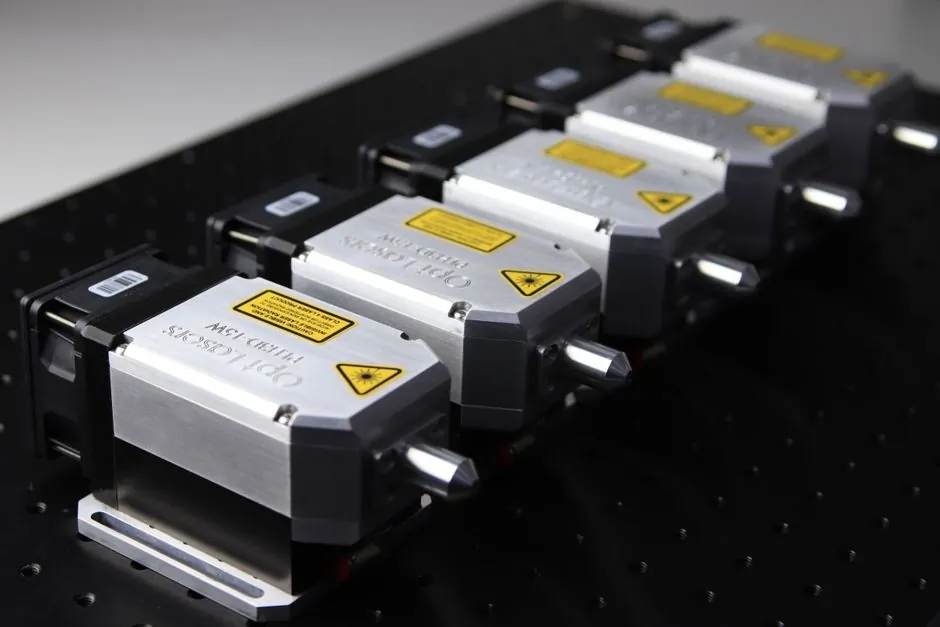
A NEMA 42 stepper is defined by its 110x110mm faceplate, 93mm mounting-hole pattern, and holding-torque range that runs from roughly 8 Nm on short-stack units to 33 Nm on long-stack models like the Motion Control Products M110STH201-8004 [S2]. Above 20 Nm the format standardises around 19mm shaft diameters, 9.5–11.7kg motor weights, and 4-lead bipolar windings driven from 80–240VAC buses [S1][S2].
For process engineers, the 20 Nm class sits at the boundary where stepper drive electronics, structural rigidity, and heat dissipation stop being trivial afterthoughts, and start to dictate machine layout and enclosure design [S4].
20 Nm Class: Standard 3-Phase and 2-Phase Specs Compared
A typical 20 Nm 3-phase NEMA 42 carries a 1.2deg step angle (300 steps/rev), 6.8A per-phase rated current, 1.2ohm phase resistance, 22mH inductance, B-class 130°C insulation, and 3000mm leads on a 9.5kg body with a 218mm stack length [S1]. The 2-phase 1.8deg alternative from Moons (AM42HS24A0-01) hits a similar 21 Nm holding torque on 149.5mm body length at only 2.4A, trading higher inductance for a more compact stack [S4].
At the same voltage and current, 3-phase windings deliver higher torque per frame size than 2-phase and 5-phase hybrid designs, which is why most new 20 Nm NEMA 42 offerings are 3-phase, 1.2deg, and 3-lead configurations [S6]. A 2-phase bipolar drive such as the DM2282 (SMC-080) is still the conventional match for legacy 1.8deg 20 Nm NEMA 42 loads [S3].
How the 20–33 Nm Envelope Maps to Frame Length
Holding torque scales roughly linearly with motor body length in the NEMA 42 family, as the Motion Control Products M110STH datasheet shows: 11 Nm at 99mm, 12 Nm at 115mm, 20 Nm at 150mm, 24 Nm at 168mm, and 33 Nm at 201mm, with motor weight climbing from 5.0 kg to 11.7 kg over the same range [S2]. Stepper Online's NEMA 42 line echoes the pattern with three stock models covering 10 Nm, 20 Nm, and 30 Nm holding torque [S5].
The 20 Nm NEMA 42 class also spans at least two closed-loop hybrid-servo kit configurations offering 12 Nm and 20 Nm (1,699 oz-in and 2,832 oz-in) with speed ratings from 0 to 2,000 RPM on a 220VAC bus, positioning the format for direct spindle replacement on small lathes and CNC routers [S7]. The 3-phase 110AI218-6803S, by contrast, is an open-loop part rated for optimal working speed up to 3000 RPM when paired with a 110–220VAC drive [S1].
Real Torque Output: Holding vs Working vs Continuous
For a NEMA 42 in the 20 Nm class, expect low-speed working torque at roughly two-thirds of the rated holding torque before the speed-dependent back-EMF drop-off begins, with full torque available only at standstill or very low RPM [S4]. This is the single most common source of field complaints when a 20 Nm motor is substituted into a load that was sized using only the holding-torque number, since the 7.5 Nm benchmark for a 1.1kW 1400 RPM lathe spindle in a thread-cutting application is comfortably inside the 20 Nm envelope but only when the drive is current-chopping into the motor [S4].
Stepper-motor drive electronics and stepper drive selection matter as much as the motor itself at this power level: closed-loop hybrid-servo kits pair an encoder with the same 110mm NEMA 42 frame, and add 0–2,000 RPM speed control without abandoning the 20 Nm class footprint [S7]. For applications where the load demands torque at speed, the 1.8deg 2-phase part, with its lower inductance, holds up better than the 1.2deg 3-phase part above ~500 RPM, while below that band the 3-phase part wins on smoothness and resonance immunity [S2][S6].
Selection Criteria: When NEMA 42 Fits, and When It Doesn't
NEMA 42 makes sense when the load needs more than ~12 Nm of holding torque and the machine has the 110x110mm panel cutout, 220VAC single-phase supply, and a heat budget for a 9.5–11.7 kg motor running at 6.0–6.8A continuous phase current [S1][S2]. The format is a common upgrade path for older 1.1kW induction-motor lathes where the existing frequency inverter fails at low RPM, because a 20 Nm NEMA 42 closed-loop kit can hold torque down to stall while still delivering a usable speed range up to 2,000 RPM [S4][S7].
NEMA 42 is the wrong choice when the load requires sustained torque at high speed, when the available drive electronics are limited to low-voltage DC bus stepper drivers, or when the application needs smooth low-speed positioning that the 1.8deg 2-phase resonance behaviour would distort, since a 3kW servo at 1500 RPM is roughly the same size as a 20 Nm NEMA 42 in continuous working torque, and it does not lose torque above 300 RPM the way a stepper does [S4]. Structural shaft considerations also matter: 19mm keyed shafts, like those on the 110AI218-6803S, need shaft selection criteria that match the high-torque loads this class delivers [S1].
Integration Notes: Frame, Shaft, and Drive Pairings
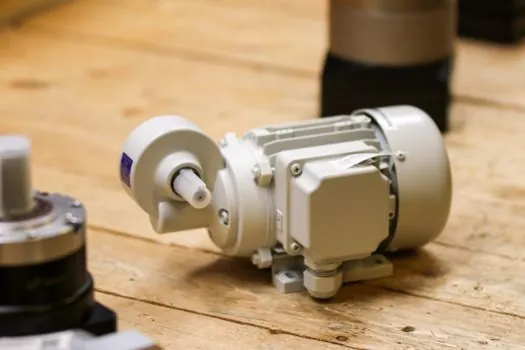
Mounting pattern, shaft diameter, and keyway are the three integration constants across 20–33 Nm NEMA 42 stock: 110x110mm face, 93mm hole-to-hole, 19mm shaft, 40mm shaft length, and a 31mm keyway on the 3-phase 20 Nm reference design [S1]. Closed-loop kits in the same frame accept the same mechanical envelope, swapping open-loop for hybrid-servo control with no machine redesign [S7].
Pairing a NEMA 42 above 20 Nm with a stepper motor driver needs careful bus-voltage and current-chopping choice, since the 6.8A per-phase rating on a 1.2ohm, 22mH winding draws substantial current at low commutation rates and will overheat on undersized chopper drives within minutes [S1]. For OEM machine builders, AC motor comparisons matter when a 3kW induction alternative is on the table, because at this power level the efficiency gap between open-loop stepper and closed-loop AC servo starts to drive the total cost of ownership math, not just the bill of materials [S2][S4].
Failure Modes and Field-Proven Mitigations
The most common NEMA 42 failure above 20 Nm is not catastrophic motor burn-out, but mid-band resonance and stall-induced position loss when the drive runs above the back-EMF knee without closed-loop feedback [S4]. The second most common is bearing failure on long-stack units, since the 11.7 kg 33 Nm model at 201mm body length has a higher rotor-inertia footprint (Moons' AM42HS24A0-01 lists 10,900 gcm²) that loads the front bearing when coupled to a belt or gearbox [S4].
Field-proven mitigations are: (1) use a 3-phase 1.2deg part with microstepping drive to push mid-band resonance above the operating range; (2) add an optical encoder for closed-loop hybrid-servo control on loads that risk stall at speed; (3) check torque sensor feedback or current monitoring on the drive side to detect missed steps before they propagate into scrap parts [S2][S7].
Two trackable signals for the next cycle: (a) vendor releases of 24V/48V low-voltage NEMA 42 drivers sized for the 20 Nm class, which would let the format drop into battery-powered AGV and mobile-robot markets; (b) more 3-phase 1.2deg part numbers above 20 Nm with explicit CE/RoHS/ISO certifications, since the 110AI218-6803S already carries that trio and 2026 OEM datasheets are beginning to require it for European and North American machine builders [S1][S2].