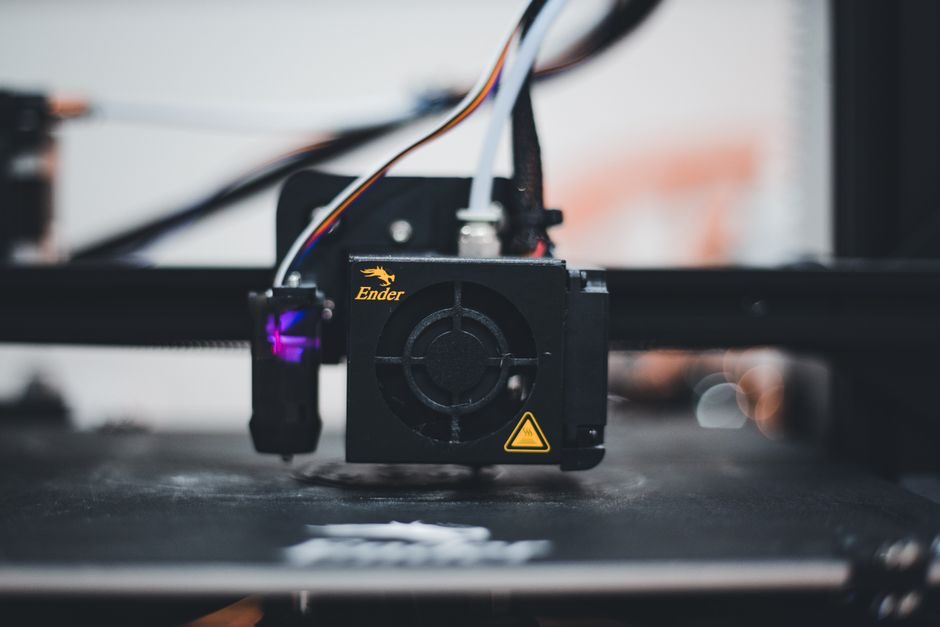
OEM production is a contract in which the manufacturer fabricates parts exactly to drawings supplied by the buyer, who owns the design, tooling intent, and any post-processing specification; the supplier's liability is confined to dimensional conformance and material traceability, not concept IP [S1].
ODM production inverts that flow: the manufacturer offers a pre-engineered, often already-certified product or part geometry, and the buyer rebrands it under a private label, accepting the supplier's underlying bill of materials, build parameters, and process window [S1]. The same distinction governs how a plastic-injection buyer and a metal additive manufacturing material buyer evaluate capability.
Where Each Model Fits an Additive Manufacturing Project
OEM is the default for aerospace, medical, and industrial-process buyers who must retain Design for Additive Manufacturing (DfAM) control, including lattice density, wall thickness, and post-machining stock, because the part carries their regulatory file and their end-customer warranty [S1]. ODM is more common in consumer goods, IoT enclosures, and dental or orthotic workflows where the buyer's value is brand, distribution, and finishing, not the print recipe itself.
A useful rule: if the build file (STEP, 3MF, or AMF) is uploaded by the buyer, the engagement is OEM-like; if the buyer selects from a catalogue and applies a logo, the engagement is ODM-like, even when both shipments come off the same EOS or SLM Solutions machine [S1].
IP, Tooling, and Non-Recurring Engineering
In an OEM additive contract, the buyer pays for or supplies the print file, fixture design, and any DfAM topology-optimization study; the supplier bills build time, powder consumption, and any heat-treatment or HIP cycle. NRE is typically the buyer's burden unless explicitly amortized. [S1]
In an ODM additive contract, the supplier's NRE — including build-file preparation, support-generation, and platform validation — is recovered through per-unit margin, so unit pricing is higher but no separate engineering invoice is issued. Buyers who change the ODM geometry mid-program usually trigger a re-engineering fee that mirrors what an OEM buyer would have paid upfront [S1].
Speed, MOQ, and Cost Trade-Off

OEM orders with custom DfAM typically take 6–12 weeks from PO to first article because of simulation, support design, and parameter qualification; ODM catalogue parts can ship in 1–3 weeks because the build recipe is pre-validated [S1].
Minimum order quantity is the inverse: ODM suppliers often enforce MOQs of 50–500 units to cover their amortized engineering, while OEM build slots are commonly quoted per batch (often 1 piece for prototype, 5–25 for qualification runs). On a per-cubic-centimeter basis, OEM parts carry higher setup overhead but lower per-unit part price at volume, whereas ODM parts carry lower setup overhead but a built-in margin premium that compresses only at the ODM supplier's preferred batch sizes [S1].
Standards, Certification, and Traceability
Buyers in regulated sectors should require OEM terms whenever the part must ship with a per-heat powder chemistry certificate, build-plate log, or post-process HIP record linked to the buyer's part number. The peer-reviewed journal Additive Manufacturing (Elsevier, ISSN 2214-8604, 5-year impact factor 13.6) routinely publishes the test methods — for example the 2025 vat-photopolymerization working-curve interlaboratory study — that eventually become the OEM supplier's acceptance criteria [S3].
ODM buyers should still demand documentation, but they inherit whatever certification the ODM supplier already holds (ISO 9001, AS9100, ISO 13485), and re-certifying a modified ODM design under the buyer's name is the buyer's responsibility, not the factory's. Buyers who compare 3D printing vs. subtractive manufacturing trade-offs — geometry freedom vs. surface finish and tolerance — should keep those same standards in scope for either engagement model [S6].
Decision Matrix: OEM vs ODM on Five Criteria
Five criteria that reliably separate the two models in RFQ scoring: (1) IP ownership — buyer-owned in OEM, shared/supplier-owned in ODM; (2) NRE cost — buyer-paid in OEM, amortized in ODM; (3) Time to first article — 6–12 weeks OEM, 1–3 weeks ODM; (4) Per-unit cost at 100 pcs — OEM lower (no margin premium), ODM higher; (5) Regulatory file ownership — buyer's name on OEM, supplier's pre-existing file transferred (often partially) on ODM [S1].
Spec the matrix into the RFQ template: any score that forces a buyer to choose between fast time-to-market and retained DfAM control points toward a hybrid engagement — ODM chassis with an OEM custom interface, for example — which is now a common middle path in consumer electronics and medical-device prototyping.
Common Failure Modes Buyers Hit
OEM failure: the supplier interprets a print file differently across operators, producing a wall-thickness or down-skin drift that only surfaces in CT inspection. The contract must name the STL/3MF revision, the slicing software version, and the layer height; without those three pins, the OEM has plausible deniability [S1].
ODM failure: the buyer re-skins the supplier's geometry for a target market with different regulatory exposure (FCC, CE-RED, MDR) and discovers too late that the ODM radio module, fasteners, or biocompatible surface finish cannot be re-certified under the buyer's name. The supplier's catalogue is the buyer's spec sheet; treat it like one.
Cross-cutting failure on either model: ignoring downstream industrial control integration. Buyers who intend to embed an ODM sensor module into a PLC-monitored line should confirm digital output protocols and PLC handshake compatibility during RFQ, not at field commissioning.
Signals to Track for the Rest of 2026

Three numbers worth watching: (1) the next JCR impact-factor update for Additive Manufacturing, after the 2026 value of 11.3 and 5-year value of 13.6 [S3]; (2) the publication cadence of ASTM F42 and ISO/TC 261 work items, which increasingly govern both OEM supplier qualification and ODM catalogue acceptance; (3) per-kilogram metal-powder pricing for Ti-6Al-4V and 316L, the two grades that decide whether an OEM volume run breaks below an ODM catalogue price.
For a deeper look at how process monitoring underwrites OEM acceptance criteria, the spec map on additive manufacturing quality standards lines up the melt-pool, NDE, and CT testing vocabulary that should appear in any OEM contract appendix.
Spec-level background on the components involved: pressure transmitter.