Open-pit capacity planning still rests on the engineering/service capacity split formalized in Russian open-pit mining handbooks, where engineering capacity is derived from the rock's digging resistance and the machine's cycle-time geometry, while service capacity nets out shift losses, weather, blasting delays, and haul-truck queueing [S2][S3].
That dual-capacity framework, published in the Journal of Mining Science (Part I 2008, Part III 2010), is now the reference basis for shovel, loader, and dumper-fleet planning in many open-cast operations, and the same logic is being re-implemented in the digital fleet tools that OEMs such as Sandvik and Chinese slurry-pump and mill-liner suppliers ship in 2026 [S1][S2][S3][S4].
Engineering capacity: cycle geometry, bucket fill, and rock diggability
Engineering capacity (technical productivity) of a hydraulic shovel or rope shovel is the bucket volume times the design cycle time at a defined swing angle and face height, de-rated by the rock's diggability category and blast-fragmentation distribution [S3]. The Springer analysis recommends modelling these parameters in a computer procedure rather than as static lookup values, because the number of optimization parameters (swing angle 90° vs 180°, dipper fill factor, bucket payload vs bucket volume) makes closed-form lookups systematically conservative [S3].
For a typical 22-25 m³ electric rope shovel paired with 136-363 t rigid-frame haul trucks, the engineering hourly rate at a 90° swing is the input the rest of the mine plan is anchored to; deviation from that rate shows up almost immediately in the truck-fleet requirement downstream [S2]. Operators that still rely on the 1989 Standard Production Quotas for Open Cast Mining Industries are now layering those tables with continuous OEM data because the static quotas cannot reflect current truck class or autonomous-drilling penetration [S3].
Service capacity: where the real bottleneck lives
Service capacity is what engineering capacity becomes after the mine-technical losses are applied, and the 2010 Part III paper isolates the loss mechanisms as: shift-change non-productive time, weather stoppages, blasting-window interruptions, truck-spotting delays, and operator skill variation [S2]. The paper treats these as a deterministic correction in the range of a few percent to roughly 30% combined, with truck-spotting and bucket-to-truck payload mismatch being the dominant terms in deep, truck-intensive pits [S2].
In 2026, that service-capacity gap is the metric OEMs sell against. Sandvik's rock-technology product line explicitly bundles equipment, automation software, and condition-monitoring so a buyer can lift the difference between engineering and service capacity rather than buy a larger machine to compensate [S4]. Procon's mining-services group similarly frames its value as raising fleet efficiency to keep ore delivery consistent to the mill, rather than as added nameplate tonnes [S5].
Equipment classes lined up against the planning criteria
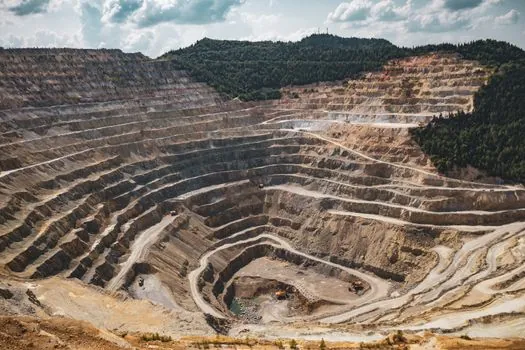
For greenfield or expansion planning the four equipment classes most often weighed are: electric rope shovels (high tonnage, low unit cost at scale), hydraulic excavators (flexible selectivity, lower capital), wheel loaders (used for selective ore and clean-up), and rigid-frame haul trucks (matched to shovel dipper size and haul road grade) [S3][S4]. The decision criteria that sort them are diggability and rock fragmentation, truck-spotting geometry, selectivity requirement, and electrification/automation readiness, with the comparative score changing once a pit exceeds roughly 40-50 m depth and truck cycle time starts to dominate [S2].
On slurry-side ancillaries, mills, and hydrocyclones the relevant comparison criteria are: solids-handling capacity in t/h, liner wear life, and whether the supplier holds ISO 9001, ISO 14001, and ISO 45001 certification as a single integrated system rather than three separate certificates [S1]. Naipu Mining's 2026 product sheet lists rubber composite mill liners, steel-rubber composite pipes, and a hydrocyclone range marketed for finer classification granularity and longer wearing-part life, with the certification triple cited as the gating requirement for many domestic and overseas mine customers [S1].
Automation, condition monitoring, and the 2026 spare-parts reality
Sandvik's current product positioning places automation software, fleet monitoring, and rock-support installation alongside the machines themselves, on the explicit argument that mining is moving to deeper, harder-to-reach orebodies where equipment efficiency, profitability, and operator safety are no longer optional [S4][S6]. The automation layer feeds back into capacity planning by replacing the static service-loss table with measured availability, mean time between failures, and payload-per-cycle data captured at the machine [S4].
For a 2026 capex package, the practical implication is that a mining dump truck selection should be evaluated jointly with the dispatch system's API, the condition-monitoring retro-fit kit, and the OEM's regional spares warehouse, because field data consistently show that availability, not nameplate payload, sets the achievable annual tonnage. Buyers in the broader mining-equipment space can benchmark this against the 2026 spec map for mining equipment buyers and engineers, and against self-aligning bearing selection for mining duty, since truck-class driveline bearings are a recurring constraint on the haul-fleet side of the model.
Standards, certifications, and sourcing that gate a 2026 spec
For the non-machine inputs, the standards and certifications that show up on a 2026 capacity-planning audit are: ISO 9001 for the supplier quality system, ISO 14001 for environmental management, and ISO 45001 for occupational health and safety, typically demanded as a single integrated certificate rather than three stand-alone documents [S1]. Where the equipment is operating in hazardous zones, the supporting instrumentation needs the matching ATEX/IECEx documentation, including pressure transmitter and flow meter selections that carry the appropriate zone rating. For truck-mounted electrical harnesses, lighting, and cab signaling, lighting equipment and electric lamps choices on the rig affect both shift-cycle safety audits and energy-budget calculations, while NDT equipment selection drives the in-service inspection interval that feeds directly back into the service-capacity model [S1].
Anti-static requirements, including anti-static equipment for rubber-lined slurry systems and mill-liner handling, are increasingly part of the audit checklist on operations handling combustible dust or methane-classified seams, and they are one of the few non-OEM items that a capacity planner can standardize across the whole shovel-truck-mill chain [S1].
Signals to track over the next two quarters
Two specific items will sharpen the next planning cycle: a revised open-pit capacity calculation reference (the Springer Part I/II/III series is from 2008-2010, and a successor volume that explicitly models autonomous truck fleets and trolley-assist shovels would be the obvious input to revisit the static service-loss table) [S2][S3]; and an OEM-published availability benchmark for trolley-assist and battery-electric rigid-frame haul trucks, which is the data point that will let a planner move truck-fleet modelling out of the diesel-cycle assumption that the 2010 paper still uses [S2][S4]. Until both land, the conservative move is to keep engineering capacity as the published value and apply a measured, mine-specific service-loss factor rather than a handbook default.