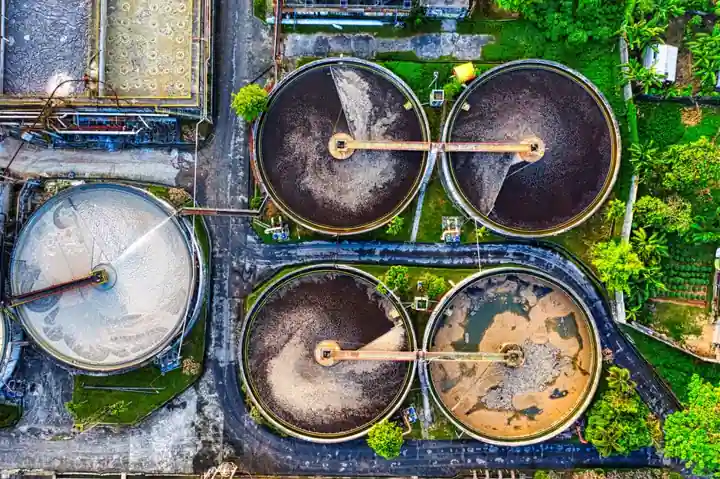
Operators of seawater reverse osmosis (SWRO) plants are now specifying digital twins, IIoT sensor layers, and AI-based energy management across the high-pressure pump train, energy recovery device (ERD) skid, and multi-stage RO rack, with adoption gated by ISA-95 layer integration and IEC 62443 cybersecurity scopes [S1][S5].
Process-engineering scope covers three retrofittable layers: a brownfield sensor overlay using HART and IO-Link devices, an edge layer with pressure transmitters on the RO feed and interstage headers, and a plant-level MES bridge that pushes normalised KPI streams into a cloud-hosted optimisation model. The technical question is not whether to digitise, but which layer to fund first [S2].
Layered reference model: where Industry 4.0 actually lands in a SWRO plant
An SWRO plant in 2026 is mapped against a five-layer Industry 4.0 reference model running from field sensors (ISA-95 Level 0) up to enterprise analytics, with the bulk of new spend concentrated in Levels 1-2 [S1]. The desalination-specific twist is that the most valuable data points sit on the high-pressure side: feed pump discharge pressure (typically 60-80 bar for standard SWRO), interstage pressure differentials across the RO array (a 0.5-1.0 bar rise per stage flags fouling), and ERD shaft speed, all of which are points where modern flow meters and pressure sensors replace legacy gauges.
Brownfield sites typically install an overlay that leaves the existing industrial valve actuators in place and adds wirelessHART gateways plus IO-Link masters on the chemical dosing skids. Greenfield EPC packages now ship with embedded OPC UA over TSN backbones, which removes the protocol-translation burden that slowed the 2018-2022 wave of pilots [S5]. The four highest-leverage retrofit points, in order of payback, are the high-pressure pump VFD, the ERD, the CIP dosing skid, and the membrane cleaning RO-CIP sequencing.
Decision criteria: HART vs IO-Link vs OPC UA over TSN
Three protocols compete for the field-level connectivity layer on desalination retrofits, and the right pick depends on the asset class. HART and WirelessHART dominate instrumentation upgrades on existing 4-20 mA loops because no cable is pulled and the existing pressure sensor housings, junction boxes, and DCS marshalling remain untouched, which matters for hazardous-area sites classified under IEC 60079 series [S1].
IO-Link is the strong default on chemical dosing skids and cartridge-level valve manifolds where point-to-point wiring is being added anyway, with bidirectional parameter storage and a 230.4 kbit/s update rate sufficient for dosing flow meters and conductivity probes [S5]. OPC UA over TSN is the new-build default for the high-pressure pump skid and the membrane filtration rack, where deterministic latency (sub-millisecond) and vendor-neutral information models are required for closed-loop pressure control on the feed side [S5].
AI and digital-twin use cases that have cleared pilot stage
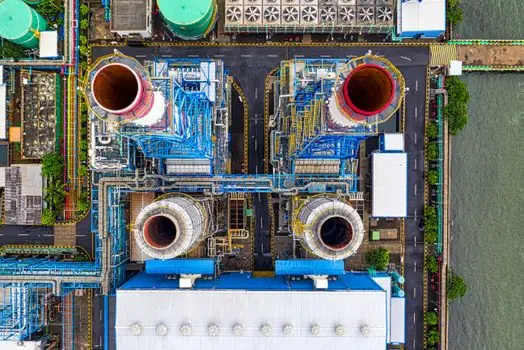
Four use cases are now in production at commercial SWRO sites and have moved beyond proof-of-concept: RO membrane fouling prediction 7-14 days ahead, chemical dosing optimisation on antiscalant and SHMP, energy recovery device efficiency tracking against the 96-98% mechanical-efficiency benchmark of isobaric ERDs, and high-pressure pump cavitation detection through vibration spectral analysis [S1][S3]. The first two are typically delivered as MES-level services that consume SCADA tag streams; the latter two require edge-level AI inference on a PLC adjacent platform.
The economic case for AI sits in two numbers: specific energy consumption, which falls in a 3-4 kWh/m³ range for modern SWRO with isobaric ERD, and membrane replacement cost, which typically runs 15-25% of annual OPEX at mid-life.
Cybersecurity and standards: IEC 62443 is now non-negotiable
Desalination is being reclassified as critical national infrastructure in several jurisdictions, which has pulled IEC 62443-3-3 SL-2 and SL-3 conformance from a procurement preference to a hard requirement on most public-tender projects awarded after Q1 2025 [S5]. The practical consequence is that any IIoT gateway, edge historian, or cloud connector added to the plant must be documented in a zone-and-conduit model, and a Security Level must be assigned per zone.
Three standards govern the operational layer in parallel: IEC 62443 (cybersecurity zones and SL targets), IEC 62541 (OPC UA information model), and IEC 61131-3 plus the PLCopen Motion Control extensions for the pump and ERD control logic [S5]. Plants that skip the zone-and-conduit exercise find their insurance premiums and audit findings move against them within 12-18 months of commissioning.
Who should adopt now, and who should wait
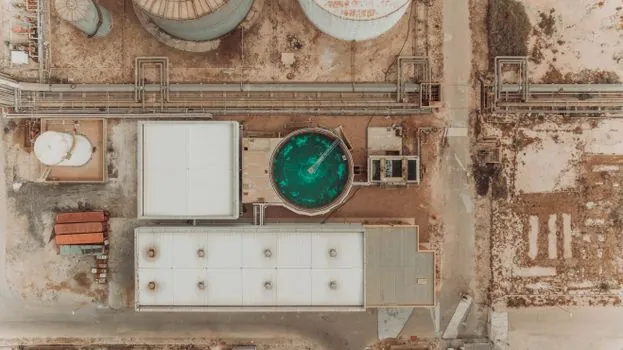
Plant owners with SWRO trains of 50,000 m³/day or larger, an existing DCS or modern PLC backbone, and a stable maintenance team of at least four instrument/automation engineers should be funding the four-layer overlay in 2026. The combination of scale, existing OT infrastructure, and a 20-30 year asset life is the breakeven point at which Industry 4.0 retrofit is cash-positive inside one membrane replacement cycle [S1][S3].
Owners of small modular units below 10,000 m³/day, plants with a paper-only control system, or single-train sites with no spare PLC I/O should defer the IIoT layer and start with energy and maintenance basics: high-pressure pump VFD retrofit, ERD upgrade, and a single membrane-fouling AI subscription. Jumping straight to a digital twin without Level 0-1 instrumentation coverage produces dashboards, not savings, and the literature consistently flags culture and mindset change as the dominant blocker, not the technology [S1][S2]. The buyer-risk and spec-gate map for desalination equipment is laid out in Desalination Manufacturing Quality Standards, which complements this view with the testing side.
Supply chain and EPC integration risk in 2026
Two supply-chain constraints are gating large-scale desalination Industry 4.0 rollouts: long-lead high-pressure pump deliveries (12-18 months for units above 25 MW) and a structural shortage of industrial Ethernet switches rated for IEC 61850-3 / IEEE 1613 substation environments, which desalination plant designers increasingly share with the substation industrial Ethernet design pattern [S6].
Standardisation pressure from EPCs is now flowing back to OEMs: SWRO trains must arrive with an OPC UA companion specification for the high-pressure pump and ERD, an ISA-95/B2MML-compliant data exchange to the EPC's digital twin platform, and a documented IEC 62443 SL target.
These three numbers, when they surface, will let buyers benchmark a 2026 retrofit against a 2024 baseline.