
An order picker is a class of materials-handling equipment designed to elevate the operator (and in many configurations the pallet) to the pick face, rather than lifting only the load, and it dominates order-fulfilment aisles where SKU velocity is high and pallet quantity per pick is low.
Selection between manual, electric pedestrian, and stand-up rider platforms hinges on lift height, aisle width, throughput target, and floor condition, with electric models commonly specified at 6 m, 8 m, 10 m, and 12 m platform heights and manual models topping out near 2.5 m.
What an Order Picker Actually Is, and What It Is Not
Order pickers are engineered for case-level and piece-level picking in racked aisles, not for horizontal transport of full pallet loads over distance, which is the domain of counterbalance forklifts, reach trucks, and turret trucks [S1].
The defining mechanical feature is the moving operator platform (or a moving forks-on-mast that the operator walks beside), so the machine's load centre and stability case are computed with the person mass included, not just the pallet.
Common categories: low-level (manual or powered, lift under 2.5 m, operator walks), medium-level (electric pedestrian, 2.5-6 m lift), high-level (rider, 6-12 m lift, often with wire or rail guidance), and very-high-level (12 m+, typically guided, used in distribution-centre racks above 12 m).
Selection Criteria Lined Up Against the Three Main Types
For a side-by-side comparison the three principal order-picker classes can be lined up against lift height, aisle width requirement, throughput, and operator-skill demand as decision criteria. [S2]
Manual low-level pickers are cheap (often 1/3 to 1/2 the price of an electric pedestrian unit of similar load rating), need no battery room, and run on any flat warehouse floor, but they cap at roughly 2.5 m platform lift and tie up labour because every vertical move is human-powered.
Electric pedestrian (medium-level) machines typically carry 200-500 kg at 2.5-6 m lift, fit 2.4-2.8 m aisles with a wire-guided option, and lift the platform under 15 s, but they still require a certified operator and add battery-charging infrastructure (typically 3-phase 32 A or higher).
High-level rider order pickers reach 6-12 m with 1.0-1.5 t capacity, demand 2.8-3.4 m guided aisles, and can lift 8-12 m in roughly 60-90 s, but the unit cost is several times the manual variant and the aisle must be flat to within roughly ±10 mm over the run to keep the rail guidance honest.
Concrete Advantages on a Working Shift
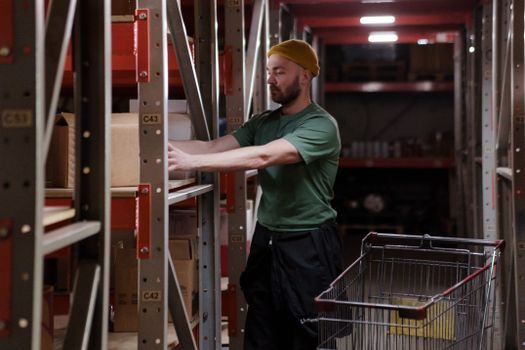
Pick rate climbs measurably: high-level guided order pickers in distribution centres routinely achieve 100-180 picks per operator-hour versus 40-70 picks per operator-hour for manual cart picking at the same SKU density, because the travel-to-pick ratio collapses when the platform moves with the operator [S1].
They compress aisle width, often allowing 2.6-3.2 m aisles where a reach truck would need 3.0-3.6 m, which directly raises warehouse storage density by 8-15% on a given footprint.
Order accuracy improves because the operator stays at the pick face and reads the label rather than bending from the floor, and the 24 V or 48 V DC control circuits on electric units interlock lift, drive, and brake, so the machine will not travel above roughly 0.5 m/s with the platform raised unless the operator confirms.
Ergonomics is the recurring win: elevating the work to waist or shoulder height removes the deep-knee bends and full-arm reaches that drive most picking-related musculoskeletal claims, which is why safety-fenced picking cells are often replaced by open-aisle order-picker operations where racking permits.
The Real Disadvantages Spec Sheets Understate
Unit cost is the headline: an electric rider order picker at 10 m lift commonly lists at several times the price of a comparably rated pallet stacker, and high-level guided machines sit at the top of the warehouse-equipment cost curve.
Floor flatness is a hard constraint, because small-diameter polyurethane wheels and rail guidance are intolerant of dips; specifications typically call for the floor to be within ±3-5 mm over 2 m, and deviations beyond that generate vibration, premature wheel wear, and safety complaints.
Operator certification is mandatory under most regional warehouse-safety frameworks, because falls from elevated platforms are the dominant injury mode, and standard practice is a formal training record, harness use above 2 m, and a daily pre-shift check covering mast chains, limit switches, and platform gate interlock.
Single-purpose layout is the structural drawback: an aisle and racking system designed around order pickers is hostile to reach trucks and counterbalance forklifts, so once a DC commits to order pickers, the picking method is hard to swap without re-racking.
Standards, Sourcing, and Where the Numbers Come From
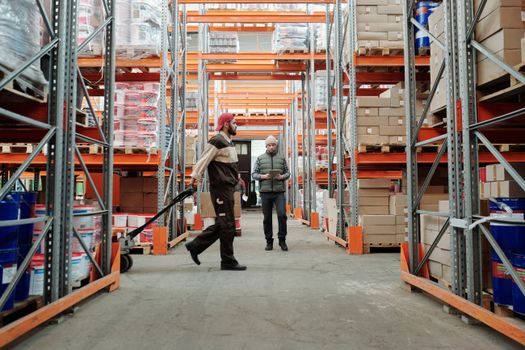
Order-picker design and use are governed by EN ISO 3691-1 (industrial truck safety, general) and EN 280 (mobile elevating work platforms) depending on configuration, with regional variants such as ANSI/ITSDF B56.1 in North America, and operators are commonly certified to OSHA 1910.178(l) in the US or equivalent national codes elsewhere. [S3]
Battery and charger specs follow IEC 60254-1 for lead-acid traction cells and increasingly IEC 61851 for lithium-ion charging interfaces, which matters when a fleet is sized to a 3-shift run, because lithium allows opportunity charging that lead-acid does not tolerate without cell damage.
Wire and rail guidance systems interface with the truck control bus (typically CAN J1939 or the manufacturer's proprietary bus), and the aisle-install tolerance is set by the racking supplier, not the truck supplier, which is a coordination point many first-time buyers miss.
Use Cases That Fit, and Use Cases That Do Not
Order pickers fit e-commerce fulfilment, pharma distribution, and spare-parts operations where case-level or piece-level picks dominate and the order line quantity averages below one pallet.
They do not fit full-pallet inbound/outbound flows, container stuffing, or construction sites, where a counterbalance forklift class or rough-terrain unit is the right answer, and forcing an order picker into that role burns cycles and damages the mast.
For mid-rise picking with mixed SKU and case volumes, the comparison versus alternatives such as a vision-guided cart system or a turret truck turns on aisle width and SKU velocity more than on raw lift height.
Forklift-class alternatives (turret, reach, counterbalance) cover the other end of the spectrum and pair naturally with weighing, so the electronic scale buying guide is a useful cross-reference when a pick needs to verify weight at the order line.
Failure Modes Engineers Should Pre-empt
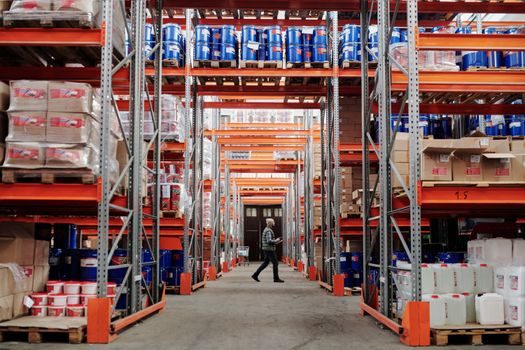
Mast-chain elongation above roughly 2-3% over the original pitch is the dominant wear item, and a service interval tied to hours rather than calendar time catches it before the lift cylinder drifts.
Platform-gate interlock failure is the dominant safety incident root cause, because operators learn to defeat it; a daily functional test (gate open = no lift, no drive) and a logged check are the minimum credible mitigation.
Wheel-bearing contamination from standing water or debris is the silent killer of aisle-cycle time, because drag rises before the bearing seizes, so floor-sweep frequency and drainage at the aisle ends are maintenance items, not housekeeping items.
Signal interference on wire-guided aisles (from new LED lighting on the wrong frequency band or from added racking earth-bonding) shows up as wandering trucks and is a commissioning job to resolve, not an operator-error problem.
Spec-level background on the components involved: pressure transmitter, and flow meter.