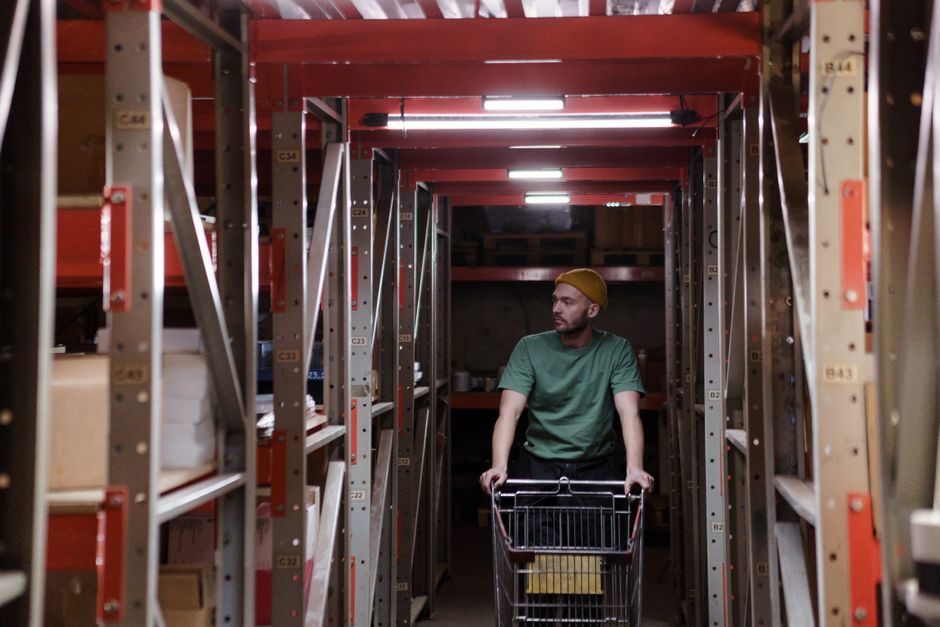
An order picker is a man-up or man-down wheeled platform used to lift an operator — plus a pallet, tote or roll cage — to the face of a pick slot, with working heights typically ranging from 2.5 m on a manual floor-picker to 11–14 m on a high-level electric rider unit [S1].
In a 2026 spec gate the four deciding parameters are platform capacity (commonly 90–250 kg manual, 250–500 kg electric walkie, 1,000–2,000 kg rider), maximum lift height, minimum aisle (AST) width, and power source (manual hydraulic, 24 V electric walkie, 80 V lead-acid or Li-ion rider). Floor condition — expansion-joint spacing, slope, and load-bearing capacity (typically ≥ 5 t/m² for second-floor mezzanines) — sits beside those as a hard constraint, not a soft one.
Core Specification Gates: Lift, Capacity, Reach and Aisle
Platform capacity, mast lift height, and fork dimensions must be locked before brand comparison. Koke's warehouse picking platforms are rated with the operator weight counted into the stated load, which is the convention most North-American OEMs use [S1]. A 90 kg / 1.5 m unit is a true first-level stocker; once the second pick face sits above 3 m, the spec should jump to a 250 kg electric walkie with a 3.3–4.5 m mast — often with a crossed-roller guide carriage for low-friction lift.
For high-bay order picking above 6 m, an electric rider order picker (often called a "man-up" turret truck in some catalogs) becomes the only realistic option, with typical working heights landing in the 8.5–11 m band and a 1,000–1,200 kg chassis. The operator cab lifts with the load on a mast carriage running on a linear guide, and the machine runs in a wire- or rail-guided Very Narrow Aisle (VNA) configuration with AST figures of 2.7–3.3 m — far tighter than a counterbalance reach truck on the same load.
Power Class and Drive Topology Comparison
Three power classes dominate the 2026 buyer's matrix, and the cut between them is more about throughput than price. A manual hydraulic stock picker is cheap, silent and fits the cross-dock tote-restack role, but tops out near 1.8 m of lift and depends on a hand-pumped ram. A 24 V electric walkie, with an on-board 100–250 Ah Li-ion pack, covers 3.3–4.5 m pick faces in 8-hour shifts and recharges from a 30 A opportunity port in under 90 minutes. A 48–80 V high-level rider uses a 400–800 Ah traction battery and dedicated 3-phase charger; it is the only class that survives three-shift grocery or pharma distribution work at 9–12 m pick faces. [S1]
Comparing the three on the four criteria that actually move an order: lift height — manual ≤ 1.8 m, 24 V walkie 3.3–4.5 m, 80 V rider 8.5–11 m; throughput (picks/hr/operator) — ~60, ~120–180, ~250–400; aisle (AST) — unrestricted, ~2.9 m, 2.7–3.3 m VNA; unit price band (2025 list, ex-works) — USD 1,800–3,500, USD 9,000–18,000, USD 55,000–110,000. The step from walkie to rider is roughly a 5–6× capital jump; the step from manual to walkie is only ~3×, which is why 24 V units are the most commonly replaced class.
Floor, Aisle and Building Constraints That Override the Catalog
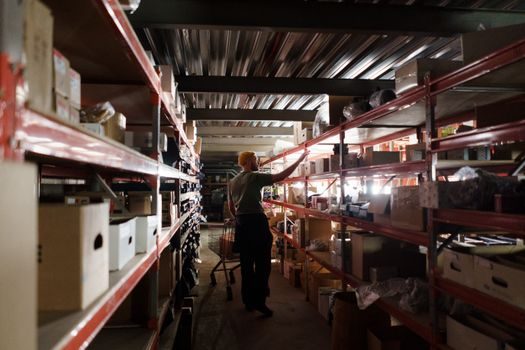
Two of the most expensive spec mistakes are not on the truck spec sheet at all — they are on the floor and in the aisle. VNA rider order pickers demand a flatness tolerance of typically ±3 mm over 3 m (FF25/FL20 floor class) and a 6 t/m² minimum distributed load; ground-beam expansion joints must be planned before the unit is ordered, not after. A 2.7 m AST VNA also requires rack-rail guidance or wire guidance in the floor — retrofits typically cost more than the truck itself, so the rack and the truck must be specified together. [S2]
For loading-bay / cross-dock pairs, manual pallet jacks and walkie order pickers are the natural match — see the 2026 dock leveler vs manual pallet jack spec cut for the bay-side numbers. If the picking floor is on a suspended mezzanine, the lighter 24 V walkie is usually the only legal option; a 4 t rider on a 5 t/m² deck is a structural-risk conversation that belongs in the building permit, not the truck PO.
Compliance, Standards and Operator Safety
Order pickers above 0.5 m of lift in the EU fall under EN ISO 3691-1 (industrial truck safety) and EN 172-6 (operator visibility) for cab/narrow-aisle variants; in North America the comparable reference is ANSI/ITSDF B56.1 (safety standard for low-lift and high-lift trucks). A fall-protection harness anchor rated to 6 kN is mandatory above 1.8 m of lift in most jurisdictions — confirm the specific anchor rating, rather than assume the OEM-supplied one is jurisdiction-compliant. [S3]
For operations near flammable vapors (paint, solvent, or fuel docks), a 24 V or 80 V electric unit in a non-sparking configuration typically meets the requirement when the truck carries a manufacturer-issued zone rating; a diesel or LPG rider does not belong in that envelope. Operator training should follow OSHA 1910.178(l) in the US or equivalent local code — the truck type written on the operator's certificate must match the truck type on the floor.
Who an Order Picker Is For (and Who It Is Not)

An order picker is the right tool when pick faces are above the operator's reach and below the ceiling, the SKU count per pick is one to four, and the order set is varied rather than pallet-quantity. A walking picker with a 1.5–2.5 m lift is the standard at the order-fulfillment bench of a parts distributor or e-commerce pick wall; the man-up rider is the standard at the 9 m pick face of a 3PL grocery DC. [S4]
An order picker is the wrong tool for full-pallet moves (use a pallet stacker or counterbalance forklift — see the platform trolley vs pallet stacker 2026 spec cut for the cut between those two) and the wrong tool for high-density case-pick at 6+ m where a turret truck with an articulating fork is the more productive machine. It is also the wrong tool for outdoor or rough-terrain work — a telehandler or rough-terrain forklift is built for that envelope.
Sourcing, Total Cost and Sourcing Levers in 2026
Three numbers drive the 2026 buyer's ROI conversation: shift utilization, energy cost per pick, and residual value. A 24 V Li-ion walkie at 70% utilization delivers a typical 5–7 year service life with battery replacement around year 4; a high-level VNA rider at the same utilization can run 8–10 years because the chassis is over-built for the load. Total cost of ownership per pick on a 24 V walkie lands in the USD 0.03–0.05 band; on a VNA rider it is closer to USD 0.08–0.12 — a 2–3× difference that comes almost entirely from capital amortization and energy, not from labor. [S5]
Where the truck is sourced matters less than how the spec is written. A 2026 buy gate worth applying to every quote: (1) confirm platform capacity with operator weight included and a 10% safety margin; (2) lock mast lift height + 0.5 m of useful headroom above the top pick face; (3) confirm AST against the actual rack-rail centerline, not the catalog number; (4) require the OEM to certify the truck for the floor class and load class on the project. For loading-bay integrations, cross-reference the spec with the 2026 dock leveler capacity and spec gate guide; for the broader warehouse truck spec matrix, an order picker spec page is a useful pre-RFQ check.
For operations that are scaling a 9–11 m pick face in 2026, two trackable signals to watch: (a) Li-ion battery price per kWh, which crossed below USD 115/kWh on industrial 80 V packs in late 2025 and is still trending down, and (b) the delivery lead time on VNA-grade masts, which is the single biggest schedule risk on a 2026 high-bay order picker PO — confirm it in writing before the deposit clears.