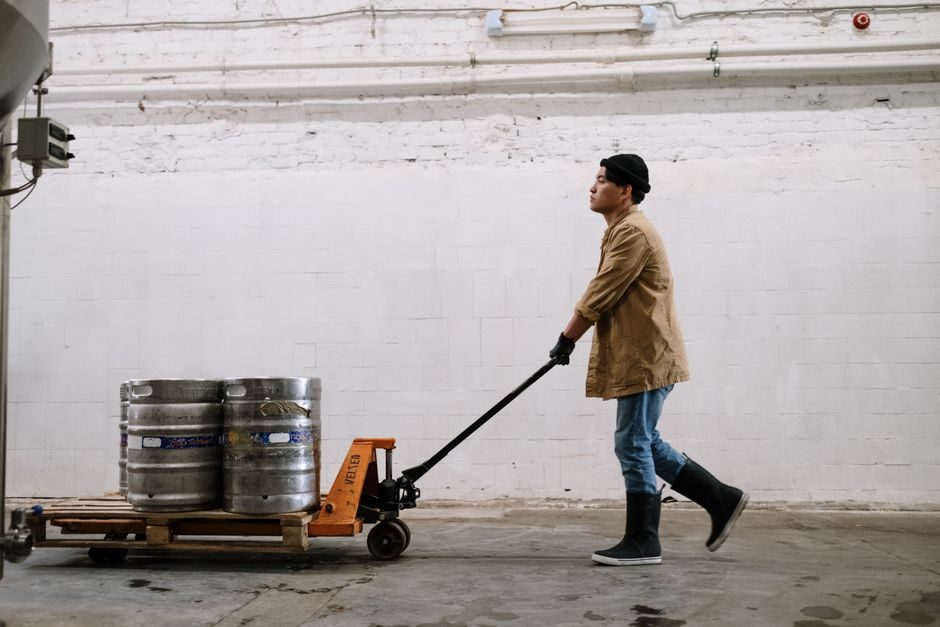
A 6600 lb capacity manual pallet jack with 27 in W x 48 in L forks and a powder-coat finish anchors the 2026 Amazon best-sellers list for the horizontal move, while a hydraulic dock leveler rated 25,000-35,000 lb dynamic load handles the vertical drop across the trailer lip [S2][S4].
The two pieces of equipment are not interchangeable. A manual pallet jack (also called a hand pallet truck or pump truck) is a wheeled, human-powered lifting tool for moving palletized loads across a finished floor. A dock leveler is a fixed, plate-form mechanism that bridges the gap and height difference between a warehouse floor and a truck bed. The selection cut for 2026 is whether the dock sees enough trailer turnover to justify a powered leveler or whether a manual pump truck and a small vertical-dock (pit or edge-of-dock) leveler covers the workload without operator fatigue or fork-truck idle time.
Dock Leveler Types, Capacities and Cycle Ratings
Hydraulic dock levelers in the 2026 aftermarket are sold under OEM brands including Rite-Hite, Kelley, Serco, Blue Giant, DLM, McGuire, Nordock, Pentalift, Poweramp and Systems Inc., with replacement springs, hold-down kits, lights, seals and bumpers available as catalog parts [S4]. Dongguan Dacheng Machinery in China lists dock levelers, mobile yard ramps, truck tailgate lifts and dock shelters as a product stack targeted at mid-volume distribution centers [S5]. Standard dynamic load ratings cluster at 25,000 lb, 30,000 lb, 35,000 lb and 40,000 lb; static load ratings are typically 2x the dynamic figure per ANSI MH30.1 loading dock leveler nomenclature. Cycle ratings for hydraulic units run 6-10 cycles/hour at full rated load before hydraulic fluid temperature begins to limit duty, while air-bag levelers cap at roughly 4-6 cycles/hour but tolerate more abuse from off-center forklift impacts.
Edge-of-dock (EOD) levelers are a smaller-format alternative for low-traffic bays with a 4-6 in working range and 20,000-25,000 lb dynamic rating. Vertical-storing levelers rise 12 in above dock to fully seal the pit when the trailer departs, improving building envelope and energy loss but adding $8,000-$15,000 per bay over a standard pit leveler. For operations with fewer than 30 trailers/day, an EOD plus a manual pallet jack is a defensible 2026 spec; above 60 trailers/day, a pit-mounted hydraulic leveler plus an electric pallet truck lowers total cost per pallet moved.
Manual Pallet Jack Capacity, Wheel and Pump Specs
The 2026 best-seller benchmark is a 6600 lb (3000 kg) capacity truck with 27 in W x 48 in L forks, powder-coat finish and polyurethane steer/load wheels, sold through Amazon's industrial best-sellers vertical and direct from makers like Global Industrial and APOLLOLIFT [S2]. Crown's PTH Series hand pallet truck is positioned around long-term serviceability: a one-piece forged pump, chrome-plated piston, sealed bushings at the pivot points and replaceable polyurethane load wheels sized 2.9 in x 3.9 in for the steer end and 2.75 in x 3.9 in for the load end [S6].
Shanghai-origin manual trucks like the GP 2-ton model are advertised as OSHA-compliant with non-slip handles, throughput in the 40-50 pallets/hour range for a single operator on a 30 m run, and 200 mm polyurethane or nylon steer wheels paired with 80 mm tandem load wheels [S3]. Big Joe's P33-compatible load wheel kit ships Durarun 95A polyurethane load wheels, which is a useful reference spec: 95 Shore A durometer is the industry norm for warehouse concrete, with 85A used on rough or debris-prone floors and 100A on smooth epoxy with heavy static loads [S1]. Tandem load wheels (two pairs per fork tip) lower rolling resistance by roughly 30% over single-wheel designs at the cost of a wider turning radius and higher replacement-part cost.
For the engineer's spec sheet, the 2026 minimum bar is: 5500 lb minimum capacity, 200 mm steer wheels in 85-95 Shore A polyurethane, 80 mm tandem load wheels, chrome-plated pump piston, one-piece forged pump body, and a 3-position handle (lift / lower / neutral) with a hand guard. Anything below that bar is a disposable retail truck, not a shop tool. Buyers looking for the full selection checklist should walk the five engineering gates — capacity, fork size, wheel durometer, pump type, and warranty path — covered in the Manual Pallet Jack Selection: 5 Engineering Gates That Lock the Model Before RFQ in 2026 walkthrough.
Pairing a Dock Leveler with a Manual Pallet Jack
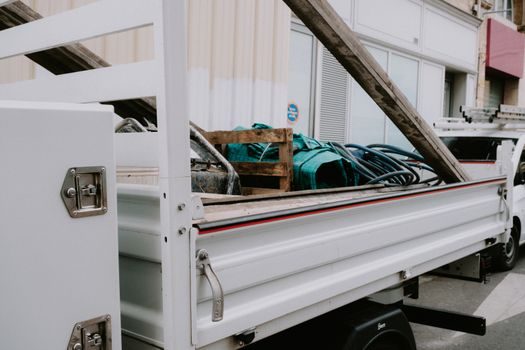
The pairing question reduces to throughput math. A 6600 lb manual pump truck on a 30 m run with 50 pallets/hour target (as quoted for the GP 2-ton Shanghai truck) needs a leveler cycle time under 20 seconds to keep the operator from waiting at the lip [S3]. Hydraulic pit levelers from the 2026 OEM catalog (Rite-Hite D-200, Kelley AFL, Serco ED, Blue Giant LHP) deliver 15-25 second full-cycle times, which matches the 50 pallets/hour single-operator pace [S4]. Air-bag levelers at 30-40 second cycles fall behind that pace and force either a second operator at the leveler or a slower pump-truck loop.
Lip geometry is the other pairing constraint. Standard dock leveler lips are 16 in long, project 5 in past the hinge, and a forklift or pallet jack must travel onto a leveler plate that is typically 6 ft wide x 8 ft long. A manual pallet jack with 48 in forks can climb a 16 in lip in 3-4 pumps provided the operator is committed to a 90-degree straight-line approach. Edge-of-dock levelers expose a 6-8 in drop to the steer wheels, which on a 5500 lb truck produces a hard impact on the 200 mm polyurethane wheels and accelerates wheel failure; this is the main reason EODs are paired with a powered pallet truck or a low-profile pallet jack rather than a standard 48 in fork truck.
Selection Criteria: Pallet Jack or Leveler First?
If the bottleneck is horizontal pallet move inside the warehouse (a distribution center with finished floors and <2 in lip), the manual pallet jack is the right first purchase. The 2026 retail benchmark of $300-$700 for a 5500-6600 lb truck with a 1-year warranty is a one-quarter payback at 50 pallets/day labor savings versus a powered alternative [S2][S6]. If the bottleneck is the vertical drop at the dock face, no amount of better pump truck will fix it: a 10-15 in trailer-bed differential without a leveler blocks every hand truck.
Selection pivots on volume. < 30 trailers/day: edge-of-dock leveler (20,000-25,000 lb dynamic) plus a standard 5500 lb manual pallet truck. 30-60 trailers/day: pit-mounted hydraulic leveler (30,000-35,000 lb dynamic, 20-second cycle) plus a 5500-6600 lb manual truck with tandem load wheels. > 60 trailers/day: vertical-storing hydraulic leveler (35,000-40,000 lb dynamic) plus an electric pallet truck or ride-on pallet jack rather than a manual pump truck, because operator fatigue at 50+ pallets/hour becomes the constraint rather than equipment cycle time. The buying-guide flow for the manual truck side is summarized in the Manual Pallet Jack Buying Guide 2026: Capacity, Pump, Forks, Wheels reference, which lines capacity, pump type, fork size and wheel durometer against 2-4 decision criteria before the RFQ goes out.
Failure Modes and Standards That Drive the Spec
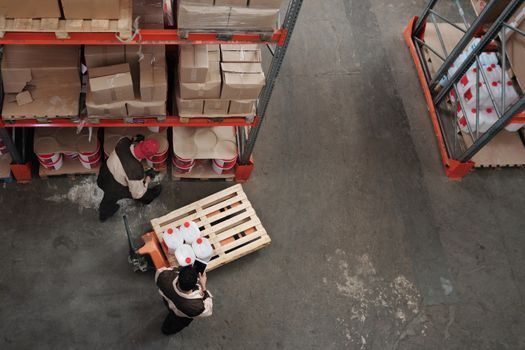
Manual pallet jack failures cluster in three zones: pump seal failure (oil bypass at full lift), wheel delamination (polyurethane separating from the polyolefin core at temperatures below -10 deg F or above 110 deg F), and handle return spring fatigue after roughly 25,000 cycles. The Durarun 95A spec cited in the Big Joe P33 kit is a polyurethane load wheel rated for the temperature and load window of an ambient warehouse; cold-storage or freezer applications below 0 deg F require a neoprene or rubber load wheel with the same 85-95 Shore A durometer window [S1][S6].
Dock leveler failures cluster in: lip hinge cracking (weld fatigue after 100,000 cycles, accelerated by off-center forklift impact), hold-down cylinder leakage (air-bag units), and hydraulic seal failure at the main lift cylinder (hydraulic units). The 2026 OEM aftermarket therefore stocks springs, hold-down kits, bumpers and seals as catalog items from suppliers like PartsBrite, where Rite-Hite, Kelley, Serco, Blue Giant and Nordock are carried as line items [S4]. Compliance citations on the China-export manual truck side reference OSHA general-industry walking-working surfaces and the handle-control / foot-protection rules, while ANSI MH30.1 and EN 1398 are the usual dock-leveler standards to pin in the RFQ [S3].
For a clean spec cut, the comparison reads: a manual pallet jack is mobile, $300-$700, 5500-6600 lb, 50 pallets/hour, replaceable wheels, no fixed install; a dock leveler is fixed, $4,000-$15,000, 20,000-40,000 lb dynamic, 6-10 cycles/hour, requires pit or pour-in pan, ANSI MH30.1 rated. The two only overlap at the loading bay face, and the 2026 pair that covers the median distribution-center case is a 30,000 lb hydraulic pit leveler plus a 6600 lb manual pump truck with tandem 95A polyurethane load wheels.
Trackable signals for the rest of 2026: a 25,000-35,000 lb hydraulic pit leveler cycle-time quote below 18 seconds, and a 6600 lb-class manual truck with 95A Durarun-style polyurethane tandem load wheels shipped under a 2-year pump warranty. Both data points re-anchor the 2026 spec baseline on the next refresh.
For component-level specifications, see pallet rack.
