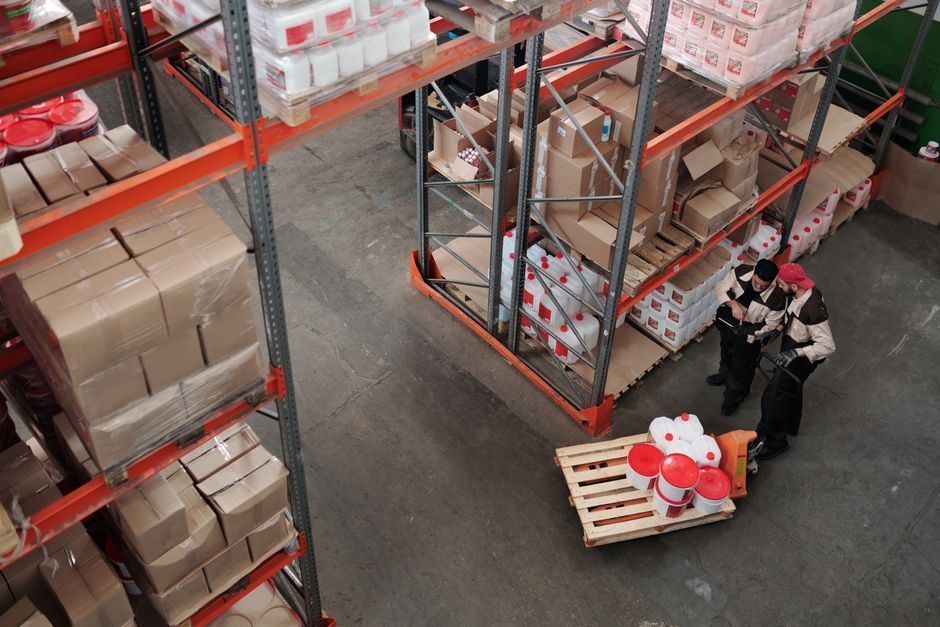
Platform trolleys and pallet stackers sit in the same warehouse aisle but solve different physics problems: a platform trolley is a manual push-around deck on four polyurethane wheels with zero vertical lift, while a pallet stacker is a powered mast truck that hoists a fork carriage 3-5 m so a single pallet can be dropped on racking.
The decision usually comes down to three numbers: peak load, lift height, and distance travelled per shift. DirectIndustry's 2026-05 supplier index lists industrial platform trolley models in 1,000-2,000 kg carrying-capacity bands for Euro-pallet footprints of 1,200 x 800 mm and 1,200 x 1,000 mm, while electric stand-on stackers such as the Mitsubishi PREMiA EM PBV/PBF20N3D(R)(S) on the same index are rated at 2,000 kg with 24 V drive [S1][S2].
Core Definition and Mechanical Scope
A platform trolley is a non-powered, four-wheeled deck intended for horizontal load transfer on smooth industrial floors; load is engaged by pushing, pulling, or — in tugger-train setups — by a battery tow tractor following a routed path. DirectIndustry's 2026-05 supplier index groups JDC-pattern trailers into a "rail-mounted / 4-wheel drive / platform / multidirectional / for tugger trains" family, and lists the JDC standard deck at 1,200 x 800 mm (Euro pallet) with optional 1,200 x 1,000 mm for large load carriers [S1].
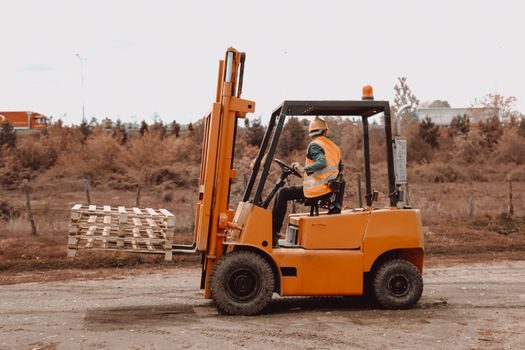
A pallet stacker is a powered counterbalanced or straddle truck with a vertical mast, fork carriage, and hydraulic or electric lift cylinder; the operator stands on a fold-down platform or walks behind with tiller control. The 2026 PREMiA EM PBV/PBF20N3D(R)(S) is documented as electric, stand-on, 24 V architecture with 2,000 kg rated capacity, sitting inside the dominant 1,500-2,000 kg class for pedestrian stackers in 2026 OEM catalogues [S2].
Load, Lift, and Battery: Three Numbers That Force the Choice
Capacity bands overlap: manual platform trolleys cover 300 kg (light-duty plastic-deck models on Alibaba's 2026-05 supplier list) up to 2,000 kg for steel-deck heavy units, while ULINE's 2026-05 in-stock hydraulic stacker line starts around 1,000 kg and tops out near 2,000 kg for manual-pump models, with powered reach stackers climbing to 2,500 kg on industrial supply lines [S4][S5].
Lift height is the cleanest separator: a platform trolley has no engineered vertical lift (deck height is fixed at roughly 200-280 mm off the floor to clear standard wheel diameters), whereas a pallet stacker is specced for 1.6 m (low-lift walkie), 3.0-3.6 m (standard straddle), or 4.5-5.4 m (high-mast reach, above which an aerial work platform class truck takes operator-up picking instead of a fork mast). ULINE's 2026 in-stock stacker line lists lift ranges from 59" to 144" (1.5-3.66 m) on manual hydraulic models, and electric walkie stackers commonly reach 4.5 m in the same catalogue family [S4].
Power source diverges sharply: platform trolleys need no battery (passive deck) or only a small 24 V tugger-train tractor battery, while an electric pallet stacker carries a 24 V traction-plus-lift battery pack sized 100-300 Ah. The Mitsubishi PREMiA EM family runs a 24 V system across both stand-on PBV (straddle) and PBF (counterbalanced) chassis variants, a voltage class shared by most pedestrian stackers globally [S2].
Use-Case Fit: Who Each Tool Is For
Platform trolleys fit three operational profiles: dock-to-aisle transfer on the same level, in-line assembly feeding where the operator loads/unloads at the same working height, and milk-run tugger routes with a tow tractor pulling 2-6 trailers on a fixed loop. The 2026-05 DirectIndustry manufacturer index lists multidirectional and rail-mounted trolley variants explicitly targeted at tugger-train applications, with perforated-panel and stackable-frame options for empty-trailer nesting [S1].
Pallet stackers fit a different profile: low-volume pallet racking at 2-4 m pick faces, order-picking cells where one operator feeds pick stations from pallet reserve, and end-of-aisle truck loading where a pallet must be raised to bed height. The electric stand-on PREMiA EM is a typical fit for retail-back-store and light-manufacturing racking, while manual hydraulic stackers remain the default where shifts are short and lift frequency is below 20 cycles per operator per day [S2][S4]. Higher-throughput racking above 4 m typically shifts to a stacker crane aisle rather than a walkie stacker.
Comparison: Platform Trolley vs Pallet Stacker on Decision Criteria
Side by side on the criteria a spec-driven buyer actually uses, the two products split cleanly. The numbers below are drawn from the 2026-05 DirectIndustry supplier index, the Mitsubishi PREMiA EM product page (2026-05), and ULINE's 2026-05 in-stock hydraulic stacker listing [S1][S2][S4].
- Load capacity: trolley 300-2,000 kg; stacker 1,000-2,500 kg (overlap 1,000-2,000 kg). - Lift height: trolley 0 m (fixed deck); stacker 1.5-5.4 m. - Power: trolley none or 24 V tow-tractor pull; stacker 24 V traction + lift battery (100-300 Ah) or manual hydraulic pump. - Operator effort: trolley push/pull (2-8 kg handle force at 1,000 kg on swivel casters); stacker walkie or stand-on with electric drive. - Footprint: trolley matches pallet (1,200 x 800 mm Euro or 1,200 x 1,000 mm); stacker adds mast and straddle legs (1,200-1,400 mm truck width, 1,800-2,400 mm length). - Unit price band (2026 Alibaba and ULINE listings): manual trolley USD 79-400 for light models, USD 600-1,500 for heavy steel decks; manual stacker USD 1,200-2,800; electric stacker USD 4,500-12,000 [S4][S5][S6].
Limitations, Failure Modes, and Sourcing Standards
Platform trolleys fail in three predictable ways: caster overload on rough floors (polyurethane wheels above 1,500 kg static load glaze and flat-spot), deck flex on spans above 1,200 mm without cross-bracing, and tow-bar fatigue on continuous tugger loops above 8 hours per shift. ULINE's 2026-05 hydraulic stacker listing calls out a 26" (660 mm) overall width on its slim models to fit congested stockroom aisles — a constraint that becomes a hard limit for a 1,200 mm pallet trolley trying the same lanes [S4].
Pallet stackers have their own failure modes: mast deflection above 4.5 m lifts under 1,500 kg residual, battery depth-of-discharge derating below 20% state of charge, and load-wheel brinelling on cold-store floors below -20 °C if standard nylon wheels are kept. The Alibaba 2026-05 platform-stacker supplier index is dominated by Chinese OEMs offering LIFT TABLE / ELECTRIC STACKER / ELECTRIC PALLET TRUCK / HAND PALLET TRUCK / HAND STACKER as the canonical five-product bundle, which is the same line-up referenced in the Manual Pallet Jack vs Electric Pallet Truck: 2026 Spec & Sourcing Cut buying logic and the Pallet Stacker Buying Guide 2026: Load, Lift, Power and Sourcing Levers spec breakdown [S5].
Standardisation: pallet footprint and lift-truck geometry are governed by ISO 6780 (pallet main dimensions, 1,200 x 800 mm Euro as the interchangeability baseline) and EN 1726-1 (safety of industrial trucks, operator platform, mast, and braking requirements). Capacity, stability, and load-curve testing typically follow EN ISO 3691-1 for pedestrian stackers. Buyers should verify CE marking under the Machinery Directive (2006/42/EC) and, for truck batteries, IEC 62619 for lithium chemistries when specified [S2][S4].
Trackable Signals Going Forward
Two signals to watch: first, the 2026 DirectIndustry trolley-manufacturer index expanded the rail-mounted / multidirectional segment to four active vendors as of 2026-05, confirming tugger-train adoption in auto and white-goods assembly [S1]. Second, the 2026 ULINE stock range pushed slim-body hydraulic stackers to a 26" (660 mm) chassis for congested back-store retail, signalling the manual stacker is being shaped by e-warehouse aisle-width constraints rather than pure load specs [S4]. For adjacent ground-floor handling, the Manual Pallet Jack Buying Guide 2026: Capacity, Pump, Forks, Wheels covers the 2,000-3,500 kg walkie class that sits below the stacker in cost and above the trolley in lift.