
Order pickers divide into four operating classes — counterbalance, reach, turret/VNA, and high-level order picker — set by mast travel mechanism, lift height, and aisle geometry requirements. The Clark Equipment Company prototype appeared in 1917, with hydraulic-lift production units entering commercial service in 1932 [S1].
Modern warehouse order pickers run on 24–80 V DC or 80–96 V AC electric drives, lift payloads of 1,000–2,500 kg, and reach operator platforms up to 12 m, with very-narrow-aisle (VNA) variants specified for aisles as tight as 1.6–1.8 m. Selection logic is governed by rack depth, pick-face height, throughput in picks/hour, and floor condition; units with elevated platforms fall under separate stability rules from standard forklifts [S1].
Class Definition by Lift Mechanism and Operating Envelope
Order-picker classification breaks along three engineering axes: mast type (single-stage, two-stage, three-stage), drive configuration (stand-on, sit-on, rider, walkie), and maximum lift height band (low-level ≤ 2.5 m, medium 2.5–6 m, high-level 6–12 m) [S1]. The original 1932 Clark hydraulic-lift design established the counterweight chassis layout still in use on most low-level models today.
Reach-class order pickers add a pantograph or scissor extension that pushes the load wheels beyond the drive wheels, typically 500–800 mm of reach, allowing the chassis to retract into the aisle while the load remains in the rack face. VNA turret trucks use a rotating head or fork that swings 90° within the aisle, letting the chassis stay stationary while the load indexes to either rack side — this geometry enables 1.6–1.8 m aisle widths versus 3.0–3.5 m for standard reach trucks [S1].
Selection Criteria: Aisle Width, Lift Height, and Throughput
Specifying an order picker starts with three measurable inputs: minimum aisle width (turning radius + load + 200 mm clearance per side), maximum required pick face height, and target throughput in lines per operator-hour. Low-level walkie pickers handle ≤ 2.5 m pick faces at 60–100 lines/hour; high-level VNA units hit 250–400 lines/hour when paired with wire or rail guidance [S1].
Floor condition drives the second decision: VNA trucks require level concrete to ±3 mm over 10 m for wire guidance to track reliably; deviations outside that band force a switch to free-navigation VNA or a wider reach truck.
Counterbalance vs Reach vs Turret/VNA: Criteria Comparison
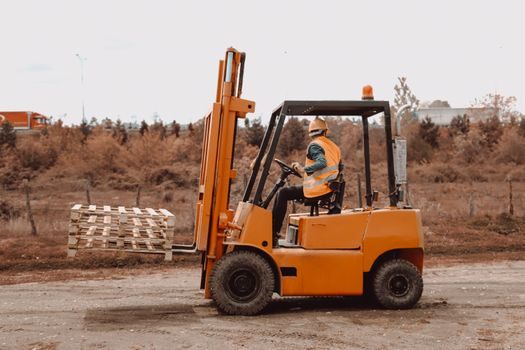
The four classes line up against the main spec drivers as follows. Counterbalance order pickers use an integral rear ballast (forklift heritage) and need no reach mechanism, so they work outdoors and on uneven ground but require the widest aisle (~3.5 m). Reach trucks add the pantograph reach and drop aisle width to 2.6–3.0 m, trading outdoor flexibility for indoor rack density. Turret/VNA trucks use a mast-rotated fork or turret head to hit 1.6–1.8 m aisles but require wire or rail guidance and level floors. High-level man-up order pickers lift the operator with the load to 6–12 m and dominate cold-storage and e-commerce fulfilment where pick density justifies the capital cost [S1].
The comparison compresses to four decision criteria: aisle width (counterbalance widest, VNA narrowest), lift height (man-up highest at 12 m, walkie lowest at 2.5 m), throughput (VNA highest at 250–400 lines/hour, walkie lowest at 60–100), and capital cost (man-up highest, counterbalance lowest per unit). For mixed-duty warehouses under 4,000 m², the reach truck usually wins on flexibility per dollar spent; above that threshold with dedicated pick faces, VNA delivers the lower total cost per pick over a 10-year life cycle [S1].
Who an Order Picker Is For — And Who It Is Not
Order pickers fit operations with rack-served picking, SKU counts above ~500, and pick rates that justify mechanised travel between pick faces. Distribution centres, cold-storage facilities, pharmaceutical warehouses, and e-commerce fulfilment hubs are the primary use cases, with 3PL operations a fast-growing segment as third-party logistics providers standardise fleets across multiple sites [S1].
Order pickers are not the right tool for unit-load handling above 2,500 kg, outdoor yard work on unpaved surfaces, or single-pick-per-pallet flows. For those cases, a counterbalance forklift remains the correct specification; reach and VNA geometry is wasted on long-haul pallet moves. Likewise, PLC -controlled conveyor or automated storage/retrieval systems outperform order pickers when SKU count is low and throughput per line is high, since the picker travel-time overhead is not amortised across enough picks.
Safety, Stability, and Governing Standards
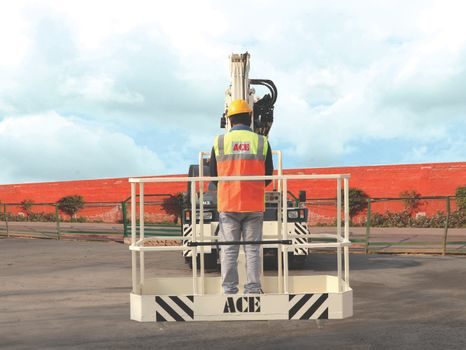
Order-picker safety is governed by ANSI/ITSDF B56.1 (Safety Standard for Low-Lift and High-Lift Trucks) in North America and EN 1726-1 (Safety of industrial trucks — Self-propelled trucks up to and including 10 000 kg capacity) in Europe; both require a documented stability test with the load at maximum lift height and the truck on a 5–10% grade depending on class. Elevated-platform man-up models add a separate guard-rail and harness requirement that does not apply to walkie stockers.
Operator-presence sensing, automatic speed reduction above 1.5 m lift, and tilt-locks on masts above 4 m are baseline requirements on units built after 2020. Wire-guided VNA trucks also require a defined emergency-stop signal on the guidance wire itself, with a maximum response time of 250 ms per the OEM service manuals. The order picker class is one of the highest-liability forklift categories because the operator rides with the load, so the consequences of a stability failure scale with lift height.
Limitations, Failure Modes, and Sourcing Signals
Known failure modes across the class include mast-channel wear at the roller interface (typical replacement interval 8,000–12,000 hours), reach-cylinder seal failure on pantograph units above 6 m lift, and wire-guidance signal loss on VNA trucks when floor joints exceed the 3 mm/10 m tolerance. Battery thermal runaway is a separate risk on lithium-ion conversions; specifiers should require UN 38.3 transport certification and a battery management system with cell-level monitoring.
Trackable 2026 sourcing signals include OEM rollout of 96 V lithium battery packs for high-level man-up models, expansion of wire-guidance-free VNA navigation using LiDAR SLAM, and tightening of EN 1726-1 stability rules for cold-storage operation below -25 °C. For broader industrial control context, the pressure transmitter and flow meter classes that monitor hydraulic performance in picker lift systems are covered separately, while comparison data on dock leveler types helps specifiers match the receiving end of the pick flow to the order-picker fleet upstream.