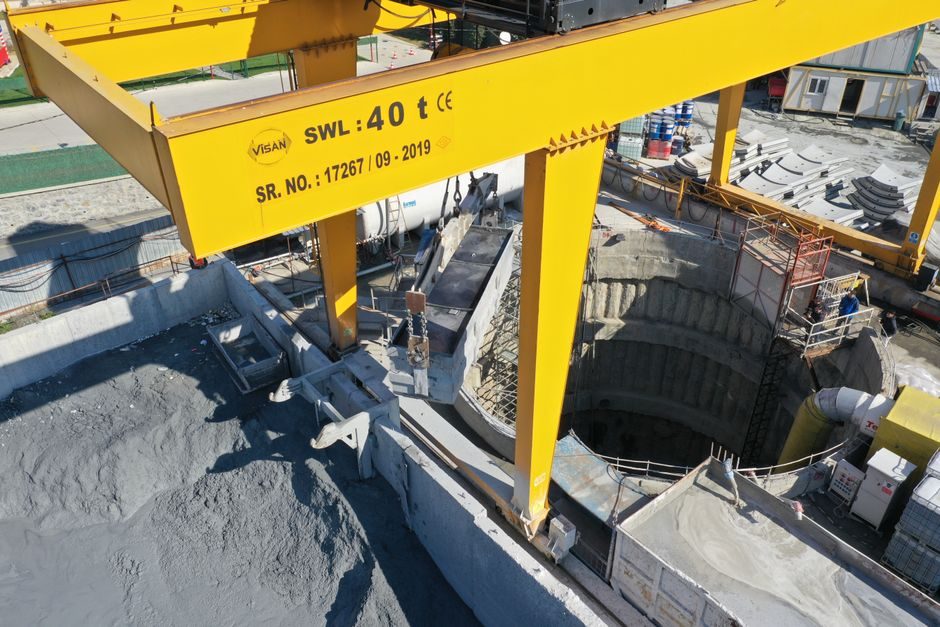
An overhead bridge crane is sized by five numbers before any vendor quote matters: lift capacity (t), span (m), CMAA duty class, hoist type, and girder count [S1][S3]. Get those locked first and you avoid the classic mistake of paying for a Class D hoist in a Class A service environment, or under-buying a single-girder unit for a foundry.
The market in 2026 is a mix of US system-integrators (Dearborn Crane with 60 years of overhead experience [S3], Waukesha Crane as builder + service provider [S4], Overhead Crane Consulting as a specialist advisor [S1]) and a large Chinese OEM/ODM base in Shandong offering single-girder and double-girder bridge cranes at landed prices that frequently undercut US-built equivalents by a wide margin [S5][S6]. Both routes are legitimate, but they answer to different procurement questions.
Duty Class and Service Environment Drive the Spec
CMAA 70 / 74 / 76 duty classifications A through F map directly to number of lift cycles, load spectrum, and standby hours per ASME standards [S1][S3]. Class A (standby / infrequent service) suits repair bays and light maintenance; Class C is the common shop floor rating; Class D and E are required for steel mills, foundries, scrap yards and high-cycle production lines [S1].
Specifying the wrong class is the single most expensive spec error in a overhead bridge crane project. A Class A hoist in a Class D scrap yard fails the wire rope, brakes and gearbox inside 12 months; the same Class D hoist in a Class A storage room wastes 30-50% of your CapEx. The selection on duty class, span, girder and hoist breakdown walks through which gate to lock first when the load and cycle counts are not yet finalised.
Single Girder vs Double Girder: When Each Wins
Single-girder bridge cranes (commonly top-running or under-running) typically span 7.5-25 m and handle up to about 10 t with a lightweight electric wire-rope or chain hoist [S3][S5]. They cost less, install faster, and are the default for warehouses and light fabrication.
Double-girder units are required above ~10 t, when you need higher hook lift (no hoist mounted under the girder), true CMAA D/E duty, or tandem lifting with two hoists on one bridge [S1][S5]. They also allow easier maintenance access from above, which matters on 24/7 lines. The structural comparison is straightforward: more steel, more headroom, more cost, more duty margin.
Top-Running vs Under-Running: Runway Cost Changes Everything
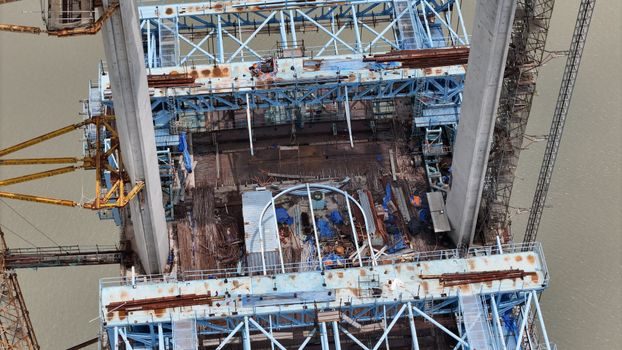
A top-running bridge crane rides on rails mounted on top of the runway beams, with the end trucks carrying the bridge load directly [S1]. Heavier capacity and better hook height are the trade. An under-running (under-hung) crane hangs from the lower flange of the runway beam, which removes the need for support columns in new builds and lets you retrofit into an existing building with adequate roof structure [S3].
Under-running systems are popular in light-duty warehouses and tool-rooms, but they constrain capacity (typically ≤5 t) and place bending and fatigue loads on the runway beam itself, so the building's runway steel has to be designed for it [S1]. On a green-field plant, top-running is almost always the lower-total-cost route once you factor in runway columns; on a retrofit, under-running avoids the civil work.
Hoist Type: Wire Rope vs Chain vs Electric Chain
Electric wire-rope hoists (typically 5-80 t, hoist speeds 4-8 m/min main lift, 16-32 m/min cross travel, 50-80 m/min long travel on VFD) cover the majority of industrial overhead bridge crane builds [S1][S3]. For light-duty under-hung and small single-girder units below 5 t, electric chain hoists (such as those stocked and serviced by Waukesha Crane [S4]) are the standard answer — quieter, lower headroom, lower cost.
Air-driven and manual hoists still exist in niche hazardous-area or infrequent-service applications, but 2026 industrial buyers default to electric. Variable Frequency Drives (VFDs) for long and cross travel are now standard on Class C and above; they reduce load swing on the pendant or radio control and extend mechanical life.
Capacity, Span and Headroom: The Three Real Numbers

Capacity is the rated load plus the weight of the hook block, lifting beam or below-the-hook attachment; undersizing here is the most common safety failure. Span is the centre-to-centre distance between runway rails — different from the building width, and worth measuring on site, not from the original drawings [S1]. Hook approach dimensions (the minimum distance from the runway rail centreline to the hook when fully raised) determine usable hook height, and on a single-girder top-running crane this is often the binding constraint.
For a quick envelope check on a 10 t Class C single-girder: typical span 15-20 m, total bridge weight roughly 4-7 t, runway beam W14-W24 sections depending on span and load. Double-girder 20 t Class D over 25 m span will run 15-25 t of bridge steel. The crawler crane reference is useful here only for capacity-class cross-checks; the engineering is different.
Safety Controls and Code Compliance: Non-Negotiable
OSHA 1910.179 governs overhead and gantry crane inspections in the US; the inspection interval is annual minimum for normal service, quarterly for severe service, with a pre-shift visual check [S4]. All bridge cranes operating in the US require upper and lower limit switches, runway end-stop bumpers, and an overload limit device (load moment indicator or hoist overload cutout).
Pendant controls with 4-6 buttons are the minimum spec; radio remote control adds roughly 5-10% to the hoist package cost and pays back quickly on any crane serving more than one workstation. Two-speed or VFD long travel, anti-sway software, and a horn / warning light package are now the de-facto standard for any Class C+ unit [S1][S4].
Sourcing: US System-Integrator vs Chinese OEM/ODM

For US-spec, code-compliant, on-site-installed cranes with full service, the system-integrator channel (Dearborn [S3], Waukesha [S4], and the consulting route via Overhead Crane Consulting [S1]) handles design, structural certification, electrical UL 508A panels, installation, and OSHA inspection paperwork. Lead time typically 10-16 weeks for a standard single-girder; 20-30 weeks for a custom double-girder.
For export / price-sensitive projects, the Chinese OEM base — heavily concentrated in Shandong province — ships single-girder bridge cranes from roughly US$2,000 per set at MOQ 1 [S5], with double-girder units scaling with capacity and span [S5][S6]. Buyers need to budget separately for: shipping (often break-bulk for complete bridges), customs duty, US-side structural engineering review, electrical re-work to UL/NFPA 79, runway beam supply, and the local OSHA inspection before commissioning. The total landed cost can still be 30-50% below a US-built equivalent, but only if the buyer is set up to manage the supply chain.
Selection Criteria Comparison: The Main Configurations
Lining the four common configurations against the four procurement gates buyers actually decide on: [S1]
1) Single-girder top-running, ≤10 t, CMAA A-C: lowest cost, fastest install, limited hook height. Fits warehouses, light fabrication, tool rooms [S3].
2) Single-girder under-running, ≤5 t, CMAA A-B: retrofit-friendly, no runway columns, headroom constrained. Fits existing light buildings [S1][S3].
3) Double-girder top-running, 10-80 t, CMAA C-D: higher cost, full hook height, VFD travel, easy maintenance access. Fits machine shops, steel service centres, production lines [S1][S5].
4) Double-girder top-running, 20-500 t, CMAA D-F: heavy industrial, scrap, mill duty. Built for continuous high-cycle service, with reinforced end trucks, larger drums, and thermal-rated motors. Cross-checks against gantry crane vs overhead bridge crane decisions when the application could go either way (no permanent runway, or outdoor operation).
Limits, Failure Modes and Common Sourcing Traps
Three failure modes dominate the warranty-period data. (1) Under-rated hoist duty class — a Class A electric chain hoist installed in a production-line Class C application burns out the motor or strips the gearbox inside 6-18 months. (2) Undersized runway beams — a bridge crane running on building structural steel that was not designed for it will crack the runway welds or deflect beyond tolerance. (3) Undersized electrical infrastructure — VFDs draw high inrush; undersized supply cabling causes nuisance trips and motor damage [S1].
Common sourcing trap: comparing quotes on capacity alone, not on duty class, span, hoist lift, travel speed, and control package. A US$2,000 single-girder offer from a Shandong OEM [S5] is not the same spec as a US$25,000 single-girder from a US system-integrator — duty class, hoist brand, control package, and runway engineering are usually the differences. Lock the spec sheet before you request pricing, and the comparison becomes tractable.
For component-level specifications, see linear guide.